Nonlinear effects of built environment on travel resilience under extreme weather events and optimization strategies: The case of Xiamen Island
Received date: 2025-06-06
Revised date: 2025-11-06
Online published: 2026-01-23
Supported by
National Natural Science Foundation of China(42401230)
National Natural Science Foundation of China(42301212)
Youth Foundation for Humanities and Social Sciences of Ministry of Education(24YJCZH351)
Fujian Provincial Natural Science Foundation(2024J08004)
Natural Science Foundation of Xiamen, China(3502Z202371006)
Fundamental Research Funds for the Central Universities(20720250025)
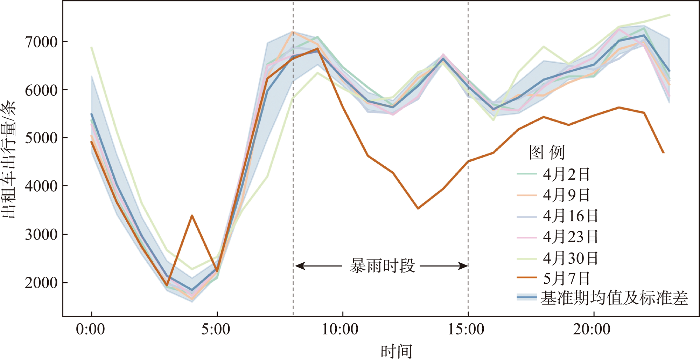
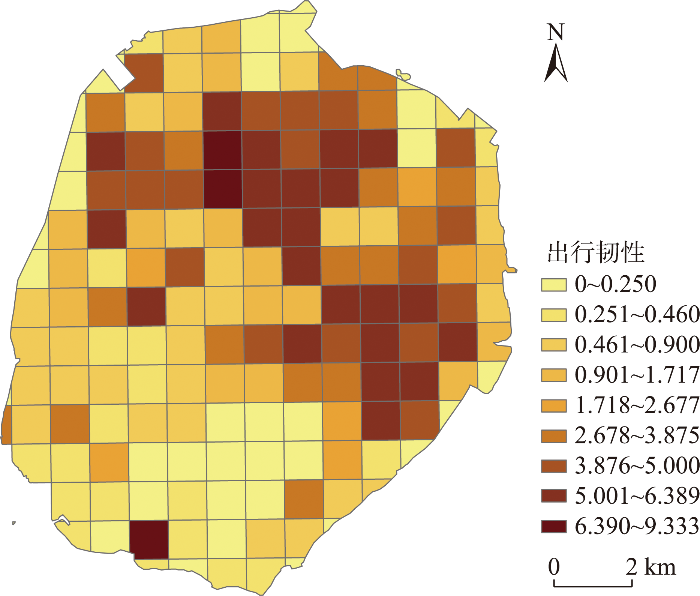
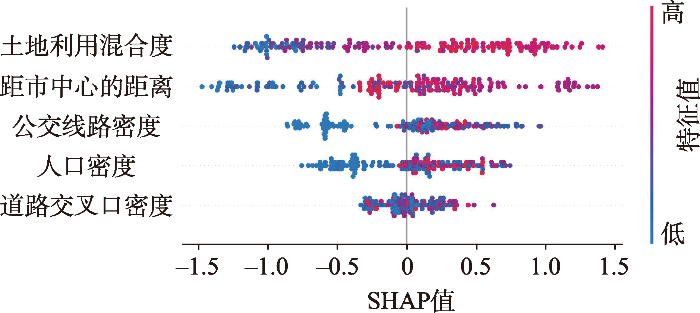
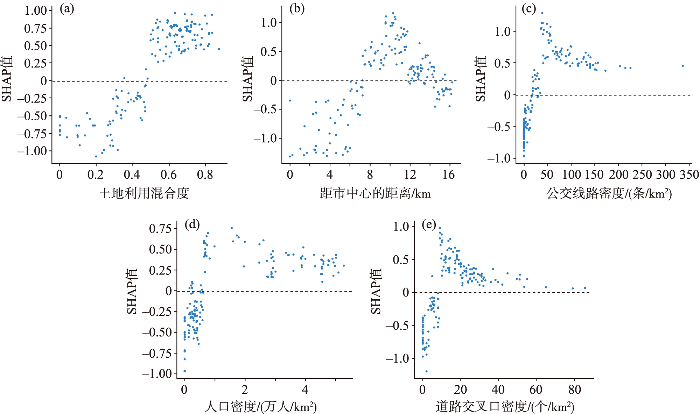
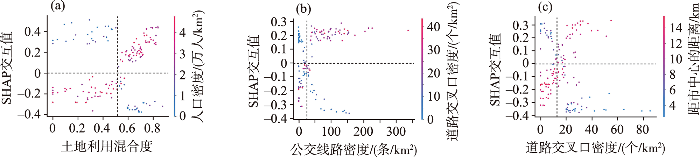
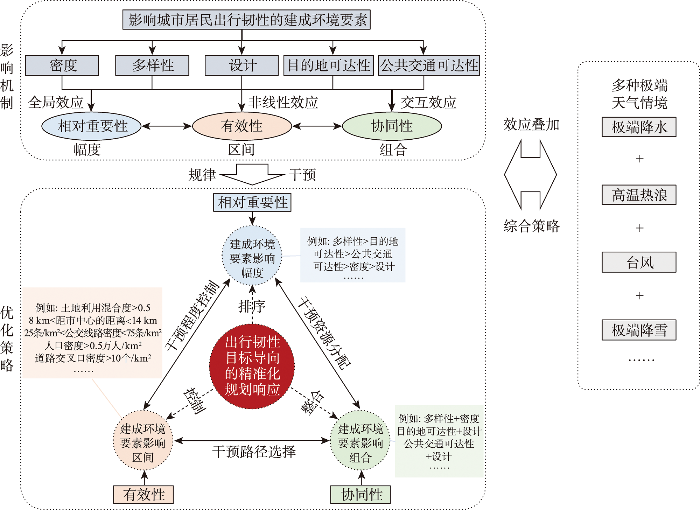
In recent years, extreme weather has become increasingly common, seriously affecting the daily travel behavior of urban residents. Exploring the travel resilience of urban residents under extreme weather and its influencing factors can help cities actively respond to climate change and become more resilient. However, there is still a significant lack of research on the impact of built environment on travel resilience. This study took Xiamen Island as an example, using taxi trip data and interpretable machine learning method (LightGBM and SHAP) to investigate the travel resilience of urban residents during extreme precipitation events and its relationship with the built environment. The results show that: 1) Extreme precipitation leads to a reduction of about 14.4% in daily travel volume for urban residents, and the response to extreme precipitation showed a time lag. At the same time, travel resilience showed significant spatial heterogeneity. 2) Land use diversity had the highest impact on travel resilience, and all built environment variables were nonlinearly correlated with travel resilience, with interactive effects generated between different built environment variables. Finally, based on the magnitude, range, and combination of impacts of built environment factors on travel resilience, this study proposed precise planning strategies for achieving a climate-adaptive built environment.
XIAO Longzhu , LIU Jixiang . Nonlinear effects of built environment on travel resilience under extreme weather events and optimization strategies: The case of Xiamen Island[J]. PROGRESS IN GEOGRAPHY, 2026 , 45(1) : 196 -208 . DOI: 10.18306/dlkxjz.2026.01.014
表1 建成环境变量描述性分析Tab.1 Description of built environment variables |
| 维度 | 变量 | 描述 | 平均值(标准差) |
|---|---|---|---|
| 目的地可达性 | 距市中心距离 | 网格中心点到市中心的路网距离(km) | 3.74 (1.89) |
| 公共交通可达性 | 公交线路密度 | 网格公交线路密度(条/km2) | 74.45 (56.02) |
| 设计 | 道路交叉口密度 | 网格三向及以上道路交叉口密度(个/km2) | 85.03 (56.87) |
| 密度 | 人口密度 | 网格人口密度(万人/km2) | 1.32 (0.96) |
| 多样性 | 土地利用混合度 | 利用改进的熵指数法[27]计算。共划分14种土地利用类型(如居住、教育、医疗、市政设施、工业、商业服务业等) | 0.66 (0.18) |
| [1] |
李涛, 崔磊波, 王姣娥, 等. 基于时间序列预测的城际出行韧性评估方法与时空格局[J]. 热带地理, 2024, 44(5): 838-849.
[
|
| [2] |
|
| [3] |
|
| [4] |
|
| [5] |
|
| [6] |
易嘉伟, 王楠, 千家乐, 等. 基于大数据的极端暴雨事件下城市道路交通及人群活动时空响应[J]. 地理学报, 2020, 75(3): 497-508.
[
|
| [7] |
|
| [8] |
|
| [9] |
|
| [10] |
王波, 甄峰, 孙鸿鹄. 基于社交媒体签到数据的城市居民暴雨洪涝响应时空分析[J]. 地理科学, 2020, 40(9): 1543-1552.
[
|
| [11] |
|
| [12] |
武占云. 将适应气候变化纳入国土空间规划: 进展、困境与思路[J]. 气候变化研究进展, 2021, 17(5): 559-569.
[
|
| [13] |
林陈贞, 郑艳, 孙劭. 气候变化背景下城市韧性测度: 以长三角城市应对雨洪风险为例[J]. 上海城市规划, 2023(1): 18-24.
[
|
| [14] |
马程伟, 文超祥. 适应气候变化的海岸带韧性研究综述: 基于文献计量分析[J]. 生态学报, 2024, 44(5): 2173-2186.
[
|
| [15] |
|
| [16] |
黄洁, 王姣娥. 出行韧性的理论与方法及实证[J]. 地理学报, 2023, 78(10): 2507-2519.
[
|
| [17] |
|
| [18] |
|
| [19] |
|
| [20] |
|
| [21] |
|
| [22] |
|
| [23] |
|
| [24] |
|
| [25] |
|
| [26] |
|
| [27] |
|
| [28] |
|
| [29] |
刘吉祥, 肖龙珠, 周江评, 等. 建成环境与青少年步行通学的非线性关系: 基于极限梯度提升模型的研究[J]. 地理科学进展, 2022, 41(2): 251-263.
[
|
| [30] |
|
| [31] |
|
| [32] |
|
| [33] |
|
| [34] |
|
| [35] |
|
| [36] |
|
| [37] |
|
| [38] |
|
| [39] |
|
/
| 〈 |
|
〉 |