Development processes, trends, and future directions of the tourism geography knowledge system
Received date: 2025-06-23
Revised date: 2025-11-07
Online published: 2026-01-23
Supported by
National Natural Science Foundation of China(42501282)
National Natural Science Foundation of China(42371257)
National Natural Science Foundation of China(41930644)
The University Synergy Innovation Program of Anhui Province(GXXT-2022-093)
Tourism geography is a discipline that studies the spatial differentiation patterns, temporal development processes, and regional characteristics of tourism phenomena, tourism elements, and comprehensive tourism geographic systems. In the new development stage, grounding itself in China's context, addressing theoretical, practical, and methodological issues in China's tourism development practices, and providing Chinese paradigms and solutions for knowledge production are not only the mission of the Chinese tourism geography discipline but also key to enhancing its own disciplinary vitality. The disciplinary vitality of Chinese tourism geography is rooted in the scale, uniqueness, and complexity of China's tourism development practices, and is manifested in the process where tourism, as an "emerging developmental element and driving force", actively responds to national strategies and socioeconomic development needs. This study systematically reviewed the development processes and trends of knowledge production in tourism geography from the perspectives of disciplinary systems, academic systems, and discourse systems. The findings indicate that: 1) Multiple environmental factors, including institutional, socioeconomic, cultural, and disciplinary development contexts, collectively shaped the substantive content, presentation methods, and the theoretical and methodological consciousness of knowledge producers in tourism geography in China. 2) The construction of an autonomous knowledge system in Chinese tourism geography faces both internal and external challenges. External challenges are reflected in the mismatch between the construction of an international discourse system and China's international status, the disparity between developmental advantages and thematic advantages, and practices of academic hegemony. Internal challenges include the marginalization of tourism geography within the disciplinary system, fragmentation of research outputs, and the lag of theory behind practice. 3) Examining tourism development practices of Chinese-style modernization with a problem-oriented disciplinary awareness, defining the essential orientation of knowledge production in Chinese tourism geography with an academic innovation consciousness, and strengthening the autonomous narrative system of Chinese tourism geography with a discourse dialogue awareness are beneficial directions for overcoming the autonomy challenges. Accelerating the construction of an autonomous knowledge system in Chinese tourism geography is fundamental for enhancing the disciplinary vitality of tourism geography.
Key words: tourism geography; knowledge system; development trends; embedded autonomy
LI Donghua , HUA Yulian , LU Lin , KONG Xiangmei . Development processes, trends, and future directions of the tourism geography knowledge system[J]. PROGRESS IN GEOGRAPHY, 2026 , 45(1) : 13 -29 . DOI: 10.18306/dlkxjz.2026.01.002
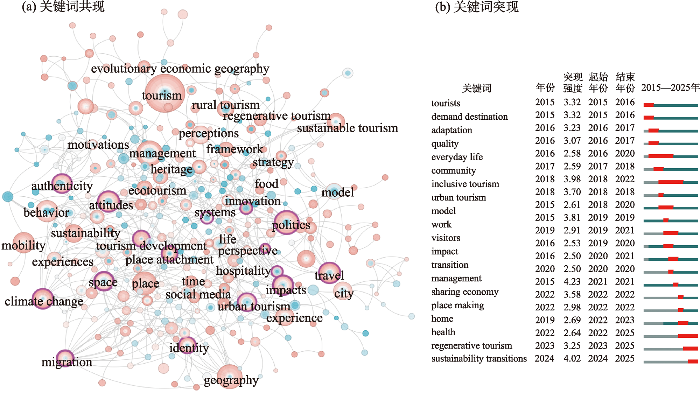
图1 国际旅游地理学代表性研究关键词图谱注:选取Tourism Geographies作为国际旅游地理学知识生产的代表性期刊平台,基于Web of Science 核心集检索该期刊文献,得到2015—2025年的589篇非综述文献;基于CiteSpace共词分析可视化;文献检索时间为2025年9月20日;图a节点大小表示出现频次高低;图b红色线段表示关键词爆发的起止时间,深绿色线段表示研究热度较低的年份,浅绿色线段表示对应年份没有出现相关研究。 Fig.1 Keyword map of seminal research in international tourism geography |
| [1] |
张东刚. 建构中国自主的知识体系的若干思考[J]. 中国社会科学, 2024(5): 90-104, 206.
[
|
| [2] |
习近平. 坚持党的领导传承红色基因扎根中国大地走出一条建设中国特色世界一流大学新路[N]. 人民日报, 2022-04-26(1).
[
|
| [3] |
陆林, 花玉莲, 陈劼绮. 地域类型视角下中国旅游学的知识体系构建[J]. 旅游学刊, 2024, 39(9): 15-30.
[
|
| [4] |
保继刚, 楚义芳. 旅游地理学[M]. 3版. 北京: 高等教育出版社, 2012.
[
|
| [5] |
陆林. 旅游地理学[M]. 北京: 科学出版社, 2024.
[
|
| [6] |
张政文, 李凤亮, 雷磊, 等. 构建中国特色哲学社会科学“三大体系”: 理论阐释(上)[J]. 探索与争鸣, 2023(9): 4, 177.
[
|
| [7] |
习近平. 在哲学社会科学工作座谈会上的讲话[N]. 人民日报, 2016-05-19(2).
[
|
| [8] |
谢伏瞻. 建构中国自主的知识体系[N]. 人民日报, 2022-05-17(9).
[
|
| [9] |
|
| [10] |
|
| [11] |
|
| [12] |
|
| [13] |
|
| [14] |
|
| [15] |
辻村太郎. 景観の保護と観光産業[J]. 地理学, 1933, 1(1): 100-103.
[
|
| [16] |
木内信藏. 本邦の温泉聚落に関する二、三の問題[J]. 地学雑誌, 1940, 52(3): 110-125.
[
|
| [17] |
金玉实, 赵玉宗. 日本旅游地理学的百年传统与演进[J]. 地理研究, 2018, 37(10): 2039-2057.
[
|
| [18] |
|
| [19] |
|
| [20] |
葛全胜, 钟林生, 陆林. 中国旅游地理学发展历程与趋势[J]. 中国生态旅游, 2021, 11(1): 1-10.
[
|
| [21] |
陆林. 旅游地理文献分析[J]. 地理研究, 1997, 16(2): 106-113.
[
|
| [22] |
邓小平. 邓小平论旅游[M]. 北京: 中央文献出版社, 2000.
[
|
| [23] |
|
| [24] |
|
| [25] |
|
| [26] |
|
| [27] |
|
| [28] |
郭来喜, 保继刚. 中国旅游地理学的回顾与展望[J]. 地理研究, 1990, 9(1): 78-87.
[
|
| [29] |
吴必虎, 冯若梅, 张丽. 90年代中国旅游地理学进展研究[J]. 经济地理, 2000, 20(3): 91-95, 128.
[
|
| [30] |
保继刚. 从理想主义、现实主义到理想主义理性回归: 中国旅游地理学发展30年回顾[J]. 地理学报, 2009, 64(10): 1184-1192.
[
|
| [31] |
樊杰. 中国人文地理学70年创新发展与学术特色[J]. 中国科学: 地球科学, 2019, 49(11): 1697-1719.
[
|
| [32] |
|
| [33] |
|
| [34] |
|
| [35] |
赵政原, 刘志高. 演化经济地理学视角下旅游目的地研究述评及启示[J]. 地理科学进展, 2019, 38(1): 101-110.
[
|
| [36] |
陆大道. 主编寄语[J]. 中国生态旅游, 2021, 11(1): Ⅰ.
[
|
| [37] |
|
| [38] |
|
| [39] |
保继刚, 张捷, 徐红罡, 等. 中国旅游地理研究: 在他乡与故乡之间[J]. 地理研究, 2017, 36(5): 803-823.
[
|
| [40] |
翁时秀, 保继刚. 中国旅游地理学学术实践的代际差异与学科转型[J]. 地理研究, 2017, 36(5): 824-836.
[
|
| [41] |
保继刚, 杨虹霓, 翁时秀. 中国旅游地理学的发展与创新[J]. 经济地理, 2021, 41(10): 79-86.
[
|
| [42] |
翟锦程. 中国自主知识体系价值取向与构建的实践基础[J]. 南开学报(哲学社会科学版), 2023(3): 40-49.
[
|
| [43] |
黄意武. 习近平文化思想对马克思主义文化理论的原创性贡献[J]. 学习与探索, 2024(9): 26-33.
[
|
| [44] |
|
| [45] |
|
| [46] |
|
| [47] |
陆林, 张清源, 许艳, 等. 全球地方化视角下旅游地尺度重组: 以浙江乌镇为例[J]. 地理学报, 2020, 75(2): 410-425.
[
|
| [48] |
陆林, 张清源, 黄剑锋, 等. 基于全球地方化视角的旅游地演化理论探讨与展望[J]. 地理学报, 2021, 76(6): 1504-1520.
[
|
| [49] |
|
| [50] |
张子昂, 保继刚, 贾文通. 侨产资源对侨乡旅游地开发的尺度性影响过程与作用机制: 以开平赤坎古镇为例[J]. 自然资源学报, 2023, 38(12): 3058-3073.
[
|
| [51] |
|
| [52] |
黄震方, 黄睿. 基于人地关系的旅游地理学理论透视与学术创新[J]. 地理研究, 2015, 34(1): 15-26.
[
|
| [53] |
|
| [54] |
|
| [55] |
|
| [56] |
|
| [57] |
吴必虎. 大城市环城游憩带(ReBAM)研究: 以上海市为例[J]. 地理科学, 2001, 21(4): 354-359.
[
|
| [58] |
保继刚, 左冰. 为旅游吸引物权立法[J]. 旅游学刊, 2012, 27(7): 11-18.
[
|
| [59] |
张凌云. 非惯常环境: 旅游核心概念的再研究: 建构旅游学研究框架的一种尝试[J]. 旅游学刊, 2009, 24(7): 12-17.
[
|
| [60] |
张凌云. 旅游学研究的新框架: 对非惯常环境下消费者行为和现象的研究[J]. 旅游学刊, 2008, 23(10): 12-16.
[
|
| [61] |
陆林, 任以胜, 徐雨晨. 旅游建构城市群“乡土—生态”空间的理论框架及研究展望[J]. 地理学报, 2019, 74(6): 1267-1278.
[
|
| [62] |
李咪咪, 党宁, 夏娟, 等. 旅游地理学研究的中国贡献[J]. 旅游学刊, 2023, 38(9): 1-3.
[
|
| [63] |
|
| [64] |
|
| [65] |
|
| [66] |
|
| [67] |
|
| [68] |
|
| [69] |
|
| [70] |
孙正聿. 原创性概念和标识性概念: 建构中国自主知识体系的概念基础[J]. 中国社会科学, 2024(7): 38-51, 204-205.
[
|
| [71] |
|
| [72] |
|
| [73] |
杨振之, 陈谨. “形象遮蔽”与“形象叠加”的理论与实证研究[J]. 旅游学刊, 2003, 18(3): 62-67.
[
|
| [74] |
孙根年. 我国境外旅游本底趋势线的建立及科学意义[J]. 地理科学, 1998, 18(5): 442-448.
[
|
| [75] |
张海洲, 陆林, 贺亚楠. 产业链旅游: 概念内涵与案例分析[J]. 世界地理研究, 2020, 29(5): 1006-1016.
[
|
| [76] |
任以胜, 陆林, 韩玉刚. 新旅游资源观视角下旅游资源研究框架[J]. 自然资源学报, 2022, 37(3): 551-567.
[
|
| [77] |
许艳, 张清源, 陆林. 潮汐性旅游流研究: 概念框架与研究思路[J]. 地理科学进展, 2022, 41(3): 521-530.
[
|
| [78] |
张朝枝, 张鑫. 流动性的旅游体验模型建构: 基于骑行入藏者的研究[J]. 地理研究, 2017, 36(12): 2332-2342.
[
|
| [79] |
杨效忠, 李冬花, 黄剑锋, 等. 线性旅游目的地的概念框架与研究展望[J]. 地理学报, 2023, 78(12): 2939-2957.
[
|
| [80] |
|
| [81] |
|
| [82] |
|
| [83] |
张捷, 董雪旺, 汪侠, 等. 国家战略需求与中国旅游地理研究实践[J]. 中国生态旅游, 2021, 11(1): 27-41.
[
|
| [84] |
|
| [85] |
陆林, 肖洪根, 周尚意. 中国旅游地理研究的重点问题: 学术内涵、核心概念和未来方向[J]. 中国生态旅游, 2021, 11(1): 42-51.
[
|
| [86] |
|
| [87] |
|
| [88] |
|
| [89] |
|
| [90] |
|
| [91] |
|
| [92] |
|
| [93] |
徐红罡, 刘方方, 普涵艺. 旅游地理学与地理学关系研究: 基于2006—2016年国际旅游地理文献[J]. 旅游学刊, 2018, 33(11): 139-148.
[
|
| [94] |
张潇, 陆林, 徐雨晨. 基于《Tourism Geographies》的近十年国外旅游地理研究进展[J]. 人文地理, 2019, 34(6): 26-34, 109.
[
|
| [95] |
雷彬, 李松志, 张祚. 我国旅游地理研究格局及热点分析: 基于2000—2019年国家自然科学基金旅游课题立项的研究[J]. 世界地理研究, 2021, 30(3): 632-644.
[
|
| [96] |
习近平. 开辟马克思主义中国化时代化新境界[J]. 求是, 2023(20): 4-9.
[
|
| [97] |
黄震方, 黄睿, 葛军莲. 中国式现代化理论视角的旅游地理研究: 科学问题与学术使命[J]. 经济地理, 2023, 43(5): 16-25.
[
|
| [98] |
康晓强. 建构中国自主的社会组织知识体系[J]. 理论学刊, 2024(6): 61-70.
[
|
| [99] |
张一, 李静. 中国国际话语权的影响因素与提升路径研究[J]. 思想教育研究, 2021(11): 48-53.
[
|
/
| 〈 |
|
〉 |