Urban spatio-temporal behavior from the perspective of households: Research progress and framework
Received date: 2024-03-20
Revised date: 2024-06-03
Online published: 2024-11-26
Supported by
National Natural Science Foundation of China(42371245)
Natural Science Foundation of Shanghai(21ZR1420600)
The Fundamental Research Funds for the Central Universities(2024QKT006)
The Fundamental Research Funds for the Central Universities(2022ECNU-XWK-XK001)
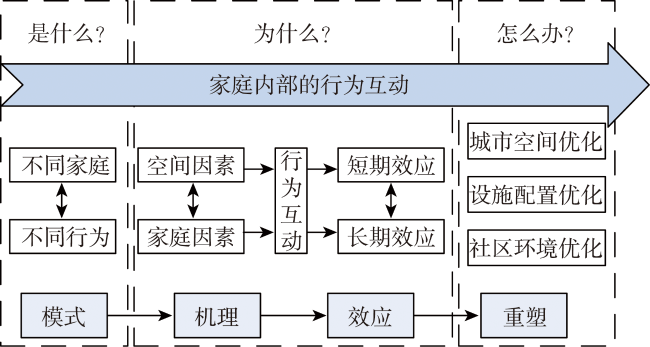
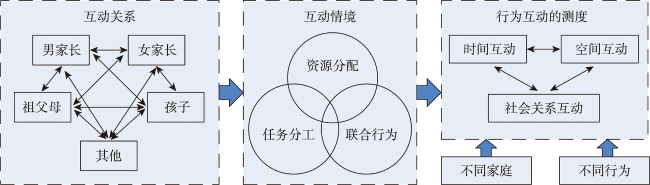
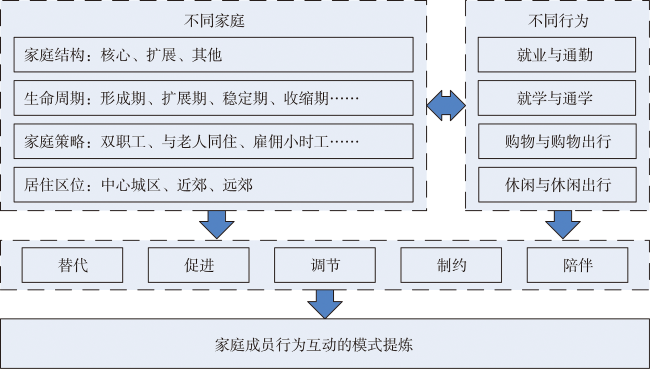
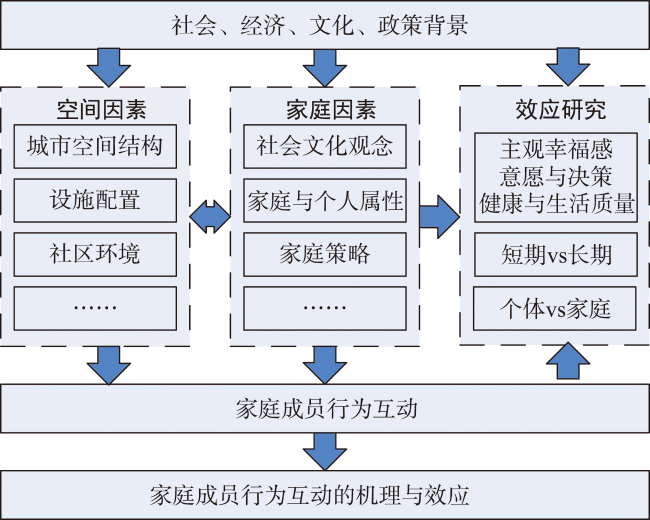
Households are a key carrier for urban spatial reconfiguration and socioeconomic transition, and also a crucial intermediate level between the individual, the community, and the city. Existing studies have recognized the importance of research on spatial-temporal behavior from the perspective of households, but they usually take the characteristics and division of responsibilities of households as background and explanatory factors. The interactions and connections between household members are rarely considered, and the complexity of intra-household behavioral interactions of various households and different types of behavior is not well understood. This research focused on household and intra-household behavioral interactions. First, it created a time-space-society framework to measure behavioral interactions in three dimensions, that is, temporal interaction, spatial interaction, and social relationship interactions, and refined the patterns of intra-household behavioral interactions. Second, it revealed the mechanisms of influence and effects of intra-household behavioral interactions, taking China's socioeconomic background into account. Finally, aiming to improve the quality of life of household members, it proposed an optimization scheme of living space with the household-friendly orientation. The research contributes to reintroducing the household level in urban research based on spatial-temporal behavior, and promoting behavioral geography research to emphasizing individuals' interactions. It also provides new ideas for examining social issues such as fertility, as well as child and elderly care, offering a scientific reference for the optimization of community life circle and urban space, and promote household-friendly urban planning and social governance.
SHEN Yue . Urban spatio-temporal behavior from the perspective of households: Research progress and framework[J]. PROGRESS IN GEOGRAPHY, 2024 , 43(11) : 2124 -2135 . DOI: 10.18306/dlkxjz.2024.11.002
| [1] |
方创琳. 新发展格局下的中国城市群与都市圈建设[J]. 经济地理, 2021, 41(4): 1-7.
[
|
| [2] |
张文忠, 何炬, 谌丽. 面向高质量发展的中国城市体检方法体系探讨[J]. 地理科学, 2021, 41(1): 1-12.
[
|
| [3] |
|
| [4] |
柴彦威, 谭一洺, 申悦, 等. 空间—行为互动理论构建的基本思路[J]. 地理研究, 2017, 36(10): 1959-1970.
[
|
| [5] |
塔娜, 柴彦威. 行为地理学的学科定位与前沿方向[J]. 地理科学进展, 2022, 41(1): 1-15.
[
|
| [6] |
申悦, 王德. 行为地理学理论与方法的跨学科应用研究[J]. 地理科学进展, 2022, 41(1): 40-52.
[
|
| [7] |
顾朝林, 刘佳燕, 等. 城市社会学[M]. 2版. 北京: 清华大学出版社, 2013.
[
|
| [8] |
|
| [9] |
|
| [10] |
|
| [11] |
杨永春, 谭一洺, 黄幸, 等. 基于文化价值观的中国城市居民住房选择: 以成都市为例[J]. 地理学报, 2012, 67(6): 841-852.
[
|
| [12] |
王丰龙, 王冬根. 北京市居民汽车使用的特征及其影响因素[J]. 地理学报, 2014, 69(6): 771-781.
[
|
| [13] |
刘瑜, 姚欣, 龚咏喜, 等. 大数据时代的空间交互分析方法和应用再论[J]. 地理学报, 2020, 75(7): 1523-1538.
[
|
| [14] |
张文佳, 鲁大铭. 行为地理学的方法论与微观人地关系研究范式[J]. 地理科学进展, 2022, 41(1): 27-39.
[
|
| [15] |
王梅梅, 杨永春, 谭一洺, 等. 中国城市居民的家庭代际分/合居行为及其影响要素: 以成都市为例[J]. 地理学报, 2015, 70(8): 1296-1312.
[
|
| [16] |
杨菊华, 何炤华. 社会转型过程中家庭的变迁与延续[J]. 人口研究, 2014, 38(2): 36-51.
[
|
| [17] |
彭希哲, 胡湛. 当代中国家庭变迁与家庭政策重构[J]. 中国社会科学, 2015(12): 113-132, 207.
[
|
| [18] |
高晓路, 吴丹贤, 许泽宁, 等. 中国老龄化地理学综述和研究框架构建[J]. 地理科学进展, 2015, 34(12): 1480-1494.
[
|
| [19] |
谢波, 魏伟, 周婕. 城市老龄化社区的居住空间环境评价及养老规划策略[J]. 规划师, 2015, 31(11): 5-11, 33.
[
|
| [20] |
周素红, 彭伊侬, 柳林, 等. 日常活动地建成环境对老年人主观幸福感的影响[J]. 地理研究, 2019, 38(7): 1625-1639.
[
|
| [21] |
刘磊, 石楠, 何艳玲, 等. 儿童友好城市建设实践[J]. 城市规划, 2022, 46(1): 44-52.
[
|
| [22] |
|
| [23] |
|
| [24] |
高岩辉, 刘科伟, 张晓露. 劳动力转移的理论流派与地理学的视角[J]. 人文地理, 2008, 23(5): 112-118.
[
|
| [25] |
冯长春, 李天娇, 曹广忠, 等. 家庭式迁移的流动人口住房状况[J]. 地理研究, 2017, 36(4): 633-646.
[
|
| [26] |
黄锋, 保继刚. 旅游小企业的家庭化生产对家庭代际团结的影响: 西双版纳傣族园案例[J]. 旅游学刊, 2021, 36(11): 57-68.
[
|
| [27] |
白凯, 符国群. 家庭旅游决策研究的中国化理论视角与分析思路[J]. 旅游学刊, 2011, 26(12): 49-56.
[
|
| [28] |
李琼, 林岚, 郑颖玲, 等. 国外主要家庭休闲模型研究述评[J]. 旅游学刊, 2022, 37(10): 131-148.
[
|
| [29] |
|
| [30] |
封丹, 李鹏, 朱竑. 国外“家”的地理学研究进展及启示[J]. 地理科学进展, 2015, 34(7): 809-817.
[
|
| [31] |
陈淳, 袁振杰, 朱竑. 城镇化背景下广州流动儿童对“家”空间的建构[J]. 地理学报, 2018, 73(12): 2440-2451.
[
|
| [32] |
陶伟, 蔡少燕, 余晓晨. 流动性视角下流动家庭的空间实践和情感重构[J]. 地理学报, 2019, 74(6): 1252-1266.
[
|
| [33] |
张博, 刘美新, 蔡晓梅. 物质、情感和权力: 跨国移民与家的地理学[J]. 世界地理研究, 2022, 31(6): 1130-1141.
[
|
| [34] |
|
| [35] |
|
| [36] |
姚华松, 黄耿志, 薛德升. 国内外女性主义地理学研究述评[J]. 人文地理, 2017, 32(2): 9-15.
[
|
| [37] |
|
| [38] |
申悦, 柴彦威. 基于日常活动空间的社会空间分异研究进展[J]. 地理科学进展, 2018, 37(6): 853-862.
[
|
| [39] |
申悦, 罗雪瑶. 基于个体时空邻近指数的户籍维度社会空间分异研究: 以上海市郊区10个典型镇为例[J]. 地理研究, 2022, 41(4): 1152-1169.
[
|
| [40] |
袁媛, 吴缚龙, 许学强. 转型期中国城市贫困和剥夺的空间模式[J]. 地理学报, 2009, 64(6): 753-763.
[
|
| [41] |
何深静, 刘玉亭, 吴缚龙, 等. 中国大城市低收入邻里及其居民的贫困集聚度和贫困决定因素[J]. 地理学报, 2010, 65(12): 1464-1475.
[
|
| [42] |
刘望保, 闫小培, 曹小曙. 转型期中国城镇居民住房类型分化及其影响因素: 基于CGSS(2005)的分析[J]. 地理学报, 2010, 65(8): 949-960.
[
|
| [43] |
|
| [44] |
|
| [45] |
杨传开, 刘晔, 徐伟, 等. 中国农民进城定居的意愿与影响因素: 基于CGSS2010的分析[J]. 地理研究, 2017, 36(12): 2369-2382.
[
|
| [46] |
林赛南, 梁奇, 李志刚, 等. “家庭式迁移”对中小城市流动人口定居意愿的影响: 以温州为例[J]. 地理研究, 2019, 38(7): 1640-1650.
[
|
| [47] |
塔娜, 刘志林. 西方城市女性时空行为研究的新趋势及其对中国的启示[J]. 地理科学进展, 2017, 36(10): 1208-1217.
[
|
| [48] |
|
| [49] |
|
| [50] |
申悦, 柴彦威. 基于性别比较的北京城市居民活动的时空弹性研究[J]. 地理学报, 2017, 72(12): 2214-2225.
[
|
| [51] |
|
| [52] |
|
| [53] |
|
| [54] |
|
| [55] |
|
| [56] |
|
| [57] |
|
| [58] |
|
| [59] |
|
| [60] |
|
| [61] |
|
| [62] |
|
| [63] |
|
| [64] |
|
| [65] |
|
| [66] |
张艳, 柴彦威. 转向企划—活动系统研究的时间地理学[J]. 地理科学进展, 2022, 41(1): 53-63.
[
|
| [67] |
|
| [68] |
|
| [69] |
|
| [70] |
范淑斌, 申悦. 基于潜在活动空间的个体时空可达性特征与影响因素研究: 以上海市郊区为例[J]. 地理科学进展, 2022, 41(11): 2086-2098.
[
|
| [71] |
|
| [72] |
|
/
| 〈 |
|
〉 |