The influence of housing situation and crime victimization experience on residential safety perception
Received date: 2023-06-09
Revised date: 2023-08-20
Online published: 2023-12-22
Supported by
National Natural Science Foundation of China(42171218)
Natural Science Foundation of Guangdong Province(2023A1515011462)
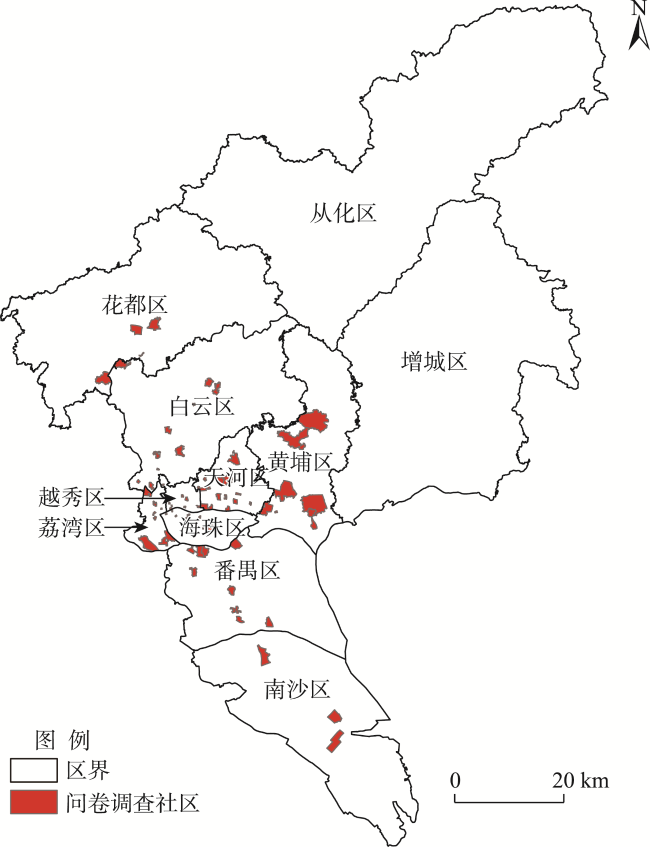
The research of security with "home" as the center is an important issue in human geography and its related disciplines. There are many theoretical models of safety perception, such as victimization model, vulnerability model, and disorder model. In terms of the influencing factors of residential safety perception, existing studies mainly focus on individual factors and environmental factors, and there are few studies that comprehensively analyze housing situation and different crime victimization experiences. Therefore, based on 1568 questionnaires through a household survey in 74 typical communities in Guangzhou City, this study used factor analysis and multiple linear regressions to analyze the impact of housing situation and crime victimization experience on residential safety perception. The results show that individual attributes, social environment in the community, housing situation, and crime victimization experience have significant influence on residential safety perception. With regard to individual attributes, gender has a significant impact on residential safety perception, and the level of residential safety perception of female residents is significantly lower than that of male residents. Age has a positive influence on residential safety perception, which increases significantly with age. With regard to social environment and housing situation, physical environment disorder and social environment disorder have a negative impact on the level of residential safety perception. Formal social control and house ownership have positive effects on residential safety perception, but informal social control and collective efficacy have no significant effects. Both direct and indirect crime victimization experience have negative effects, but direct victimization experience has a higher impact on residential safety perception than indirect victimization experience. The findings can provide decision-making reference for the official department to take targeted measures to improve the level of residents' safety perception.
GU Jie , WANG Lifang , SONG Guangwen . The influence of housing situation and crime victimization experience on residential safety perception[J]. PROGRESS IN GEOGRAPHY, 2023 , 42(12) : 2414 -2422 . DOI: 10.18306/dlkxjz.2023.12.011
表1 被解释变量的描述性统计与因子载荷Tab.1 Descriptive statistics and component loadings of explained variables |
| 测量维度 | 测量方式 | 平均值 | 标准差 | 主因子1 |
|---|---|---|---|---|
| 认知维度 | Q0-1:您觉得未来一年您会不会受到侵害 | 0.661 | 0.223 | 0.372 |
| 行为维度 | Q0-2:短暂离开家需锁好门,担心陌生人进入 | 0.619 | 0.289 | 0.860 |
| Q0-3:晚上不敢把财物放在家门口,怕被偷或损坏 | 0.581 | 0.296 | 0.797 | |
| 情感维度 | Q0-4:不在家时,担心家里被盗 | 0.613 | 0.281 | 0.884 |
| Q0-5:晚上在社区散步会感到害怕 | 0.659 | 0.289 | 0.814 |
注:参照5点量表法,很有可能或很担心、较有可能或较担心、一般或不好说、不太可能或有点担心、绝不可能或一点都不担心分别赋值0、0.25、0.50、0.75、1.00。 |
表2 个体变量的描述性统计Tab.2 Descriptive statistics of individual variables |
| 变量 | 测量方式 | 平均值 | 标准差 |
|---|---|---|---|
| X1-1性别 | Q1-1:男(1),女(0) | 0.533 | 0.499 |
| X1-2年龄 | Q1-2:周岁 | 38.030 | 14.016 |
| X1-3家庭收入 | Q1-3:月收入<1万元(1)、[1, 2)万元(2)、[2, 3)万元(3)、[3, 5)万元(4)、[5, 8]万元(5)、>8万元(6) | 1.750 | 1.079 |
| X1-4婚姻状态 | Q1-4:已婚(1),未婚(0) | 0.686 | 0.464 |
| X1-5户口 | Q1-5:本地户口(1),外地户口(0) | 0.436 | 0.496 |
注:括号中数据为变量赋值。 |
表3 解释变量的描述性统计与因子分析Tab.3 Descriptive statistics and factor analysis of explanatory variables |
| 变量 | 测量方式 | 均值 | 标准差 | 因子载荷 |
|---|---|---|---|---|
| X2物理环境失序感知 | Q2-1:社区/小区内的公共设施(如活动设施等)经常被损坏 | 2.761 | 0.962 | 0.744 |
| Q2-2:社区/小区内常见垃圾乱摆放、车乱停的现象 | 2.961 | 0.992 | 0.857 | |
| Q2-3:社区/小区内常见乱涂乱画或者乱贴广告的现象 | 2.946 | 1.017 | 0.840 | |
| Q2-4:社区/小区内环境很嘈杂 | 2.930 | 0.984 | 0.806 | |
| X3社会环境失序感知 | Q3-1:青(少)年聚集街头闲逛 | 2.139 | 1.045 | 0.815 |
| Q3-2:小区居民发生口角等冲突 | 2.021 | 0.888 | 0.831 | |
| Q3-3:周围存在可疑的陌生人 | 2.145 | 0.964 | 0.833 | |
| Q3-4:晚上常有醉酒吵闹现象 | 1.973 | 0.953 | 0.826 | |
| X4非正式控制感知 | Q4-1:社区有陌生人徘徊,会去询问清楚或提醒邻居警惕 | 2.945 | 0.991 | 0.777 |
| Q4-2:当发现社区内有人在乱涂乱画时会去制止 | 2.964 | 0.946 | 0.835 | |
| Q4-3:当发现社区内的小孩打架,会上前制止 | 3.254 | 0.954 | 0.789 | |
| Q4-4:当社区内的小孩逃学时,会询问并可能通知其家长 | 2.884 | 0.949 | 0.813 | |
| X5正式控制感知 | Q5-1:居委会等对规范社区管理起到重要作用 | 3.428 | 0.857 | 0.701 |
| Q5-2:在社区内或周边,见到民警或治安巡逻人员的频率 | 3.223 | 0.875 | 0.784 | |
| Q5-3:社区内有足够的监控摄像头来保障社区安全 | 3.112 | 1.004 | 0.802 | |
| X6集体效能感知 | Q6-1:这个社区/小区内的住户具有相似的价值观点 | 3.283 | 0.819 | 0.694 |
| Q6-2:居民经常参加社区活动 | 2.931 | 0.988 | 0.859 | |
| Q6-3:居民能向居委会等提建议或意见 | 3.026 | 0.979 | 0.867 | |
| Q6-4:小区居民能聚在一起共同处理社区问题 | 3.141 | 0.930 | 0.838 | |
| X7住房情况 | Q7-1:是否拥有产权?是(1);否(0) | 0.311 | 0.463 | — |
| Q7-2:是否为商品房?是(1);否(0) | 0.221 | 0.415 | — | |
| Q7-3:是否为公有住房:是(1);否(0) | 0.088 | 0.283 | — | |
| Q7-4:是否为员工宿舍:是(1);否(0) | 0.050 | 0.219 | — | |
| Q7-5:是否为自建房:是(1);否(0) | 0.351 | 0.477 | — | |
| Q7-6:住房条件 | 4.499 | 0.933 | — | |
| Q7-7:工作日居家时间(h) | 17.015 | 5.466 | — | |
| Q7-8:休息日居家时间(h) | 18.199 | 5.275 | — |
注:采用5点量表法,非常不符合、比较不符合、一般、比较符合、非常符合分别赋1~5分;住房条件中具备厨房、自来水、独立卫生间、防盗门、防盗窗5项中的1项为1分,全部具备为5分;“—”表示改组变量未进行因子分析。 |
表4 控制变量的描述性统计与因子分析Tab.4 Descriptive statistics and factor analysis of control variables |
| 变量 | 测量方式 | 平均值 | 标准差 | 因子载荷 |
|---|---|---|---|---|
| X8直接受害经历 | Q8-1:社区内暴力侵害 | 1.169 | 0.479 | 0.791 |
| Q8-2:社区内扒窃 | 1.237 | 0.553 | 0.844 | |
| Q8-3:入室盗窃或抢劫 | 1.176 | 0.506 | 0.822 | |
| Q8-4:公交地铁内被偷被抢 | 1.253 | 0.553 | 0.823 | |
| Q8-5:公共场所扒窃 | 1.232 | 0.542 | 0.854 | |
| X9间接受害经历(亲友) | Q9-1:社区内受害? 是(1),否(0) | 0.267 | 0.443 | 0.701 |
| Q9-2:公交地铁内受害?是(1),否(0) | 0.315 | 0.465 | 0.784 | |
| Q9-3:其他公共场所受害?是(1),否(0) | 0.222 | 0.416 | 0.802 | |
| X10间接受害经历(社区内) | Q10-1:扒窃 | 1.407 | 0.491 | 0.725 |
| Q10-2:入室盗窃 | 1.339 | 0.473 | 0.723 | |
| Q10-3:寻衅滋事和打架 | 1.189 | 0.391 | 0.707 | |
| Q10-4:诈骗 | 1.199 | 0.399 | 0.728 | |
| Q10-5:其他恶性犯罪 | 1.060 | 0.237 | 0.540 |
注:Q8-1~Q8-4和Q10-1~Q10-5采用5点量表法,0、1~3、4~6、7~9、10次以上分别赋值1~5分;Q9-1~Q9-3中“是”赋值1分,“否”赋值0分。 |
表5 居住安全感的多元线性回归分析Tab.5 Multivariate linear regression analysis of residential safety perception |
| 类型 | 代码 | 变量名称 | 回归系数B | 标准化 系数β | VIF |
|---|---|---|---|---|---|
| 常量 | X0-1 | 常量 | -0.349 | ||
| 个体属性 | X1-1 | 性别 | 0.225*** | 0.112 | 1.077 |
| X1-2 | 年龄 | 0.006** | 0.088 | 1.577 | |
| X1-3 | 家庭收入 | -0.008 | -0.008 | 1.134 | |
| X1-4 | 婚姻状态 | -0.069 | -0.032 | 1.465 | |
| X1-5 | 户口 | -0.046 | -0.023 | 1.515 | |
| 社区社会环境 | X2 | 物理环境失序 | -0.113*** | -0.113 | 1.172 |
| X3 | 社会环境失序 | -0.156*** | -0.156 | 1.396 | |
| X4 | 正式社会控制 | 0.083** | 0.083 | 1.246 | |
| X5 | 非正式社会控制 | -0.015 | -0.015 | 1.261 | |
| X6 | 集体效能 | 0.012 | 0.012 | 1.371 | |
| 住房情况 | X7-1 | 是否拥有产权 | 0.166** | 0.077 | 1.544 |
| X7-2 | 是否为商品房 | 0.073 | 0.030 | 1.509 | |
| X7-3 | 是否为公有住房 | 0.062 | 0.017 | 1.242 | |
| X7-4 | 是否为员工宿舍 | -0.070 | -0.015 | 1.145 | |
| X7-5 | 是否为自建房 | -0.028 | -0.013 | 1.529 | |
| X7-6 | 住房条件 | -0.000370 | -0.000345 | 1.110 | |
| X7-7 | 工作日居家时间 | -0.004 | -0.024 | 2.144 | |
| X7-8 | 休息日居家时间 | 0.005 | 0.026 | 2.120 | |
| 受害经历 | X8 | 自身受害经历 | -0.109*** | -0.109 | 1.259 |
| X9 | 间接受害经历(亲朋好友) | -0.106*** | -0.106 | 1.314 | |
| X10 | 间接受害经历(社区内发生) | -0.077** | -0.077 | 1.457 |
注:***、**、*分别表示P<0.001、P<0.01、P<0.05。 |
| [1] |
姜兰昱, 杨学峰. 从因变量到自变量: 犯罪恐惧感研究的发展与启示[J]. 晋阳学刊, 2013(6): 79-85.
[
|
| [2] |
谌丽, 许婧雪, 张文忠, 等. 居民城市公共安全感知与社区环境: 基于北京大规模调查问卷的分析[J]. 地理学报, 2021, 76(8): 1939-1950.
[
|
| [3] |
|
| [4] |
安莉娟, 丛中. 安全感研究述评[J]. 中国行为医学科学, 2003, 12(6): 698-699.
[
|
| [5] |
|
| [6] |
|
| [7] |
|
| [8] |
|
| [9] |
|
| [10] |
|
| [11] |
|
| [12] |
|
| [13] |
|
| [14] |
|
| [15] |
|
| [16] |
|
| [17] |
|
| [18] |
|
| [19] |
|
| [20] |
|
| [21] |
|
| [22] |
|
| [23] |
|
| [24] |
刘晓霞, 肖鸿元, 王兴中, 等. 地理学的安全感研究: 基于地点的综合理解、应用及展望[J]. 人文地理, 2018, 33(5): 38-45.
[
|
| [25] |
龙冬平, 柳林, 周素红, 等. 地理学视角下犯罪者行为研究进展[J]. 地理科学进展, 2017, 36(7): 886-902.
[
|
| [26] |
|
| [27] |
张延吉, 秦波, 朱春武. 北京城市建成环境对犯罪行为和居住安全感的影响[J]. 地理学报, 2019, 74(2): 238-252.
[
|
| [28] |
张延吉, 游永熠, 朱春武, 等. 犯罪恐惧感与犯罪活动空间分布的匹配关系及其影响因素: 以北京市为例[J]. 地理科学, 2022, 42(6): 1024-1033.
[
|
| [29] |
|
| [30] |
|
| [31] |
|
| [32] |
|
| [33] |
郑滋椀, 姜超, 汪婕, 等. 常态化防疫背景下城市盗窃犯罪的时空演变及其机理研究: 以浙江海宁市为例[J]. 地理科学进展, 2023, 42(2): 341-352.
[
|
/
| 〈 |
|
〉 |