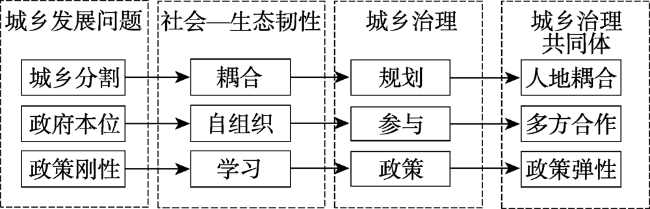
A logical framework of rural-urban governance from the perspective of social-ecological resilience
Received date: 2020-10-12
Request revised date: 2020-11-19
Online published: 2021-03-28
Supported by
Major Program of National Social Science Foundation of China(19ZDA086)
Copyright
Along with the rapid progress of urbanization, dramatic changes in the ecological environment and profound changes in the social and economic systems have made issues related to China's urban and rural development more prominent. Urban and rural governance faces new challenges. The concept of social-ecological resilience may shed some light on changes in the practice of rural-urban governance, but there is a lack of research on the relationship between them. Focusing on major issues of urban and rural development in China, this study clarified the relationship between social-ecological resilience and urban and rural development, and constructed a logical framework of rural-urban governance from the perspective of social-ecological resilience. The framework aims to promote urban and rural integration and sustainable development by introducing the key characteristics of social-ecological resilience (coupling, self-organization, and learning) into rural-urban governance mechanisms (planning, participation, and policy). In the future, social and ecological issues should be taken into overall consideration in rural-urban governance, with the idea of human-earth system coupling. A multiple-tiered network of coordinated rural-urban governance should be established. Attention should be paid to the cultivation of cooperation and innovation of the participants at different scales, especially to the construction of learning and adaptability of urban and rural communities. In practice, it is necessary to make full use of spatial planning, to incorporate ecosystem services into rural-urban spatial governance and take them as a priority. The goal of enhancing the resilience and adaptive capacity of urban and rural areas to uncertain challenges will be achieved by coordinating the relationship between ecosystem services and human well-being.
LIU Zhimin , YE Chao . A logical framework of rural-urban governance from the perspective of social-ecological resilience[J]. PROGRESS IN GEOGRAPHY, 2021 , 40(1) : 95 -103 . DOI: 10.18306/dlkxjz.2021.01.009
表1 3种韧性的比较Tab.1 Comparison of resilience in different application areas |
| 类型 | 应用领域 | 机制与特征 | 均衡状态 | 图示 |
|---|---|---|---|---|
| 工程韧性 | 工程学、心理学和灾害学 | 扰动后反弹复原的能力,是一种恢复力,关注效率和稳定性 | 静态,单一均衡状态 |  |
| 生态韧性 | 生态学、自然资源学 | 系统在进入新状态前所能吸收的扰动的量级,是一种适应力或缓冲力 | 动态,多重均衡状态 |  |
| 社会—生态韧性 | 可持续科学、社会学和规划学 | 系统对内外部变化的坚持、适应和转化的能力,强调学习和协作 | 动态,非均衡态,跨尺度交互 | 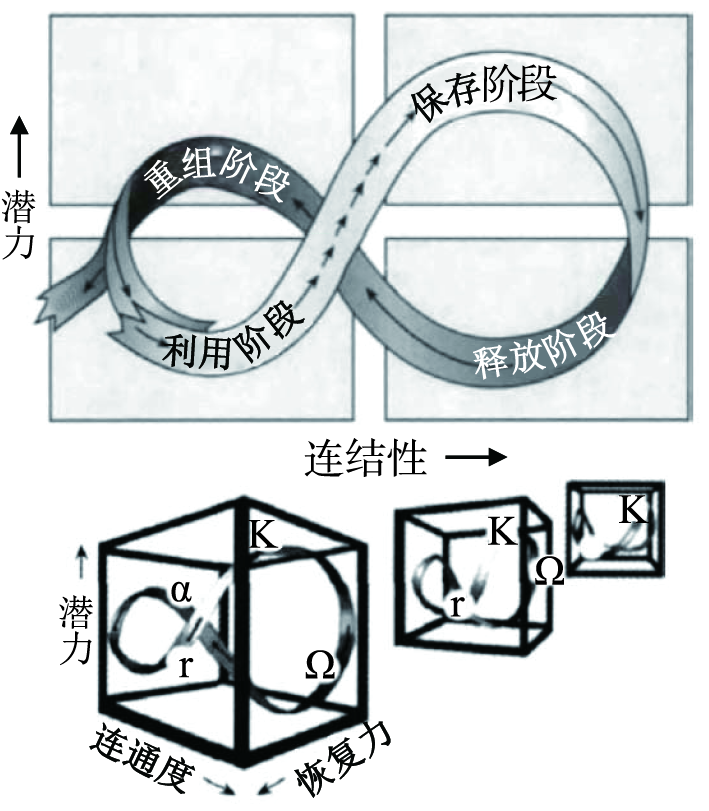 |
注:表中图示来自参考文献[22];图中r为开发阶段,K为保护阶段,Ω为释放阶段,α为更新阶段。 |
| [1] |
|
| [2] |
国家统计局. 中华人民共和国2019年国民经济和社会发展统计公报 [EB/OL]. 2020-02-28 [2020-07-18]. http://www.stats.gov.cn/tjsj/zxfb/202002/t20200228_1728913.html.
[ National Bureau of Statistics. Statistical communique of the People's Republic of China on the 2019 national economic and social development. 2020-02-28 [2020-07-18]. http://www.stats.gov.cn/tjsj/zxfb/202002/t20200228_1728913.html.]
|
| [3] |
|
| [4] |
|
| [5] |
罗鑫玥, 陈明星. 城镇化对气候变化影响的研究进展[J]. 地球科学进展, 2019,34(9):984-997.
[
|
| [6] |
史培军, 宋长青, 程昌秀. 地理协同论: 从理解“人—地关系”到设计“人—地协同”[J]. 地理学报, 2019,74(1):3-15.
[
|
| [7] |
|
| [8] |
叶超, 于洁. 模糊的边界: 城镇化与城市际性的演变 [J]. 探索与争鸣, 2020, 35(5): 96-101, 161, 159.
[
|
| [9] |
叶超, 于洁. 迈向城乡融合: 新型城镇化与乡村振兴结合研究的关键与趋势[J]. 地理科学, 2020,40(4):528-534.
[
|
| [10] |
修春亮, 魏冶, 王绮. 基于“规模—密度—形态”的大连市城市韧性评估[J]. 地理学报, 2018,73(12):2315-2328.
[
|
| [11] |
|
| [12] |
|
| [13] |
|
| [14] |
|
| [15] |
朱晓丹, 叶超, 李思梦. 可持续城市研究进展及其对国土空间规划的启示[J]. 自然资源学报, 2020,35(9):2120-2133.
[
|
| [16] |
|
| [17] |
|
| [18] |
|
| [19] |
|
| [20] |
宋爽, 王帅, 傅伯杰, 等. 社会—生态系统适应性治理研究进展与展望[J]. 地理学报, 2019,74(11):2401-2410.
[
|
| [21] |
|
| [22] |
李彤玥. 韧性城市研究新进展[J]. 国际城市规划, 2017,32(5):15-25.
[
|
| [23] |
|
| [24] |
|
| [25] |
|
| [26] |
|
| [27] |
|
| [28] |
|
| [29] |
|
| [30] |
|
| [31] |
李玉恒, 阎佳玉, 刘彦随. 基于乡村弹性的乡村振兴理论认知与路径研究[J]. 地理学报, 2019,74(10):2001-2010.
[
|
| [32] |
|
| [33] |
|
| [34] |
|
| [35] |
|
| [36] |
|
| [37] |
|
| [38] |
|
| [39] |
|
| [40] |
陈明星, 周园, 郭莎莎, 等. 新型城镇化研究的意义、目标与任务[J]. 地球科学进展, 2019,34(9):974-983.
[
|
| [41] |
|
| [42] |
|
| [43] |
|
| [44] |
|
| [45] |
|
| [46] |
|
| [47] |
|
| [48] |
|
| [49] |
|
| [50] |
|
| [51] |
|
| [52] |
|
| [53] |
赵瑞东, 方创琳, 刘海猛. 城市韧性研究进展与展望[J]. 地理科学进展, 2020,39(10):1717-1731.
[
|
| [54] |
成超男, 胡杨, 赵鸣. 城市绿色空间格局时空演变及其生态系统服务评价的研究进展与展望[J]. 地理科学进展, 2020,39(10):1770-1782.
[
|
| [55] |
|
| [56] |
|
| [57] |
|
| [58] |
|
/
| 〈 |
|
〉 |