Network structure and evolution characteristics of cities in China based on high-speed railway transport flow
Received date: 2019-09-09
Request revised date: 2020-01-19
Online published: 2020-07-28
Supported by
Research Program of the China Railway Corporation(N2018Z010)
Copyright
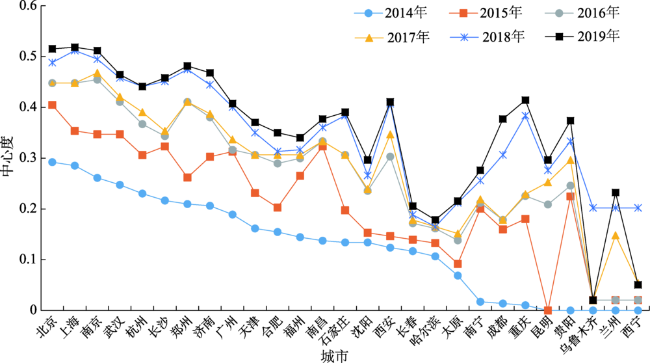
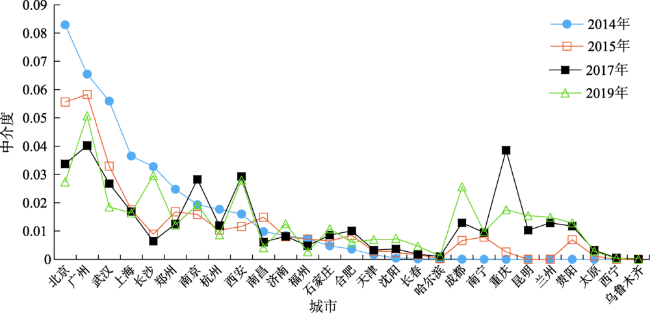
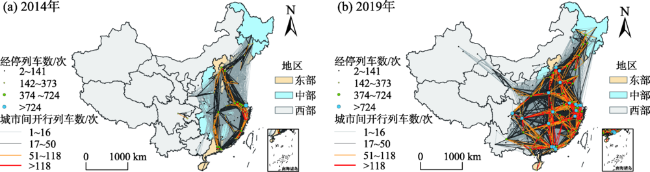
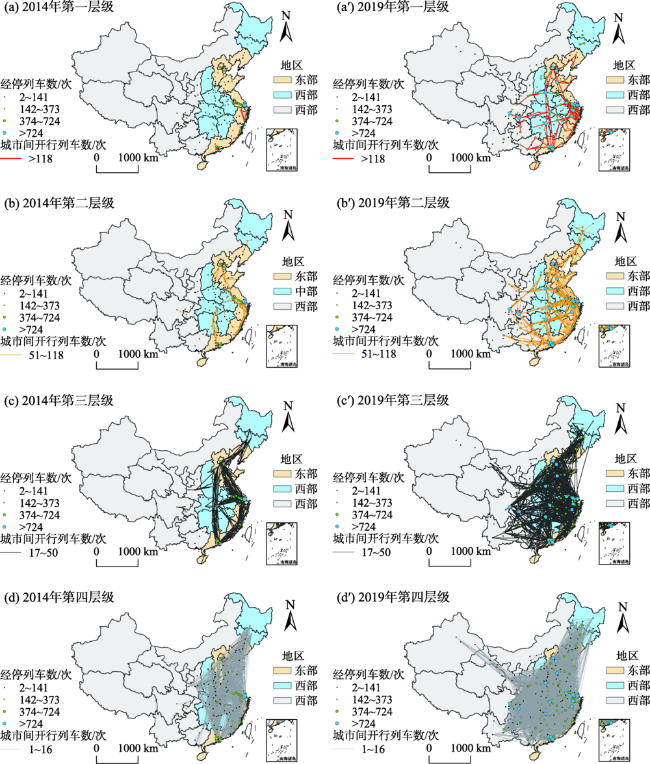
In recent years, with the gradual implementation of the Medium and Long-term Railway Network Plan, China has entered the era of high-speed railway (HSR) network, and the impact of HSR on urban and regional spatial structure has become a hot topic of human geography research. In this study, the network structure and evolution characteristics of cities in China was analyzed from various aspects, including overall scale, network density, timing variation of node centrality, and network connection mode and strength, by using social network analysis and the ArcGIS visualization tool based on the HSR passenger flow data from 2014 to 2019. The results are presented as follows: 1) City network density has increased with the increase of HSR cities and their connections. Statistics show that 76.09% of the cities in China had been opened to high-speed trains by 2019, and each city can reach 66 cities by high-speed trains without transfer. 2) Changes in the status and functions of nodal cities have reshaped the spatial pattern of the network. The network pattern dominated by a few eastern cities in the past has changed, showing a trend of multi-center and balanced development. The core position of cities from the eastern part in the network has been further strengthened. At the same time, some cities in central and western China begin to play a more important role in the network connection, which is the link and bridgeof trans-regional connection. 3) In terms of spatial pattern, the city network expands from east to west as a whole, and an interlocking and complex network-like structure on the country scale has replaced the banded structureatthe regional scale, which is similar to the eight vertical and eight horizontal HSR network. High-speed railway has weakened the constraint of geographical distance on city connections, and the corridor effect has diminished. 4) During the construction period of HSR network, the correlation strength of city network was low, and the high-intensity city connection was scattered in several city clusters in the east, which was shown as an independent and closed regional system on the whole. With the formation and expansion of the HSR network, the original pattern of city connections has been consolidated, and continued to spread and divide, forming four distinct levels of connections.
SUN Na , ZHANG Meiqing . Network structure and evolution characteristics of cities in China based on high-speed railway transport flow[J]. PROGRESS IN GEOGRAPHY, 2020 , 39(5) : 727 -737 . DOI: 10.18306/dlkxjz.2020.05.003
表1 城市网络的规模与密度Tab.1 Scale and density of city network |
| 年份 | 高铁城 市数/个 | 高铁城市在 全国的占比/% | 直达城市 对/个 | 网络 密度 |
|---|---|---|---|---|
| 2014 | 133 | 45.55 | 2268 | 0.05 |
| 2015 | 170 | 57.63 | 3820 | 0.09 |
| 2016 | 197 | 66.11 | 5316 | 0.12 |
| 2017 | 199 | 66.78 | 5640 | 0.13 |
| 2018 | 213 | 71.48 | 6726 | 0.15 |
| 2019 | 226 | 76.09 | 7448 | 0.17 |
表2 网络层级特征Tab.2 Hierarchical characteristics of city network |
| 项目 | 2014年 | 2015年 | 2016年 | 2017年 | 2018年 | 2019年 | |
|---|---|---|---|---|---|---|---|
| 高铁城市/个 | 第一层级 | 23(17.29) | 27(15.88) | 39(19.80) | 45(22.61) | 91(42.72) | 93(41.15) |
| 第二层级 | 59(44.36) | 90(52.94) | 133(67.51) | 141(70.85) | 164(77.00) | 172(76.11) | |
| 第三层级 | 109(81.95) | 156(91.76) | 183(92.89) | 182(91.46) | 201(94.37) | 211(93.36) | |
| 第四层级 | 127(95.49) | 165(97.06) | 193(97.97) | 197(98.99) | 209(98.12) | 221(97.79) | |
| 直达城对/个 | 第一层级 | 29(1.28) | 37(0.97) | 54(1.02) | 63(1.12) | 149(2.22) | 168(2.26) |
| 第二层级 | 95(4.19) | 161(4.21) | 284(5.34) | 280(4.96) | 459(6.82) | 503(6.75) | |
| 第三层级 | 407(17.95) | 635(16.62) | 877(16.50) | 887(15.73) | 1186(17.63) | 1256(16.86) | |
| 第四层级 | 1737(76.59) | 2987(78.19) | 4101(77.14) | 4410(78.19) | 4932(73.33) | 5521(74.13) | |
| 城市间开行列车数均值/(次/d) | 全国 | 14 | 13 | 14 | 14 | 18 | 18 |
| 第一层级 | 158 | 162 | 166 | 172 | 185 | 199 | |
| 第二层级 | 73 | 72 | 73 | 72 | 75 | 75 | |
| 第三层级 | 28 | 28 | 28 | 29 | 29 | 29 | |
| 第四层级 | 5 | 5 | 5 | 5 | 6 | 5 | |
注:括号中数据为占比(%)。 |
| [1] |
|
| [2] |
王姣娥, 景悦 . 中国城市网络等级结构特征及组织模式: 基于铁路和航空流的比较 [J]. 地理学报, 2017,72(8):1508-1519.
[
|
| [3] |
胡国建, 陈传明, 金星星 , 等. 中国城市体系网络化研究 [J]. 地理学报, 2019,74(4):681-693.
[
|
| [4] |
王少剑, 高爽, 王宇渠 . 基于流空间视角的城市群空间结构研究: 以珠三角城市群为例 [J]. 地理研究, 2019,38(8):1849-1861.
[
|
| [5] |
王士君, 廉超, 赵梓渝 . 从中心地到城市网络:中国城镇体系研究的理论转变 [J]. 地理研究, 2019,38(1):64-74.
[
|
| [6] |
薛俊菲 . 基于航空网络的中国城市体系等级结构与分布格局 [J]. 地理研究, 2008,27(1):23-32.
[
|
| [7] |
|
| [8] |
孟德友, 冯兴华, 文玉钊 . 铁路客运视角下东北地区城市网络结构演变及组织模式探讨 [J]. 地理研究, 2017,36(7):1339-1352.
[
|
| [9] |
|
| [10] |
陈伟, 修春亮, 柯文前 , 等. 多元交通流视角下的中国城市网络层级特征 [J]. 地理研究, 2015,34(11):2073-2083.
[
|
| [11] |
|
| [12] |
|
| [13] |
李永奎, 常诚, 郭英 , 等. 高铁网络与城市关联的时空演化与相关性分析 [J]. 华东经济管理, 2019,33(3):5-11.
[
|
| [14] |
孙阳, 姚士谋, 张落成 . 长三角城市群“空间流”层级功能结构: 基于高铁客运数据的分析 [J]. 地理科学进展, 2016,35(11):1381-1387.
[
|
| [15] |
|
| [16] |
|
| [17] |
王姣娥, 焦敬娟, 金凤君 . 高速铁路对中国城市空间相互作用强度的影响 [J]. 地理学报, 2014,69(12):1833-1846.
[
|
| [18] |
焦敬娟, 王姣娥, 金凤君 , 等. 高速铁路对城市网络结构的影响研究: 基于铁路客运班列分析 [J]. 地理学报, 2016,71(2):265-280.
[
|
| [19] |
|
| [20] |
|
| [21] |
方大春, 马为彪 . 全面高铁时代省域中心城市空间关联网络特征研究 [J]. 区域经济评论, 2018(3):105-113.
[
|
| [22] |
马学广, 唐承辉 . 中国城市网络化空间联系与格局: 基于高铁客运流的大数据分析 [J]. 经济地理, 2018,38(4):55-64.
[
|
| [23] |
陈永林, 谢炳庚, 张爱明 , 等. 不同尺度下交通对空间流动性的影响 [J]. 地理学报, 2018,73(6):1162-1172.
[
|
| [24] |
陈卓, 金凤君, 杨宇 , 等. 高速公路流的距离衰减模式与空间分异特征: 基于福建省高速公路收费站数据的实证研究 [J]. 地理科学进展, 2018,37(8):1086-1095.
[
|
/
| 〈 |
|
〉 |