Development pattern of trade facilitation of the countries along the Belt and Road
Received date: 2019-03-11
Request revised date: 2019-08-05
Online published: 2020-05-28
Supported by
National Natural Science Foundation of China(41871120)
Priority Research Program of Chinese Academy of Sciences(XDA20010102)
Copyright
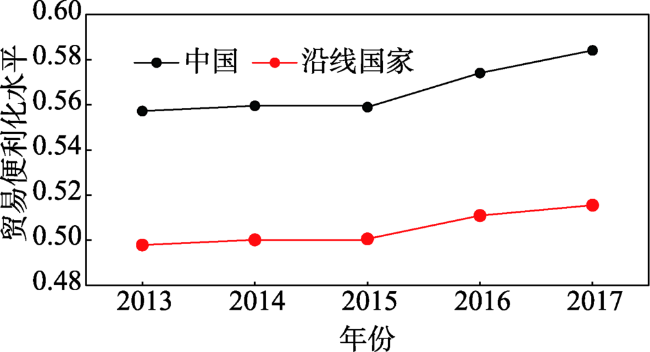
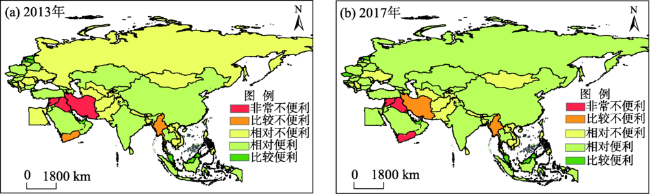
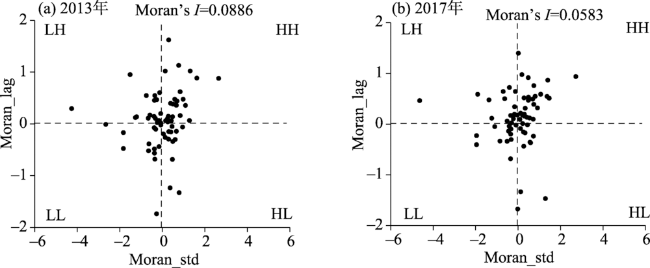
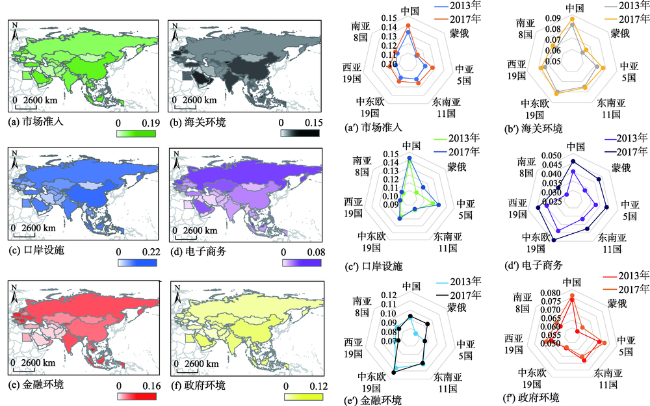
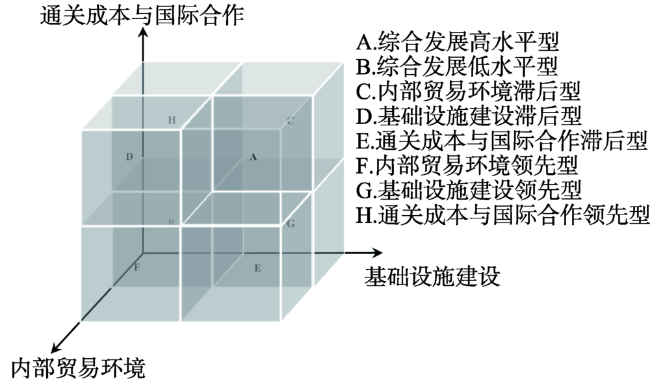
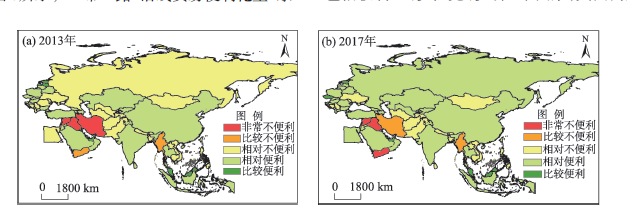
Trade facilitation plays an important role in the economic cooperation of the countries along the Belt and Road. Increasing the level of trade facilitation is conducive to promote the orderly and freely flow of economic factors in the region. Based on the perspective of trade facilitation and existing literature review, this study constructed an evaluation system of trade facilitation with 29 indicators, analyzed the development trend, spatial pattern, and development mode of trade facilitation in the countries along the Belt and Road from 2013 to 2017, and put forward some policy recommendations. The results show that: 1) Since 2013, the level of trade facilitation in the countries along the Belt and Road has been slowly rising, and the six subregions ranked from high to low according to the increase in trade facilitation levels are Mongolia and Russia, Central Asia, Central and Eastern Europe, West Asia, South Asia, and Southeast Asia. 2) Trade facilitation level of the countries along the Belt and Road showed a spatial pattern of high in the east and west and low in the center, and high in the south and low in the north. And the spatial differences gradually narrowed. 3) The change of the second-level indicators was relatively consistent with the overall trade facilitation. China ranks high among the Belt and Road countries on the second-level indicators except business environment. 4) Trade facilitation can be divided into eight modes through k-means cluster analysis. "High level comprehensive development" and "Low level comprehensive development" were the main development modes of the countries along the Belt and Road. "Lagging behind in customs clearance costs and international cooperation", "Leading in domestic trading environment" and "Leading in infrastructure construction" have become important development modes for some countries in Southeast Asia, Central and Eastern Europe, and Central Asia.
SONG Zhouying , YU Yang . Development pattern of trade facilitation of the countries along the Belt and Road[J]. PROGRESS IN GEOGRAPHY, 2020 , 39(3) : 355 -366 . DOI: 10.18306/dlkxjz.2020.03.001
表1 贸易便利化定义Tab.1 Definition of trade facilitation |
| 定义内容 | 来源机构 | 年份 |
|---|---|---|
| 货物跨境流通过程中所涉及的进出口程序和手续简化 | 世界银行(WB) | 2003 |
| 根据简单、标准化的海关程序和惯例、文件要求、货物和过境业务以及贸易和运输安排,为跨境贸易交易建立一个透明和可预测的环境 | 联合国贸易发展委员会(UNCTAD) | 2006 |
| 简化和合理化海关和其他行政程序,降低货物跨国运输的成本 | 亚太经合组织(APEC) | 2007 |
| 改善与跨国界货物贸易有关的进程的效率 | 国际商会(ICC) | 2007 |
| 在国际贸易链条的各个阶段,通过提高效率降低贸易成本的政策和措施 | 经济合作与发展组织(OECD) | 2011 |
| 将货物从卖方转移到买方并支付货款所需的程序和相关信息流简化、标准化和协调 | 联合国欧洲经济委员会(UNCEC) | 2012 |
| 简化和协调国际贸易程序,包括进出口程序。这方面的程序主要是指收集、提出、交流和处理国际贸易中货物运输所需的数据所涉及的活动 | 欧盟委员会(EC) | 2012 |
| 对国际贸易中与货物贸易相关的制度、程序与手续等的简化与协调 | 世界贸易组织(WTO) | 2015 |
表2 贸易便利化评价指标体系Tab.2 Index system of trade facilitation |
| 一级指标 | 二级指标 | 三级指标 | 权重 | 数据来源 |
|---|---|---|---|---|
| (权重) | (权重) | |||
| 通关成本与国际合作 (0.312) | 市场准入(MA) | 投资自由度 (if) | 0.050 | HF |
| (0.152) | 贸易壁垒 (tb) | 0.047 | GCR | |
| 非常规支付与行贿 (ip) | 0.032 | GCR | ||
| 贸易便利化协定 (tfa)* | 0.023 | TFAF | ||
| 海关环境(CE) | 海关手续负担 (bp) | 0.029 | GCR | |
| (0.160) | 清关效率 (ec) | 0.046 | WB | |
| 边境管理透明度 (bmc) | 0.049 | GCR | ||
| 腐败感知指数 (ti) | 0.036 | GETR | ||
| 基础设施建设 (0.357) | 口岸设施(IS) | 公路口岸设施质量 (hpi) | 0.020 | TI |
| (0.208) | 铁路口岸设施质量 (rpi) | 0.075 | GCR | |
| 航空口岸设施质量 (api) | 0.046 | GCR | ||
| 运输设施品质 (qt) | 0.037 | GCR | ||
| 电力供应品质 (qe) | 0.030 | GCR | ||
| 电子商务(EC) | 新科技可获得性 (ant) | 0.048 | GCR | |
| (0.149) | 因特网使用率 (ri) | 0.024 | GCR | |
| 电子商务使用率 (eu) | 0.048 | GCR | ||
| 手机用户数 (np) | 0.029 | GCR | ||
| 内部贸易环境 (0.331) | 金融环境(ME) | 建企成本 (bc) | 0.034 | GCR |
| (0.200) | 信贷可得性 (af) | 0.029 | GCR | |
| 市场竞争 (mc) | 0.038 | GCR | ||
| 市场活力 (md) | 0.031 | GCR | ||
| 金融服务成本 (fc) | 0.031 | GCR | ||
| 金融服务的便利性 (ff) | 0.037 | GCR | ||
| 政府环境(GE) | 规制环境 (re) | 0.062 | GCR | |
| (0.131) | 政府管制负担 (gg) | 0.010 | GCR | |
| 法规解决争端效率 (le) | 0.010 | GCR | ||
| 犯罪造成的商业成本 (vc) | 0.024 | GCR | ||
| 司法独立性 (ji) | 0.015 | GCR | ||
| 政府官员徇私舞弊 (gm) | 0.010 | GCR |
注:*表示若在当年及之前批准世界贸易组织《贸易便利化协定》为1,否则为0。 |
表3 贸易便利化评价指标体系主成分累计贡献率Tab.3 Cumulative contribution rate of the main components of trade facilitation index system (%) |
| 年份 | 主成分 | 累计贡献率 | ||||
|---|---|---|---|---|---|---|
| Comp1 | Comp2 | Comp3 | Comp4 | Comp5 | ||
| 2013 | 56.424 | 8.681 | 7.545 | 4.492 | 3.630 | 80.772 |
| 2014 | 54.295 | 9.971 | 8.189 | 5.527 | 2.123 | 80.105 |
| 2015 | 55.508 | 10.231 | 7.080 | 5.058 | 3.601 | 81.478 |
| 2016 | 50.696 | 12.707 | 6.889 | 5.783 | 4.003 | 80.078 |
| 2017 | 54.968 | 9.643 | 6.475 | 5.284 | 4.005 | 80.375 |
表4 2017年沿线国家贸易便利化模式Tab.4 Division of trade facilitation modes among countries along the Belt and Road, 2017 |
| 贸易便利化发展模式 | 国家名称 |
|---|---|
| 综合发展高水平型 | 泰国、斯洛伐克、白俄罗斯、巴林、沙特阿拉伯、印度尼西亚、印度、匈牙利、马其顿、拉脱维亚、中国、波兰、格鲁吉亚、阿联酋、卡塔尔、捷克、立陶宛、吉尔吉斯斯坦、新加坡、马来西亚、爱沙尼亚、以色列 |
| 综合发展低水平型 | 黎巴嫩、孟加拉国、菲律宾、波黑、科威特、蒙古、巴基斯坦、土库曼斯坦、塞尔维亚、斯里兰卡、阿富汗、马尔代夫、东帝汶、缅甸、也门、叙利亚、伊拉克、伊朗 |
| 内部贸易环境滞后型 | 约旦、斯洛文尼亚、土耳其、克罗地亚 |
| 基础设施建设滞后型 | 文莱、阿曼、罗马尼亚 |
| 通关成本与国际合作滞后型 | 俄罗斯、乌克兰、亚美尼亚、黑山、保加利亚、阿塞拜疆 |
| 内部贸易环境领先型 | 不丹、尼泊尔、越南、摩尔多瓦、老挝、柬埔寨、阿尔巴尼亚 |
| 基础设施建设领先型 | 塔吉克斯坦、乌兹别克斯坦、埃及、哈萨克斯坦 |
| 通关成本与国际合作领先型 | — |
| [1] |
|
| [2] |
孔庆峰, 董虹蔚 . “一带一路”国家的贸易便利化水平测算与贸易潜力研究[J]. 国际贸易问题, 2015(12):158-168.
[
|
| [3] |
刘卫东 . “一带一路”战略的科学内涵与科学问题[J]. 地理科学进展, 2015,34(5):538-544.
[
|
| [4] |
邹嘉龄, 刘春腊, 尹国庆 , 等. 中国与“一带一路”沿线国家贸易格局及其经济贡献[J]. 地理科学进展, 2015,34(5):598-605.
[
|
| [5] |
郑蕾, 刘志高 . 中国对“一带一路”沿线直接投资空间格局[J]. 地理科学进展, 2015,34(5):563-570.
[
|
| [6] |
杨小凯, 张永生 . 新贸易理论、比较利益理论及其经验研究的新成果: 文献综述[J]. 经济学(季刊), 2001(1):19-44.
[
|
| [7] |
|
| [8] |
|
| [9] |
|
| [10] |
|
| [11] |
毛艳华, 杨思维 . 21世纪海上丝绸之路贸易便利化合作与能力建设[J]. 国际经贸探索, 2015,31(4):101-112.
[
|
| [12] |
|
| [13] |
|
| [14] |
|
| [15] |
|
| [16] |
|
| [17] |
丁广伟, 张磊 . 贸易便利化、对外直接投资的出口效应分析[J]. 干旱区地理, 2017,40(5):1111-1117.
[
|
| [18] |
|
| [19] |
|
| [20] |
|
| [21] |
|
| [22] |
|
| [23] |
|
| [24] |
|
| [25] |
|
| [26] |
曾铮, 周茜 . 贸易便利化测评体系及对我国出口的影响[J]. 国际经贸探索, 2008(10):4-9.
[
|
| [27] |
单君兰, 周苹 . 基于APEC的贸易便利化测评及对我国出口影响的实证分析[J]. 国际商务研究, 2012,33(1):40-45.
[
|
| [28] |
孙林, 倪卡卡 . 东盟贸易便利化对中国农产品出口影响及国际比较: 基于面板数据模型的实证分析[J]. 国际贸易问题, 2013(4):139-147.
[
|
| [29] |
|
| [30] |
艾赛提江, 郭羽诞 . 中亚五国贸易便利化程度分析[J]. 新疆社会科学, 2012(4):75-80.
[
|
| [31] |
李豫新, 郭颖慧 . 边境贸易便利化水平对中国新疆维吾尔自治区边境贸易流量的影响: 基于贸易引力模型的实证分析[J]. 国际贸易问题, 2013(10):120-128.
[
|
| [32] |
周阳 . 美国经验视角下我国海关贸易便利化制度的完善[J]. 国际商务研究, 2010,31(6):19-28.
[
|
| [33] |
|
| [34] |
沈铭辉 . 东亚国家贸易便利化水平测算及思考[J]. 国际经济合作, 2009(7):41-46.
[
|
| [35] |
刘镇, 邱志萍, 朱丽萌 . 海上丝绸之路沿线国家投资贸易便利化时空特征及对贸易的影响[J]. 经济地理, 2018,38(3):11-20.
[
|
| [36] |
|
| [37] |
|
| [38] |
|
| [39] |
|
| [40] |
|
| [41] |
段景辉, 黄丙志 . 贸易便利化水平指标体系研究[J]. 科学发展, 2011(7):46-52.
[
|
| [42] |
方晓丽, 朱明侠 . 中国及东盟各国贸易便利化程度测算及对出口影响的实证研究[J]. 国际贸易问题, 2013(9):68-73.
[
|
| [43] |
李斌, 段娅妮, 彭星 . 贸易便利化的测评及其对我国服务贸易出口的影响: 基于跨国面板数据的实证研究[J]. 国际商务(对外经济贸易大学学报), 2014(1):5-13.
[
|
| [44] |
王中美 . 全球贸易便利化的评估研究与趋势分析[J]. 世界经济研究, 2014(3):47-52.
[
|
| [45] |
张晓静, 李梁 . “一带一路”与中国出口贸易: 基于贸易便利化视角[J]. 亚太经济, 2015(3):21-27.
[
|
| [46] |
|
/
| 〈 |
|
〉 |