Effects of weather factors on the spatial and temporal distributions of metro passenger flows: An empirical study based on smart card data
Received date: 2019-02-11
Request revised date: 2019-07-09
Online published: 2020-03-28
Supported by
National Natural Science Foundation of China(71601045)
Social Science Foundation of Jiangsu Province(16GLC008)
Fundamental Research Funds for the Central Universities(2242019K40203)
Copyright
Urban geographic space, climate, and transportation system are interrelated, and recently available traffic and spatial big data bring new opportunities for understanding the relationship among them. Urban rail transit is an important transport mode for residents to travel green and relieve traffic congestion in big cities in China. In-depth study of factors that affect the changes in the spatial and temporal distributions of metro passenger flows is conducive to the formulation of reasonable land use and traffic demand management policies, and can also provide a theoretical basis for real-time response to the changes in travel demand under specific weather conditions and optimization of transit service operation. To study the impact of weather conditions on metro usage in densely populated areas, in this research the influence of local weather factors (including temperature, humidity, rainfall and so on) on hourly metro passenger flows was investigated based on metro smart card data and weather data from Nanjing City, China. A time series model—seasonal autoregressive integrated moving average with explanatory variables (SARIMAX)—was developed to investigate the impact of weather conditions on metro passenger flows. It is found that some weather factors such as rainfall have significant influence on metro passenger flows. Except for some special sites (large residential areas and large transportation hubs), the influence of weather factors on metro passenger flows reduces gradually from the city center to suburban areas. The effects of weather conditions on regular metro passengers and irregular metro passengers were explicitly compared in this study. Irregular metro passengers are found more vulnerable to adverse weather conditions than regular metro passengers.
XU Manling , FU Xiao , TANG Junyou , LIU Zhiyuan . Effects of weather factors on the spatial and temporal distributions of metro passenger flows: An empirical study based on smart card data[J]. PROGRESS IN GEOGRAPHY, 2020 , 39(1) : 45 -55 . DOI: 10.18306/dlkxjz.2020.01.005
表1 各时段天气情况对比Tab.1 Comparison of weather conditions in different time periods |
| 时间 | 气温差/℃ | 相对湿度差/% | 气压差/hPa | 风速差/(km/h) | 降雨天数占比/% |
|---|---|---|---|---|---|
| 1—2月 | 10.00 | 53.0 | 32.51 | 13 | 33.3 |
| 3—4月 | 18.34 | 50.0 | 27.77 | 25 | 29.5 |
| 5—6月 | 14.44 | 44.0 | 19.64 | 18 | 47.5 |
| 7—8月 | 11.11 | 44.5 | 12.19 | 11 | 27.4 |
| 9—10月 | 17.77 | 41.0 | 30.82 | 24 | 42.6 |
| 11—12月 | 16.67 | 35.5 | 22.01 | 21 | 36.1 |
| 研究时段(3月9日—4月30日) | 18.34 | 50.0 | 27.77 | 25 | 28.3 |
注:加粗数值所在时段为对应该天气变量下的最佳研究时段。 |
表2 智能交通卡数据记录Tab.2 Smart card data of the metro system |
| 日期 | 卡号 | 卡种 | 设备编号 | 进站时间 | 进站站点编号 | 出站时间 | 出站站点编号 |
|---|---|---|---|---|---|---|---|
| 2016-03-09 | 990772894357 | 102 | 22079702 | 15:58:08 | 98 | 16:07:42 | 97 |
| 2016-03-09 | 990772838262 | 101 | 22022805 | 15:23:43 | 25 | 15:38:29 | 28 |
| 2016-03-09 | 993172771712 | 3 | 22046202 | 13:09:36 | 2 | 13:38:18 | 62 |
表3 天气数据记录Tab.3 Weather data |
| 日期 | 时间 | 气温/℃ | 相对湿度/% | 气压/hPa | 风向 | 风速/(km/h) | 天气状况 |
|---|---|---|---|---|---|---|---|
| 2016-03-09 | 5:00 | 3 | 75 | 1027 | 东北偏北 | 10.8 | 晴间多云 |
| 2016-03-09 | 6:00 | 3 | 70 | 1027 | 东北 | 14.4 | 晴间多云 |
| 2016-03-09 | 8:00 | 3 | 70 | 1029 | 东北 | 21.6 | 晴 |
表4 天气因素对地铁客流影响模型结果(工作日早晚高峰)Tab.4 Modeling results of the impact of weather factors on metro passenger flows (during peak hours on working days) |
| 时段 | 变量 | 系数 | P值 | AIC | MAPE |
|---|---|---|---|---|---|
| 早高峰 | 气温 | -47 | 0.81 | 1236.27 | 1.68% |
| 相对湿度 | -31 | 0.55 | |||
| 气压 | -96 | 0.59 | |||
| 风速 | 190 | 0.01** | |||
| 降雨 | -2827 | 0.09* | |||
| 晚高峰 | 气温 | 315 | 0.59 | 1467.68 | 5.94% |
| 相对湿度 | -77 | 0.60 | |||
| 气压 | 262 | 0.62 | |||
| 风速 | -473 | 0.04** | |||
| 降雨 | -3533 | 0.57 |
注:**、*分别表示P<0.05、P<0.1;MAPE为模型的平均绝对百分比误差。下同。 |
表5 天气因素对地铁客流影响模型结果(周六及周日)Tab.5 Modeling results of the impact of weather factors on metro passenger flows (during Saturdays and Sundays) |
| 时间 | 变量 | 系数 | P值 | AIC | MAPE |
|---|---|---|---|---|---|
| 周六 | 气温 | -57 | 0.31 | 2797.00 | 7.79% |
| 相对湿度 | -2 | 0.88 | |||
| 气压 | -51 | 0.30 | |||
| 风速 | -31 | 0.34 | |||
| 降雨(小雨) | -469 | 0.78 | |||
| 降雨(中雨到大雨) | -672 | 0.46 | |||
| 降雨(雷阵雨) | -1329 | 0.24 | |||
| 周日 | 气温 | 98 | 0.40 | 2399.27 | 8.67% |
| 相对湿度 | 12 | 0.52 | |||
| 气压 | 65 | 0.28 | |||
| 风速 | -8 | 0.79 | |||
| 降雨(小雨) | -1429 | 0.04** | |||
| 降雨(中到大雨) | -3968 | 0.02** |
表6 O、D点详细情况Tab.6 Selected origin-destination (OD) pairs in Nanjing City |
| 代表点 | O1 | O2 | O3 | O4 | O5 | D1 | D2 | D3 | D4 | D5 |
|---|---|---|---|---|---|---|---|---|---|---|
| 实际地铁站点 | 柳洲东路 | 油坊桥 | 双龙大道 | 马群 | 迈皋桥 | 新街口 | 集庆门大街 | 元通 | 仙林中心 | 百家湖 |
| 站点性质 | 西北向 居住区 | 西向 居住区 | 南向 居住区 | 东北向 居住区 | 北向 居住区 | CBD | 西向商住 混合区 | 西南向商住 混合区 | 东北向商住 混合区 | 南向商住 混合区 |
注:此表为工作日早高峰的O、D点选取,工作日晚高峰的O、D点选取与早高峰相反,周末的O、D点选取与早高峰情况相同。 |
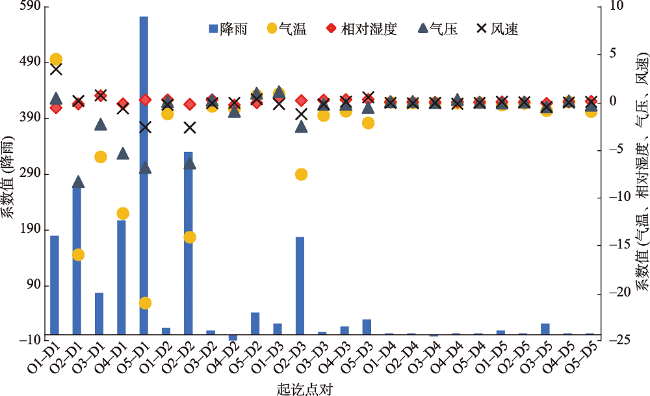
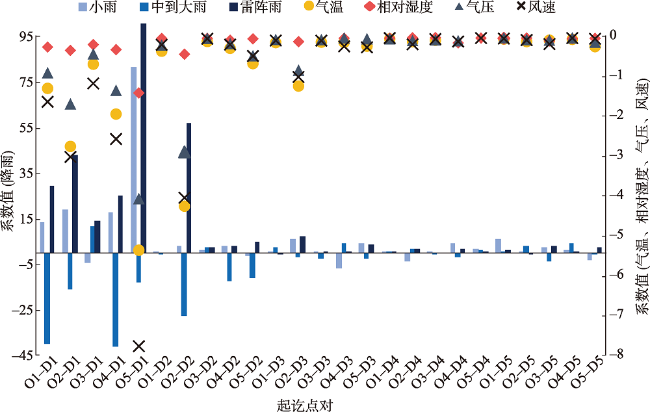
图3 不同天气因素对各OD点对间客流的影响系数值(工作日早高峰)Fig.3 Effects of different weather factors on passenger flows between selected origin-destination (OD) pairs (during morning peaks on working days) |
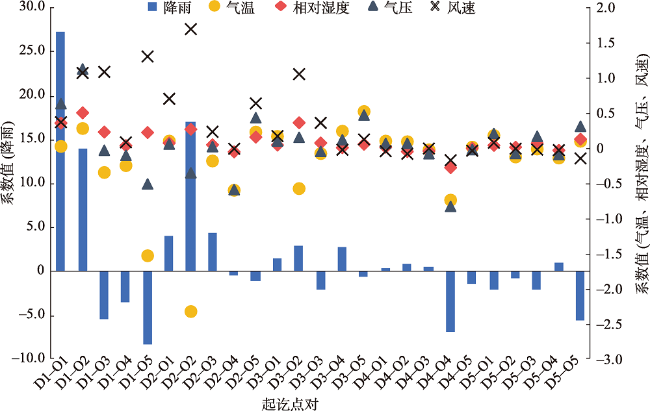
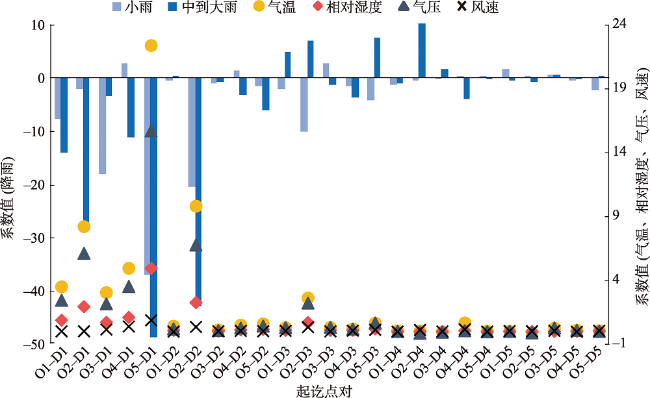
图4 不同天气因素对各OD点对间客流的影响系数值(工作日晚高峰)Fig.4 Effects of different weather factors on passenger flows between selected origin-destination (OD) pairs (during evening peaks on working days) |
图5 不同天气因素对各OD点对间客流的影响系数值(周六)Fig.5 Effects of different weather factors on passenger flows between selected origin-destination (OD) pairs (on Saturdays) |
| [1] |
关雪峰, 曾宇媚 . 时空大数据背景下并行数据处理分析挖掘的进展及趋势[J]. 地理科学进展, 2018,37(10):1314-1327.
[
|
| [2] |
黄洁, 王姣娥, 靳海涛 , 等. 北京市地铁客流的时空分布格局及特征: 基于智能交通卡数据[J]. 地理科学进展, 2018,37(3):397-406.
[
|
| [3] |
|
| [4] |
|
| [5] |
|
| [6] |
|
| [7] |
|
| [8] |
|
| [9] |
楚昌 . 城市公共自行车出行特征及预测研究: 以纽约市为例[D]. 成都: 西南交通大学, 2016.
[
|
| [10] |
陶遂 . 基于智能公交卡数据的出行行为的时空分析及规划启示: 以布里斯班为例[J]. 上海城市规划, 2017(5):94-99.
[
|
| [11] |
刘欣彤 . 降雨天气条件下短时公交客流预测研究[D]. 深圳: 哈尔滨工业大学, 2016.
[
|
| [12] |
周顺 . 基于IC卡刷卡数据的雨天轨道交通出行特征 [C]// 中国城市规划学会城市交通规划学术委员会, 中国城市规划设计研究院. 交叉创新与转型重构: 2017年中国城市交通规划年会论文集. 北京: 中国建筑工业出版社, 2017: 1-9.
[
|
| [13] |
谢振东, 刘雪琴, 吴金成 , 等. 公交IC卡数据客流预测模型研究[J]. 广东工业大学学报, 2018,35(1):16-22.
[
|
| [14] |
|
| [15] |
|
| [16] |
|
| [17] |
|
| [18] |
|
| [19] |
|
| [20] |
|
| [21] |
|
| [22] |
|
| [23] |
|
| [24] |
王莹, 韩宝明, 张琦 . 基于SARIMA模型的北京地铁进站客流量预测[J]. 交通运输系统工程与信息, 2015,15(6):205-211.
[
|
| [25] |
陶长琪 . 计量经济学 [M]. 上海: 复旦大学出版社, 2012.
[
|
/
| 〈 |
|
〉 |