A review of the studies on globalization and urban spaces: From the perspective of geographies of religion
Received date: 2019-01-30
Request revised date: 2019-04-03
Online published: 2020-03-28
Supported by
Key Program of the National Natural Science Foundation of China(41930646)
Key Program of the National Natural Science Foundation of China(41630635)
Southern Marine Science and Engineering Guangdong Laboratory (Zhuhai)(99147-42080011)
Copyright
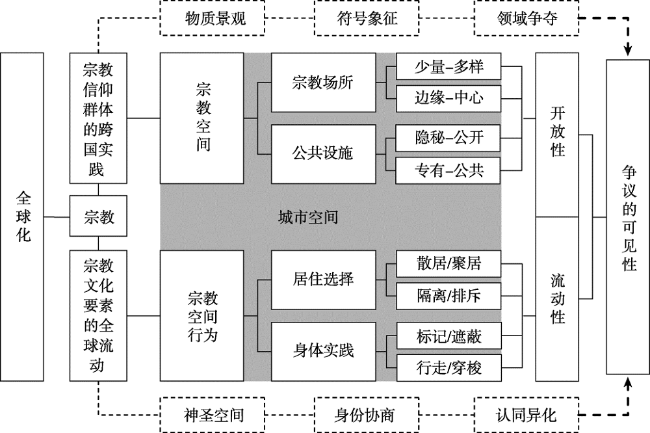
The complex flows of religions at the global scale are embedded in lived experiences of migrants, which have produced new types of urban spaces. In the context of globalization, religious diversity is not only a reflection on cultural globalization, but also a representation of migrants' intersectional identities. This article reviews how geographers of religion explore and understand the relations between religions and urban spaces from a Western perspective in the past three decades. To elaborate, this article focuses on how religion become a force that shapes the structures and fabrics of urban spaces and the society, drawing on a critical review of progress in Anglophone geographies of religions in Western societies. It identifies four key research streams in the Western studies on religion and urban spaces: 1) The emergent religious spaces are diverse and distinctive in urban areas, which are transient and liminal; 2) The multi-functional religious facilities play increasingly crucial roles in cities as they actively engage in urban public affairs; 3) Integration and segregation are apparently represented in religious believers' residential areas; and 4) Religious believers' embodied behaviors manifest their intersectional identities in urban spaces. Moreover, this body of works has considered religion as a new source producing contested urban spaces. That is, religion can be understood as a mediation of complicated social relations in the multicultural Western society. In the recent decades, the terms "visibility" and "invisibility" are frequently addressed to examine the presence and manifestation of immigrants' religious identities in the public sphere of the West. Scholars have indicated that the local adaptation of transnational religious culture has transformed the invisible or intangible religious landscapes and embodied practices into visible urban spaces in the West. Such visibility of transnational religious landscapes have not only altered the social orders, but also challenged the social relations in local communities. Despite that these debates are overwhelmingly discussed in the Anglophone literature, they are ignored by Chinese scholars. Thus, this research can be read as a contribution to current Chinese human geography that sheds light on Chinese geographies of difference and diversity, and rethinks the ways in which multiple cultures are governed in the globalizing urban China, based on a critical review.
Key words: globalization; religion; urban spaces; transnational migration; visibility; Western cities
YANG Rong , LIU Chen , XUE Desheng . A review of the studies on globalization and urban spaces: From the perspective of geographies of religion[J]. PROGRESS IN GEOGRAPHY, 2020 , 39(1) : 153 -165 . DOI: 10.18306/dlkxjz.2020.01.015
| [1] |
|
| [2] |
|
| [3] |
|
| [4] |
|
| [5] |
|
| [6] |
|
| [7] |
|
| [8] |
|
| [9] |
|
| [10] |
|
| [11] |
|
| [12] |
|
| [13] |
|
| [14] |
|
| [15] |
|
| [16] |
|
| [17] |
|
| [18] |
|
| [19] |
|
| [20] |
|
| [21] |
|
| [22] |
|
| [23] |
|
| [24] |
彼得·克拉克 . 欧洲城镇史: 400—2000年 [M]. 宋一然, 郑昱, 李陶, 等, 译. 北京: 商务印书馆, 2015: 72-302.
[
|
| [25] |
|
| [26] |
|
| [27] |
|
| [28] |
|
| [29] |
|
| [30] |
|
| [31] |
|
| [32] |
|
| [33] |
|
| [34] |
|
| [35] |
|
| [36] |
|
| [37] |
|
| [38] |
|
| [39] |
|
| [40] |
|
| [41] |
|
| [42] |
|
| [43] |
|
| [44] |
|
| [45] |
|
| [46] |
|
| [47] |
|
| [48] |
|
| [49] |
江莉莉, 白凯 . 全球化视角下的宗教地理学研究变革与转向[J]. 地理科学进展, 2013,32(5):694-709.
[
|
| [50] |
|
| [51] |
陈宁宁, 朱竑 . 新文化地理学视角下的国外宗教地理学研究[J]. 地理科学进展, 2012,31(2):75-83.
[
|
| [52] |
|
| [53] |
|
| [54] |
|
| [55] |
|
| [56] |
|
| [57] |
|
| [58] |
|
| [59] |
|
| [60] |
|
| [61] |
|
| [62] |
|
| [63] |
|
| [64] |
|
| [65] |
|
| [66] |
|
| [67] |
|
| [68] |
|
| [69] |
|
| [70] |
|
| [71] |
|
| [72] |
|
| [73] |
|
| [74] |
|
| [75] |
|
| [76] |
|
| [77] |
李凡, 司徒尚纪 . 清至民国时期基督教在佛山传播的空间透析: 以教堂景观为视角[J]. 热带地理, 2009,29(5):96-102.
[
|
| [78] |
薛熙明, 朱竑, 唐雪琼 . 城市宗教景观的空间布局及演化: 以1842年以来的广州基督教教堂为例[J]. 人文地理, 2009,24(1):48-52.
[
|
| [79] |
张芸, 王彬, 朱竑 . 外来宗教在口岸城市的空间分布及扩散特征: 以福州市基督教教堂为例[J]. 地理科学进展, 2011,30(8):1065-1072.
[
|
| [80] |
薛德升, 黄鹤绵, 王阳 . 历史时期全球化作用下的城市空间转变: 以1890s—1930s广州东山地区为例[J]. 地理科学, 2014,34(6):687-695.
[
|
| [81] |
高翔, 鱼腾飞, 张燕 . 城市中穆斯林流动人口的空间行为特征及动力机制研究: 以兰州市回族、东乡族为例[J]. 世界地理研究, 2010,19(2):60-68.
[
|
| [82] |
白凯 . 自我叙事式解读回族宗教活动空间的意义[J]. 地理学报, 2012,67(12):1698-1715.
[
|
| [83] |
余晓晨, 陶伟 . 都市非正式神圣场所中的地方依恋: 广州青年家庭教会MT小家案例[J]. 热带地理, 2017,37(1):91-101.
[
|
| [84] |
艾少伟, 李娟, 段小微 . 城市回族社区的地方性: 基于开封东大寺回族社区地方依恋研究[J]. 人文地理, 2013,28(6):28-34.
[
|
| [85] |
黄嘉玲, 何深静 . 非洲裔移民在穗宗教场所地方感特征及其形成机制: 基于广州石室圣心大教堂的实证研究[J]. 热带地理, 2014,34(3):308-318.
[
|
| [86] |
|
| [87] |
|
| [88] |
|
/
| 〈 |
|
〉 |