“Political public opinion forces” in political changes of the Middle East and North Africa and their geopolitical influences
Received date: 2018-10-06
Request revised date: 2019-01-27
Online published: 2019-06-27
Supported by
National Natural Science Foundation of China, No. 41561033,41861028 and 41261034
Major Project of National Social Science Foundation of China, No. 16ZDA041
Philosophy and Social Science Innovation Team Construction Project of Yunnan Province, No. 2017CX07
Open Fund Project of Center for Cambodia Studies of Yunnan Normal University, No. 2018JPZ003.
Copyright
Based on the definition of "public opinion," "political public opinion," and "political public opinion forces" and taking discourse power and geopolitical imagination of critical geopolitics as methodology, this study mainly analyzed the formation and impacts of "political public opinion forces" in the political changes of countries in the Middle East and North Africa region from 2010 to 2015. The research results show that the "political public opinion forces" formed against a profound domestic background in the countries of the Middle East and North Africa as well as the international context. Their formation experienced the following process: beginning with the appearance of public opinion events, then moving on to the gathering of people and the rise to political issues, and ending with the domestic and foreign forces finding agents and forming the political powers to incite, protest, and push forward the political changes. After the formation of "political public opinion forces" and under the tactics of various actors, the "political public opinion incidents" expanded at home and aboard while it spread spatially from south and north in herringbone trajectory. As the pivotal actor among the various actors, "political public opinion forces" on the one hand caused the successive political changes of related countries in the Middle East and North Africa. It on the other hand further promoted the differentiating and restructuring of regional geopolitical relations. This is a meaningful attempt to interpret and analyze public opinion events with geopolitical theory.
XIONG Liran , LIU Baoqiang , WU Youde , JIANG Meiying . “Political public opinion forces” in political changes of the Middle East and North Africa and their geopolitical influences[J]. PROGRESS IN GEOGRAPHY, 2019 , 38(6) : 930 -940 . DOI: 10.18306/dlkxjz.2019.06.013
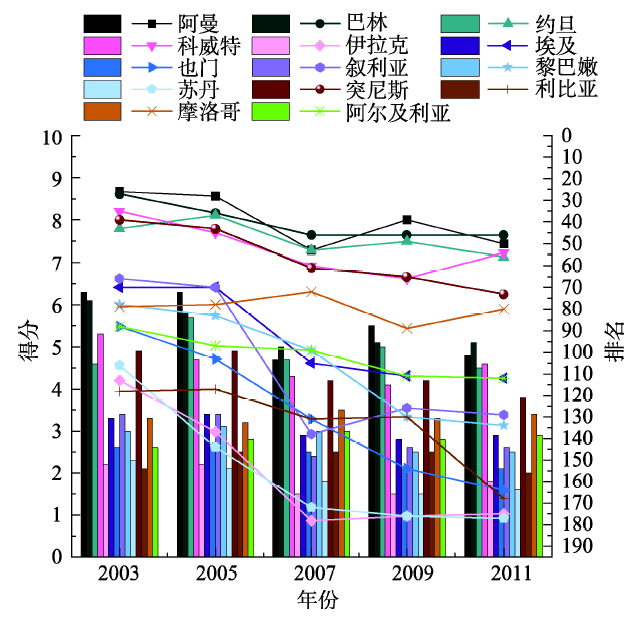
Fig.1 Corruption index and ranking of 14 countries in the Middle East and North Africa, 2003-2011图1 2003—2011年中东北非地区部分国家腐败指数和排名 |
Fig.2 Unemployment rate of young people (15-24 years old) in 15 countries of the Middle East and North Africa图2 2001—2010年中东北非地区部分国家年轻人口群体(15~24岁)失业率 |
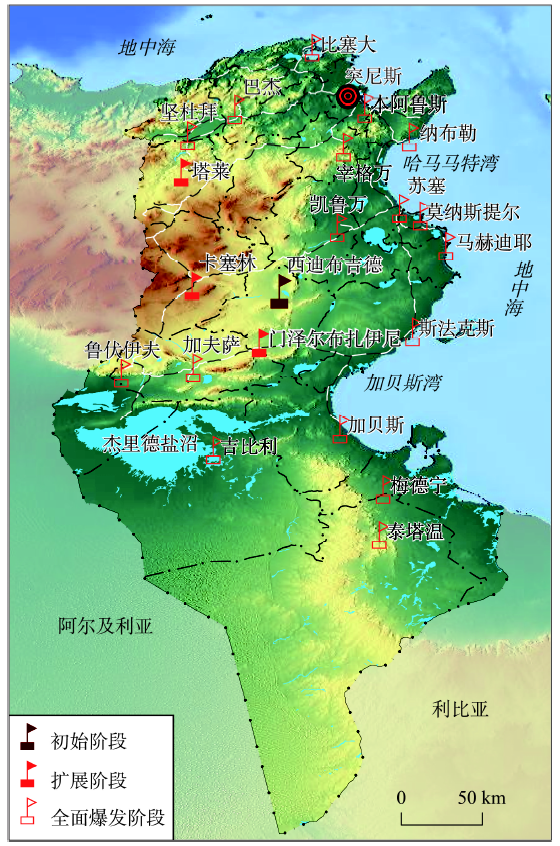
Fig.3 Spatial expansion of the "political public opinion incidents" in Tunisia图3 “政治性民意事件”在突尼斯的空间扩展示意图 |
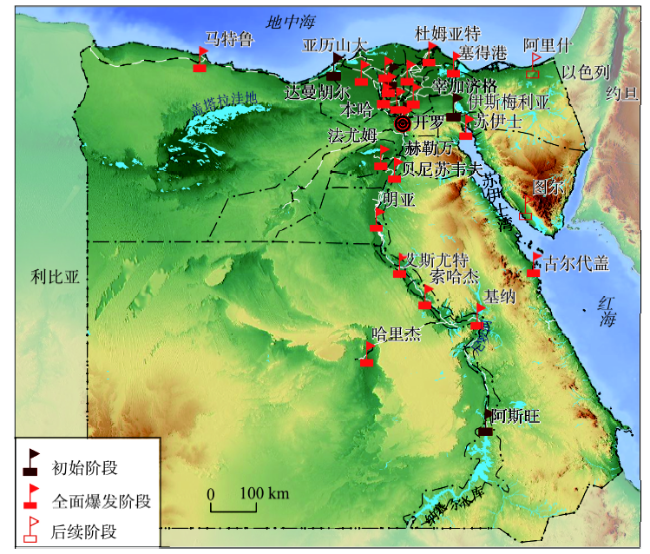
Fig.4 Spatial expansion of the "political public opinion incidents" in Egypt图4 “政治性民意事件”在埃及的空间扩展示意图 |
Tab. 1 Political situation changes in the Middle East and North Africa, 2010-2015表1 2010—2015年中东北非国家政局变换情况 |
| 国家 | 起始时间 | 政局变换情况 |
|---|---|---|
| 突尼斯 | 2010年12月18日 | 2011年1月14日,本·阿里前往沙特政治避难;2011年12月,蒙瑟夫·马佐基当选过渡政府临时总统;国内世俗和宗教力量持续博弈;2014年12月22日,世俗派“自由”“直选”总统埃塞卜西当选新任政府领导人 |
| 阿尔及利亚 | 2010年12月29日 | 爆发大规模反政府示威,但政局基本稳定 |
| 约旦 | 2011年1月14日 | 国王阿卜杜拉二世撤换里法伊、巴希特、法耶兹·塔拉瓦奈等四任政府总理;2012年10月,举行大选,国王任命阿卜杜拉·恩苏尔为约旦新首相 |
| 阿曼 | 2011年1月17日 | 苏丹卡布斯承诺进行经济改革;被迫授予议会立法权 |
| 埃及 | 2011年1月25日 | 2011年2月11日穆巴拉克辞职,政权倒台;军方接管政权,但国内持续混乱;2012年6月,穆尔西赢得首次民主选举;以穆兄会为代表的宗教势力与以军方为代表的世俗力量持续对抗;2013年7月国防部长法塔赫·塞西发动政变,阿德里·曼苏尔任临时总统;2014年6月,塞西当选总统 |
| 叙利亚 | 2011年1月26日 | 爆发反政府示威,继而演化为持续至今的内战;2014年6月,巴沙尔·阿萨德连任总统 |
| 也门 | 2011年1月27日 | 2011年11月,总统萨利赫辞职;2012年2月曼苏尔·哈迪当选新总统,并组建过渡政府;胡塞武装与政府军爆发大规模内战,政府基本失去首都萨那的控制权;2015年1月哈迪被迫辞职,胡塞武装单方组建过渡政府 |
| 苏丹 | 2011年1月30日 | 2011年1月南苏丹公投独立;2015年4月巴希尔连任总统 |
| 伊拉克 | 2011年2月10日 | 内战不断;民种族主义武装和宗教恐怖主义肆虐 |
| 巴林 | 2011年2月14日 | 爆发大规模示威活动;国王哈迈德解散内阁,实行经济让步;释放部分政治犯;对政府机构进行改组;邀请海合会武装力量介入镇压本国动乱 |
| 利比亚 | 2011年2月17日 | 爆发大规模反政府示威;在多国武装力量的打击之下,政权被推翻;2011年10月,总统卡扎菲被俘身亡;国内多支种族或宗教武装力量,且与过渡政府军队冲突不断;2014年,恐怖主义武装组织伊斯兰国渗透并发展壮大;战乱不断 |
| 科威特 | 2011年2月19日 | 爆发多次反政府集会;2011年11月,总理纳赛尔及内阁辞职;2012年埃米尔任命贾比尔为首相 |
| 摩洛哥 | 2011年2月20日 | 发生民主示威活动;国王穆罕默德六世做出政治让步;2011年7月,进行公投宪法改革 |
| 毛里塔尼亚 | 2011年2月26日 | 发生群众游行示威活动,但政局未受影响 |
| 黎巴嫩 | 2011年2月27日 | 爆发民众抗议活动,政府承诺提高40%的工资 |
| 沙特阿拉伯 | 2011年3月11日 | 零星示威;国王阿卜杜拉拨款1300亿美元用于改善民生;对女性参与社会、政治等方面作出让步 |
The authors have declared that no competing interests exist.
| [1] |
[
|
| [2] |
[
|
| [3] |
[
|
| [4] |
[
|
| [5] |
[
|
| [6] |
[
|
| [7] |
[
|
| [8] |
[
|
| [9] |
[
|
| [10] |
[
|
| [11] |
[
|
| [12] |
[
|
| [13] |
[
|
| [14] |
[
|
| [15] |
[
|
| [16] |
[
|
| [17] |
|
| [18] |
|
| [19] |
|
| [20] |
|
| [21] |
|
| [22] |
|
| [23] |
|
| [24] |
|
| [25] |
|
| [26] |
|
| [27] |
|
| [28] |
|
| [29] |
|
| [30] |
|
| [31] |
|
| [32] |
|
| [33] |
|
| [34] |
|
| [35] |
|
| [36] |
|
| [37] |
|
| [38] |
|
| [39] |
|
| [40] |
|
| [41] |
|
| [42] |
|
| [43] |
|
| [44] |
|
/
| 〈 |
|
〉 |