Received date: 2017-09-27
Request revised date: 2018-03-08
Online published: 2018-07-28
Supported by
National Natural Science Foundation of China, No.41731278
Copyright
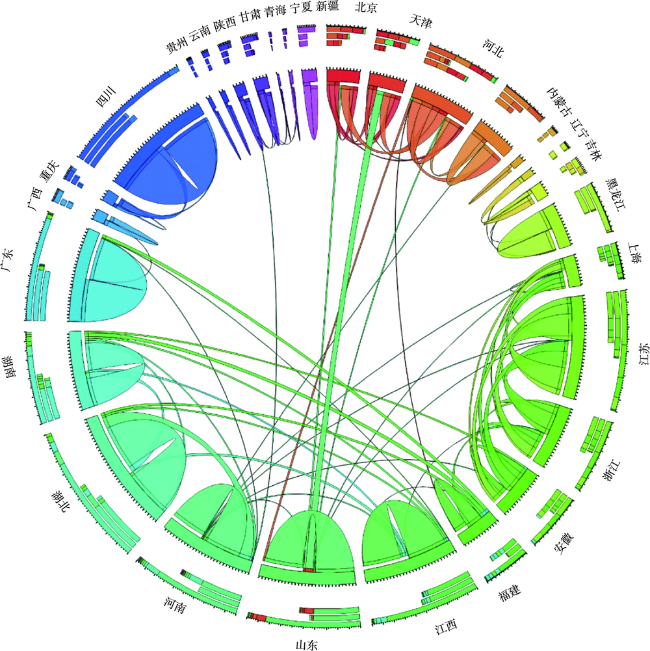
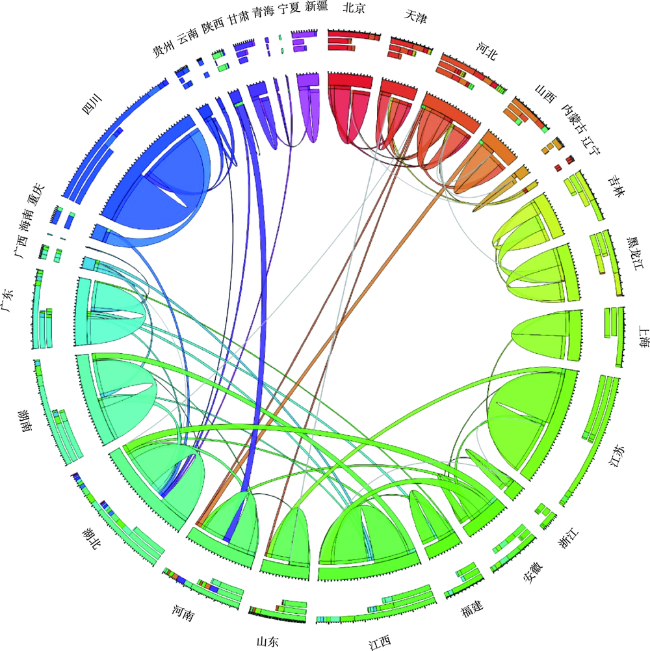
Cross-boundary flows of e-waste have been addressed in economic geography literature, reflecting the deep conflicts of values between environmental protection and resources recovery at the global scale. Based on the principle of extended producer responsibility, a division of activity between the informal sector and formal recycling plants has formed in China with the state subsidy to the latter to buy waste products collected by the former. Using the Wilson spatial interaction model, this study depicted the interprovincial flows of e-waste in China in 2014, and compared the estimation with the results from a survey on formal recycling plants. Both results show that around 1/3 of the e-waste flowing to the formal recycling plants came from interprovincial transportation, despite the government intention to plan a regional self-sufficient system for e-waste recycling at the provincial level. We discussed the reasons for the mismatch between the planned and the real spatial patterns of e-waste flows. In conclusion, we identified several implications from the experience of China for the global e-waste management.
TONG Xin , WANG Tao , CHEN Yanguang , SONG Xin , LUO Zhaoxuan , HUANG Huiting . Interregional flows of e-waste in China[J]. PROGRESS IN GEOGRAPHY, 2018 , 37(7) : 954 -962 . DOI: 10.18306/dlkxjz.2018.07.009
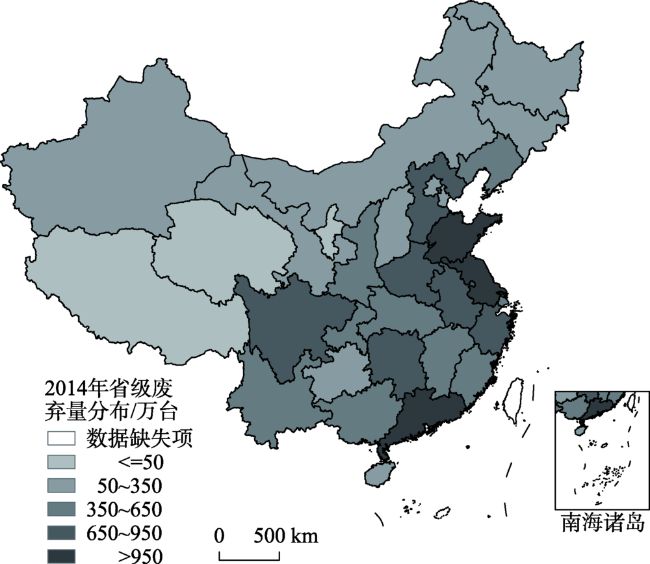
Fig.1 Spatial pattern of e-waste generation in China, 2014图1 2014年中国强制回收的五种废弃电器电子产品产生量的空间分布 |
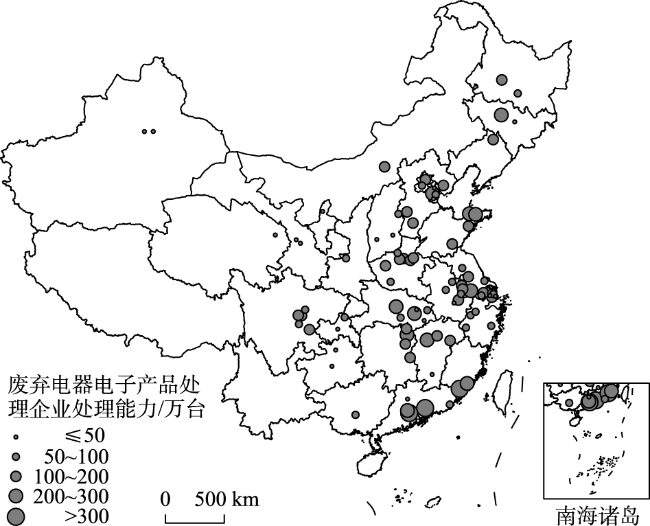
Fig.2 Spatial distribution of formal e-waste recycling capacity in China, 20142014年中国正规废弃电器电子产品处理能力空间分布 |
Fig. 3 Interprovincial flows of e-waste in China in 2014 estimated with the spatial interaction model图3 根据空间相互作用模型估算的中国2014年电子废物的省际流动状态 |
Fig.4 Interprovincial flows of e-waste in China in 2014 estimated by survey图4 根据问卷调查结果推算的中国2014年电子废物的省际流动状态 |
The authors have declared that no competing interests exist.
| [1] |
[
|
| [2] |
[
|
| [3] |
|
| [4] |
BCRC (
|
| [5] |
|
| [6] |
|
| [7] |
|
| [8] |
|
| [9] |
|
| [10] |
|
| [11] |
|
| [12] |
|
| [13] |
|
| [14] |
|
| [15] |
|
| [16] |
|
| [17] |
|
| [18] |
|
| [19] |
|
| [20] |
|
| [21] |
|
| [22] |
|
| [23] |
|
| [24] |
|
| [25] |
|
| [26] |
|
| [27] |
|
| [28] |
|
| [29] |
|
| [30] |
|
| [31] |
|
| [32] |
|
| [33] |
|
/
| 〈 |
|
〉 |