Comparison and application of NDVI time-series reconstruction methods at site scale on the Tibetan Plateau
Received date: 2017-04-12
Request revised date: 2017-11-08
Online published: 2018-03-28
Supported by
National Natural Science Foundation of China, No.41601478
National Key R&D Program of China, No. 2016YFC0500103
Science Technology Service Project of Chinese Academy of Sciences, No. KFJ-SW-STS-167
Copyright
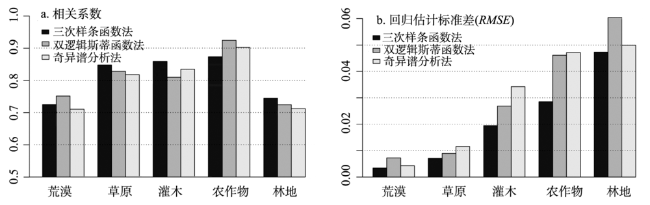
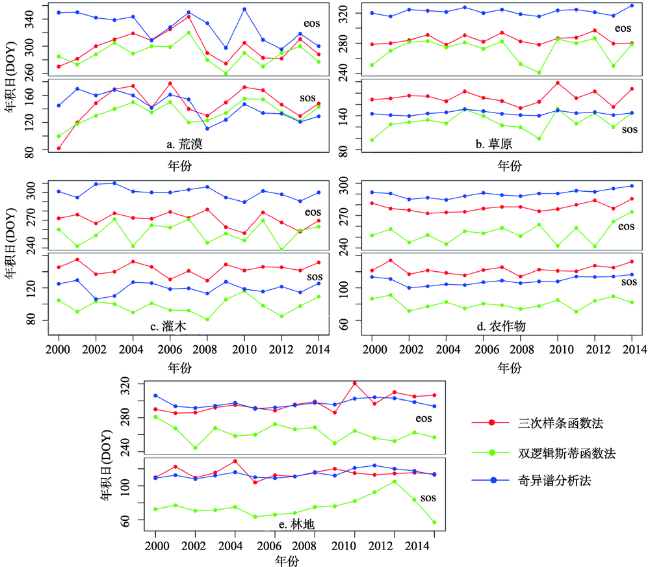
Vegetation index data based on satellite remote sensing have been widely applied in many fields such as vegetation monitoring and biomass estimation. However, the noise caused by the sensors, atmospheric conditions, and environmental factors affect the application of such data. Therefore, it is of practical significance to carry out research on the reconstruction of vegetation index. In this article, MODIS normalized differential vegetation index (NDVI) datasets of 106 meteorological stations on the Qinghai-Tibet Plateau with typical vegetation types, from 2000 to 2015, were reconstructed using three methods: cubic spline function (Spline), double logistic function (D-L), and singular spectrum analysis (SSA). Based on the results of phenological parameter extraction and NDVI time-series reconstruction, the ability of preserving the authenticity of the original data, detail fitting, and phenological character extraction of the three algorithms are compared and analyzed. The result suggests that there is no single method that performed the best for all types of vegetation, owing to the spatial heterogeneity of vegetation cover types and the varying denoising ability of the algorithms. D-L showed better performance for desert, shrubs, and woodland, which are heavily affected by random noise from snow and clouds, whereas for grassland and cropland, Spline had better performance. The fitting curves of SSA are below the D-L and Spline curves and the lower the NDVI value, the worse the reconstruction performance. With regard to maintaining the true values of the original data, Spline is superior to the D-L method for woodland, shrubs, and grassland, while the SSA is superior to the D-L function for woodland. The D-L method resulted in an earlier phenological period, Spline and SSA had a lagged outcome of the start of the growing season (SOS) and end of the growing season (EOS) respectively. Phenological index is unstable for shrubs and woodland and fluctuate irregularly for desert with all three methods, due to the low absolute value of NDVI. In addition, the phenology curve of spline is similar to that of SSA, and the SOS and EOS index derived from the D-L method is ahead of other methods for all vegetation cover types. The EOS extracted by the SSA method is larger than that by other methods for most of the vegetation cover types. This research could provide a reference for the selection of noise reduction methods for NDVI time-series data with different vegetation cover types in plateau vegetation.
LIU Jianwen , ZHOU Yuke . Comparison and application of NDVI time-series reconstruction methods at site scale on the Tibetan Plateau[J]. PROGRESS IN GEOGRAPHY, 2018 , 37(3) : 427 -437 . DOI: 10.18306/dlkxjz.2018.03.013
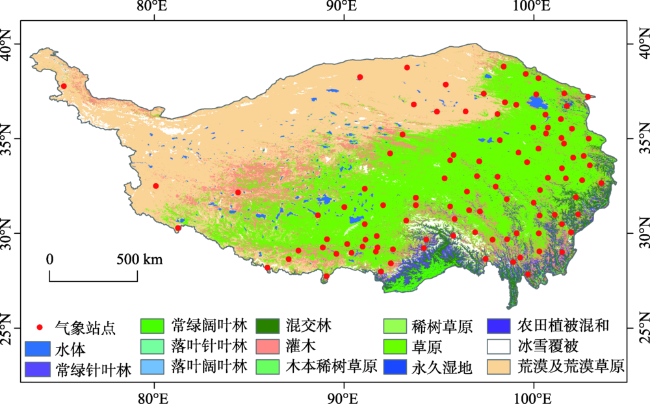
Fig.1 Spatial distribution of the meteorological stations and land cover types on the Tibetan Plateau图1 青藏高原气象观测站点及土地覆被类型分布图 |
Tab.1 IGCP land cover classification scheme and codes in the MCD12Q1 product表1 MCD12Q1产品土地分类方案及其代号 |
| 代码 | 0 | 1 | 2 | 3 | 4 | 5 | 6 | 7 | 8 |
|---|---|---|---|---|---|---|---|---|---|
| 类别 | 水体 | 常绿针叶林 | 常绿阔叶林 | 落叶针叶林 | 落叶阔叶林 | 混交林 | 封闭灌丛 | 开放灌丛 | 木本稀树草原 |
| 代码 | 9 | 10 | 11 | 12 | 13 | 14 | 15 | 16 | 254 |
| 类别 | 稀树草原 | 草原 | 永久湿地 | 农田 | 城镇与建设用地 | 农田/自然植被混合 | 冰雪覆被 | 荒漠及荒漠草原 | 未分类 |
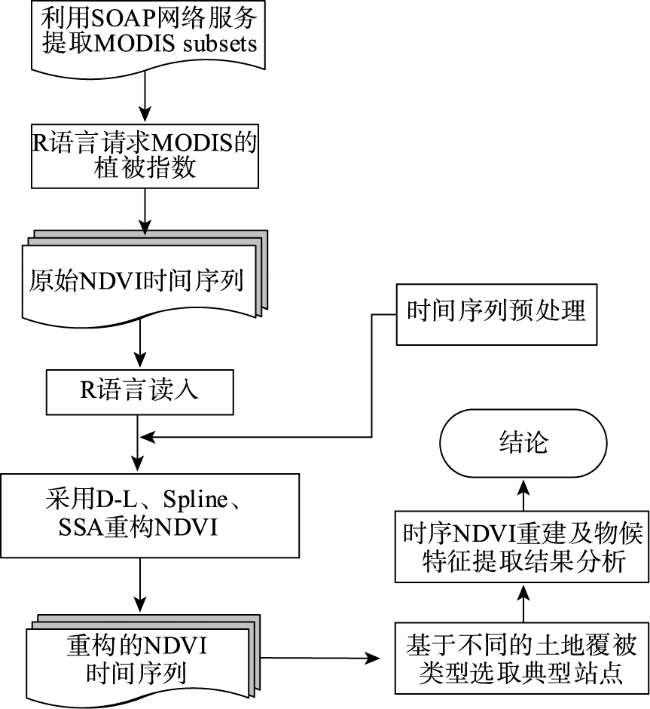
Fig.2 Flowchart for the comparison of time-series NDVI reconstruction methods图2 NDVI时序重构方法对比研究流程图 |
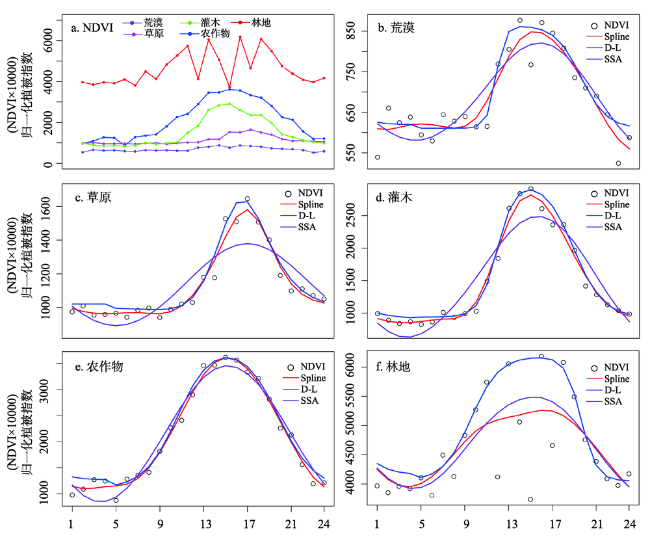
Fig.3 Comparison of the original and the reconstructed MODIS time-series NDVI图3 不同土地覆被类型NDVI时间序列重构曲线对比 |
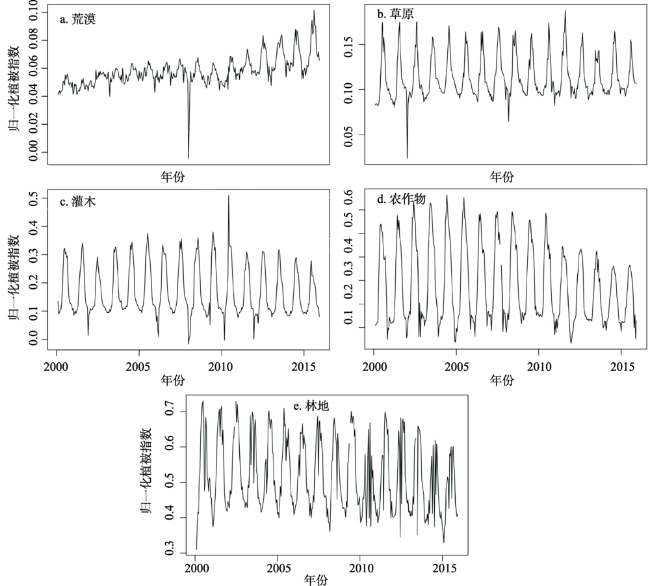
Fig.4 NDVI time-series curve of different land cover types, 2000-2015图4 2000-2015不同覆被类型的归一化植被指数(NDVI)时序曲线 |
Fig.5 Comparison of the ability of three time-series reconstruction methods on keeping the main characters of NDVI for different land cover types图5 不同覆被类型NDVI重构保真能力比较 |
Fig.6 The phenology parameters derived from three time-series reconstruction methods for different land cover types图6 3种方法不同植被类型的物候参数提取结果 |
The authors have declared that no competing interests exist.
| [1] |
[
|
| [2] |
[
|
| [3] |
[
|
| [4] |
[
|
| [5] |
[
|
| [6] |
[
|
| [7] |
[
|
| [8] |
[
|
| [9] |
[
|
| [10] |
[
|
| [11] |
|
| [12] |
|
| [13] |
|
| [14] |
|
| [15] |
|
| [16] |
|
| [17] |
|
| [18] |
|
| [19] |
|
| [20] |
|
| [21] |
|
| [22] |
|
| [23] |
|
/
| 〈 |
|
〉 |