





党的二十大报告指出,要“全面推进乡村振兴,巩固拓展脱贫攻坚成果”。2023年中央一号文件也强调,“坚决守住不发生规模性返贫底线”。返贫作为贫困治理中突出的社会现象,对全面提高人民生活水平和推动社会和谐发展具有阻碍作用[1]。随着中国脱贫攻坚战取得全面胜利,在“后脱贫时代”,中国贫困治理重点逐步转向防止规模性返贫[2]。在脱贫攻坚和乡村振兴阶段,乡村旅游发挥了积极作用,并且形成了不同的开发模式。但因其自身脆弱性[3]和外部条件等干扰,导致乡村旅游地脱贫农户存在一定返贫风险。不同的乡村旅游发展模式,其返贫风险有无差异,返贫风险因子有哪些,不同模式下的返贫阻断路径是什么?诊断不同发展模式下乡村旅游地农户的返贫风险程度和潜在返贫因子,提出有针对性的阻断路径,对促进乡村旅游可持续减贫、实现共同富裕具有重要的现实意义。
1 理论框架与指标体系
1.1 理论基础
防止规模性返贫、确保农户稳定脱贫是后脱贫时代亟待解决的重要问题,也是实现乡村振兴与共同富裕的重要基础。当前返贫问题主要集中在脱贫人口和边缘人口上,精准探索规模性返贫的成因、特征和类型是政府及学界高度关注的问题[4]。返贫是指已经脱贫的个体或区域呈现不彻底或不可持续的贫困退出,再次陷入贫困的动态过程[5]。返贫问题是阻碍区域稳定脱贫和可持续发展的重点问题[6]。返贫研究目前主要集中在返贫诱因、返贫风险和返贫治理等方面。返贫问题的出现可以归结为返贫者自身脆弱性[7]和自然社会环境脆弱性[8],同时不合理的分配机制和扶贫措施[9]也会加剧返贫问题。返贫风险的高低与脱贫时间的长短存在负向依赖关系[10],落后的思想观念和发展意识[7]、疾病和子女教育大额支出[11]、不合理的产业结构、恶劣的自然环境以及脱贫地区滞后的经济发展与贫困互为因果[12]。应对现有返贫现象,可采取构建返贫预警机制[13]或生态补偿式返贫治理模式[14]等措施进行防范。
乡村旅游作为众多欠发达地区脱贫致富的重要手段,已成为区域经济发展的支柱性产业[15]。由于旅游业自身特性,基础结构会受到包括乡村旅游地空间结构、资源禀赋、社区及宏观政策和需求市场等因素与条件影响,形成各具特色的发展模式、发展规律,并呈现不同的发展效果[16]。乡村经过长期的历史积累和发展探索,形成现阶段蕴含着当地农户生产生活行为习惯的发展模式。从乡村旅游发展动力角度来看,受乡村区位、资源等条件限制,其发展模式和特点可分为需求拉动型、供给推动型、中介影响型、支持作用型以及混合驱动型模式[17]。从旅游资源角度看,中国乡村旅游发展模式以城郊休闲游憩型、景区景点依托型、文化民俗旅游型、生态休闲农业型、特色产业主导型和特色资源开发型等为主[18]。中国脱贫地区多处于自然资源富集和生态脆弱叠加区域[19]。为充分发挥旅游扶贫效益,脱贫地区多由政府主导带动村企探索有限资源发展乡村旅游,依据当地综合环境和优质资源选择适宜发展模式[20]。旅游系统理论指出旅游活动本身就是一个综合性系统,旅游系统构建应充分考虑当地经济、社会、资源、环境等多方面的相互关系和协调发展[17]。从发展角度来看,旅游业发展主要依托于相应资源,以相关企业、旅游设施为基础,以旅游要素为核心、以旅游产业为主体[21]。依据联合国可持续发展委员会(UNCSD)提出的“驱动力—状态—响应(driving force-status-response,DSR)模型”[22],在脱贫攻坚与乡村振兴政策指导下,当地政府主导推动脱贫地区充分发掘当地内部异质性旅游资源[18]、民俗文化[23]等“推动力”,借助外部特色产业[24]、外来资本引入[25]等“拉动力”,激发推进乡村振兴。乡村发展需求的转变促使政府、社会和市场多方协调,根据“长板效应”,按照当地优质资源选择适宜发展模式。从驱动力[26]角度来看,脱贫地区乡村旅游发展模式可总结为:资源驱动型、产业推动型、文旅联动型及企业带动型,即“四动”模式(图1)。不同发展模式下农户参与、生计资本提升和生计能力改善程度具有差异[27]。因此,本文选取脱贫地区乡村旅游“四动”模式的典型村进行研究,对比分析不同发展模式下乡村返贫风险的影响差异。
图1
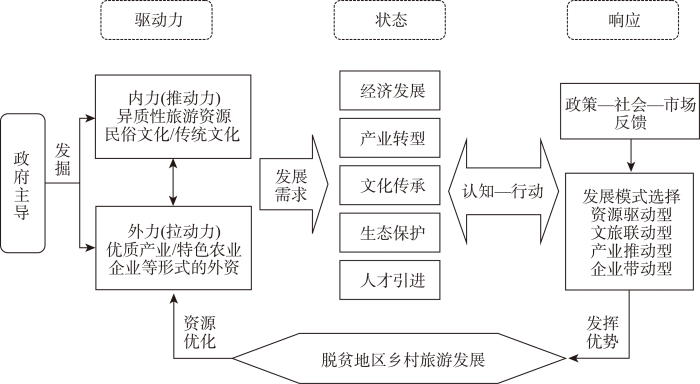
图1
脱贫地区乡村旅游差异化发展模式
Fig.1
Differentiated development model of rural tourism in poverty alleviation areas
脆弱性是贫困的典型特征,可持续生计作为一种探索农户生计脆弱性原因并予以解决的集成性分析框架[28],被广泛应用于返贫研究中。包括多维贫困理论[29]、农户脆弱性[30]、返贫风险[6]及脱贫稳定性的测度和评估[31]。脆弱性分析框架能有效衡量系统遭受外来影响的不利程度,可持续生计与之结合不仅能有效探索农户自身生计影响,而且可充分反映农户抵御脆弱性背景及生计风险的能力。农户返贫风险主要由脆弱的生计资本、外部环境冲击以及个体薄弱的适应能力组成。在脱贫攻坚政策的有效干预下,脱贫地区脆弱性环境得到一定改善。良好的政策条件促使生计背景正向影响生计资本的积累,进而增强农户适应能力以抵御外部环境冲击,形成良性循环,综合改善农户个体微观生存环境,实现稳定脱贫。乡村发展是一种综合性经济行为,各类发展模式相互融合促进。适宜的发展模式能有效发挥当地发展优势,促使当地获得更多政府、社会等内外部支持,提升农户生计资本和生计能力。不适宜的发展模式则会破坏农户内部生计闭环,导致生计资本和生存能力急剧下降,进而导致返贫(图2)。
图2
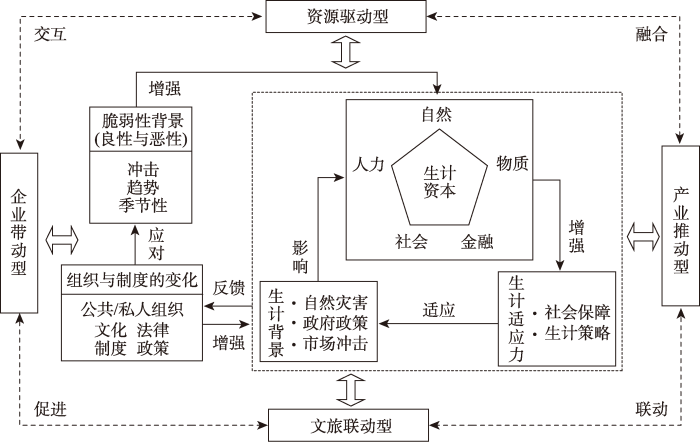
图2
乡村旅游地返贫风险逻辑框架
Fig.2
Analytical framework for the risk of rural tourism area returning to poverty
1.2 评价指标体系构建
农户返贫风险依赖于可持续生计水平、生计环境和农户自身生计能力。脆弱性生计背景的冲击和季节性等突发性影响因素会干扰农户的生活水平,进而影响到农户生计能力。而农户对生计环境的适应能力在面对外部冲击时即可发挥作用,通过获取社会保障或改变生计策略以稳固农户内生性生计资本,抵御外部冲击,以维持自身平衡,减弱返贫风险。拥有不同生计资本和社会保障的农户在面对风险冲击时的应对能力不同,潜在返贫风险也不同[32]。而旅游业在改善农户现有生计资本、重构乡村人地关系的同时也给农户带来一定程度生计风险,其影响程度取决于农户的适应能力[33]。因此,从外部冲击、自身生计能力及适应能力三方面综合衡量农户的返贫风险,能较为全面地反映农户的真实状况。基于可持续生计分析框架[34]和风险—适应框架,参考已有研究[32⇓-34],从突发性冲击、内部生计能力和保障措施3个维度构建乡村旅游地农户返贫风险指标体系,具体包含生计背景风险、人力资本风险、自然资本风险、物质资本风险、金融资本风险、社会资本风险和生计适应力风险等7个二级指标、21个三级指标。依据模糊层次分析法进行标准化,测算各指标权重,并进行一致性检验,计算结果如表1所示。
表1 乡村旅游地农户返贫风险评价指标体系及量化解释
Tab.1
| 目标 | 维度 | 权重 | 指标 | 指标解释、属性及赋值 | 权重 | |
|---|---|---|---|---|---|---|
| 乡村旅游地农户返贫风险 A | 突发性冲击 | 生计背景风险B1 | 0.1419 | 自然社会灾害C1 | 自然或社会导致财产损失程度(-):无影响=0,影响较小=0.25,影响一般=0.5,影响较大=0.75,影响严重=1 | 0.0644 |
| 政府政策C2 | (旅游扶贫、乡村振兴等)政策对农户家庭收入的影响程度(-):无影响=0,影响较小=0.25,影响一般=0.5,影响较大=0.75,影响严重=1 | 0.0323 | ||||
| 市场冲击C3 | 旅游淡旺季对农户家庭收入的影响程度(-):无影响=0,影响较小=0.25,影响一般=0.5,影响较大=0.75,影响严重=1 | 0.0452 | ||||
| 内生性生计能力 | 人力资本风险B2 | 0.1858 | 劳动力比重C4 | 家庭成年劳动力占总人口比例(+): C4<20%=0.2;20%≤ C4<40%=0.4;40%≤ C4<60%=0.6;60%≤ C4<80%=0.8;C4≥80%=1 | 0.0538 | |
| 受教育程度C5 | 家庭成员中最高受教育程度(+):小学=0,初中=0.25,高中=0.5,大专/本科=0.75,本科以上=1 | 0.0440 | ||||
| 劳动力质量C6 | 家庭成员总体健康状况(+):很差=0,较差=0.25,一般=0.5,较好=0.75,很好=1 | 0.0587 | ||||
| 劳动技能培训C7 | 每年接受技能培训次数(+):0次=0,1~2次=0.25,3~4次=0.5,5~6次=0.75,6次以上=1 | 0.0294 | ||||
| 自然资本风险B3 | 0.1087 | 耕地面积C8 | 农户实际耕种面积(亩)(+):不足1亩=0,1~3亩=0.25,3~5亩=0.5,5~7亩=0.75,7亩以上=1 | 0.0370 | ||
| 耕地质量C9 | 农户家庭实际耕地的总体质量(+):无=0,贫瘠=0.25,一般=0.5,比较肥沃=0.75,非常肥沃=1 | 0.0250 | ||||
| 家庭区位C10 | 距离公路、景区是否较近(取两者均值)(+):非常远=0,比较远=0.25,一般=0.5,比较近=0.75,非常近=1 | 0.0466 | ||||
| 物质资本风险B4 | 0.1601 | 住房结构C11 | 家庭住房最高类型(+):土坯房=0,一层平房=0.25,两层楼房=0.5,三层及以上楼房=0.75,别墅=1 | 0.0549 | ||
| 住房数量C12 | 家庭房屋套数(+):1套=0.25,2套农村自建房=0.5,农村1套,城镇1套=0.75,3套及以上=1 | 0.0707 | ||||
| 交通工具情况C13 | 家庭最高等级交通工具(+):机动三轮车=0,电动车=0.25,摩托车=0.5,面包车=0.75,小轿车或货车=1(若有多选,则按最高计) | 0.0345 | ||||
| 金融资本风险B5 | 0.1709 | 家庭总收入C14 | 家庭总体年收入(万元)(+):C14<3=0.25;3≤C14<6=0.5;6≤C14<10=0.75;C14≥10=1 | 0.0802 | ||
| 储蓄状况C15 | 家庭现有储蓄情况(万元)(+):C15<5=0.25;5≤C15<10=0.5;10≤C15<15=0.75;C15≥15=1 | 0.0564 | ||||
| 借贷机会C16 | 借贷款难易程度(+):非常困难=0,比较困难=0.25,一般=0.5,比较容易=0.75,非常容易=1 | 0.0343 | ||||
| 社会资本风险B6 | 0.0906 | 社会连接度C17 | 家庭成员中有无乡村干部或国家公职人员(+):无=0,有=1 | 0.0410 | ||
| 邻里信任关系C18 | 邻里关系(+):非常不融洽=0,不太融洽=0.25,一般=0.5,比较融洽=0.75,非常融洽=1 | 0.0215 | ||||
| 交流意愿C19 | 参加社区集体组织或活动意愿(+):非常不愿意=0,不太愿意=0.25,一般=0.5,比较愿意=0.75,非常愿意=1 | 0.0280 | ||||
| 保障措施 | 生计适应力风险B7 | 0.1419 | 政府社会保障C20 | 农户享受各项补贴种类数(如农业补贴、医疗保险、养老金等)(+):1种=0.25,2种=0.5,3种=0.75,3种以上=1 | 0.0601 | |
| 生计策略多样性C21 | 农户总生计策略种类数(+):单一生计=0.5,双重生计=0.75,多种生计(生计方式≥3)=1 | 0.0819 | ||||
注:括号内的“+”表示正向影响,“-”表示负向影响。
2 研究区域、数据与方法
2.1 研究区概况
湖北省恩施州地处鄂渝湘黔交界处,森林覆盖率近70%,年均气温16.2 ℃,年均降水量1600 mm。恩施州自然、人文旅游资源丰富,全州现有A级景区38个(截至2022年)①(①数据来源于
图3
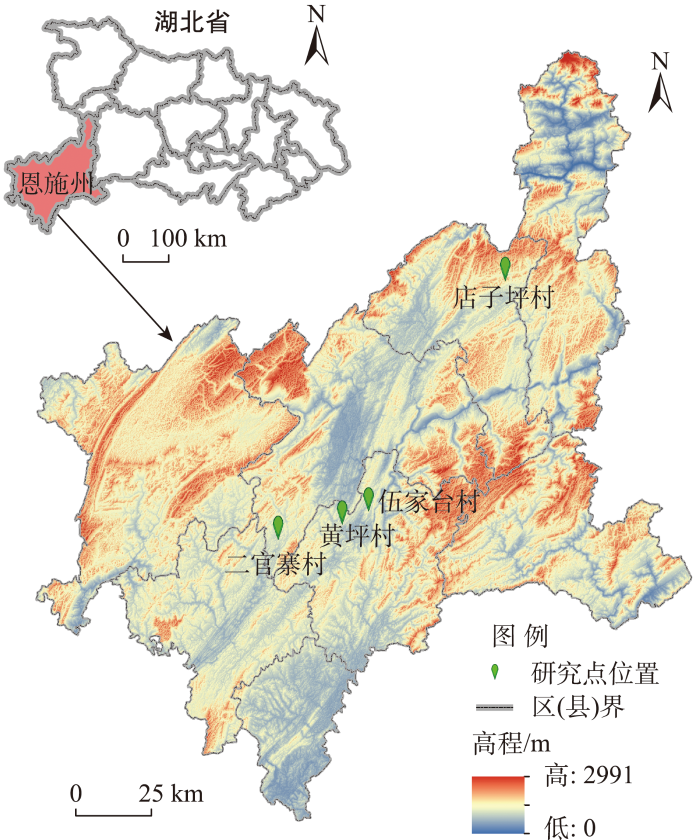
二官寨村位于恩施市盛家坝乡西北部,距盛家坝镇17 km,全村37.6 km2,平均海拔1000 m,总人口3020人,2019年人均年收入11084元。该村主要以土家族特色村寨和民族文化为依托,实行“文化+旅游”的发展模式。文旅融合促进了二官寨村土家老屋等民族文化资源的保护性开发,并利用特色民族文化资源带动乡村摆脱贫困,实现全面振兴,属文旅联动型乡村。
黄坪村南距宣恩县城10 km,北距恩施州33 km,209国道穿村而过,全村人口共2084人,面积约 12 km2,耕地面积285.4 hm2。在精准扶贫政策帮扶下,该村通过发展黄金梨产业,举办赏花节和采摘节,依托电商平台销售农产品,成功打造“沃地娃”黄金梨产业品牌。通过“产业+旅游”的发展模式,吸引年轻人回乡创业,投资建设阿尼阿兹特色民宿。特色产业推动了该村产业结构调整,激发了产业活力,提升了乡村旅游可持续发展能力,属典型的产业推动型。
伍家台村位于宣恩县贡茶产业经济带的核心区,距县城17 km,全村共有国土面积8.5 km2,总人口2020人。该村富有含硒量高的沙性土壤、温和湿润的气候为茶叶种植提供优良条件,建有4A级贡茶文化旅游区。成立“伍家台昌臣茶业有限公司”,依托“公司+合作社+农户”的发展模式,带动贫困户种植茶叶,拓宽茶叶销售渠道,参与乡村旅游,属企业带动型。
店子坪村位于建始县龙坪乡西南边缘,距龙坪乡28 km,平均海拔1200 m。村内辖7个村民小组,总人口686人,全村耕地面积47.67 hm2。该村地理位置偏僻、交通闭塞,经济发展落后,基础条件差,2014年贫困发生率在50%以上。2005年,“愚公支书”王光国带领村民绝壁凿路,开通了该村与外界的联系。近年来,依托“当代愚公”红色文化,以传承弘扬“愚公移山”精神和“新时代奋斗精神”为教学主线,建成红色教育基地,开展集党性教育、主题学习、培训研学、文旅康养、休闲旅居于一体的红色乡村旅游教育活动,乡村旅游脱贫成效显著,该村属典型的特色资源驱动型乡村。
2.2 数据来源
本文数据主要来源于资料收集、问卷调查和半结构化访谈。根据已构建的乡村旅游地农户返贫风险评价体系,结合当地经济和文化发展背景,参考已有研究[4],设计调查问卷,并于2021年4月27—28日对案例地进行预调研,依据信效度检验结果进一步修改完善问卷内容,形成最终调研问卷。调研团队于2021年5月9—16日前往4个案例地开展调研。首先,通过区(县)文旅局、发改局、村委会、当地景区及旅游公司等有关部门了解案例村旅游扶贫、乡村旅游产业发展以及居民生计等基本信息,共获取有效访谈录音时长12 h。其次,采取参与式农村评估法(participatory rural appraisal,PRA)一对一与农户进行问卷调查,户主为主要被调查人,其他成员辅助回答,依据问卷与农户进行开放式对话,初步了解农户返贫风险状况,每户访谈时间为0.5~1 h,后期整理有效访谈记录8万余字。调研过程先对4个村落按照“组—户”进行分层抽样,再随机进行访问,确保问卷代表性。因本次调研以农户家庭为单位,且受案例地容量限制,本次实地调研共发放 200份访谈问卷,收回有效问卷170份,问卷有效率85%。问卷访谈包括2个部分:(1) 受访农户基本情况;(2) 农户家庭生计、自然灾害和市场等外部条件所带来的影响以及政府的帮扶措施等。
2.3 研究方法
(1) 模糊层次分析法
模糊层次分析法(FAHP)是美国运筹学家Saaty教授[36]于20世纪70年代提出的定性与定量相结合的系统分析方法。FAHP对同一层次(等级)的要素以上一级的要素为准则进行两两比较时,根据评定尺度确定两两指标间的相对重要性程度,据此建立模糊判断矩阵,能较好地保留数据的原始性和真实性。FAHP一般采用0.1~0.9分制标度法,邀请旅游管理与经济学的7位专家对评价因素两两之间的重要程度比较后进行打分,由此得到指标两两比较后的模糊判断矩阵S。将评价指标体系中负向指标进行逆向化处理后,根据式(1)对模糊判断矩阵的权重进行计算,汇集全部指标权重可得权重矩阵W。
式中:
(2) 模糊综合评价
模糊综合评价法(FCE)是一种基于模糊数学的隶属度理论,把定性评价转化为科学合理定量评价的综合评价方法[37]。采用FCE计算出乡村旅游地农户返贫风险的综合评价值,以及影响不同发展模式下各村农户返贫风险的最大风险因素,提出针对性的解决路径,化解乡村旅游地农户潜在返贫风险。
依据可持续生计评价指标集设置构建准则层评价因素集
式中:
3 结果分析
3.1 农户返贫风险总体评价
表2 乡村旅游地农户返贫风险评价结果
Tab.2
| 判断矩阵 | 隶属向量 | |||||
|---|---|---|---|---|---|---|
| V1 (高) | V2 (较高) | V3 (一般) | V4 (较低) | V5 (低) | 评价结果 | |
| 生计背景风险B1 | 0.0535 | 0.2959 | 0.2425 | 0.3348 | 0.0733 | 2.9215 |
| 人力资本风险B2 | 0.1311 | 0.1977 | 0.2236 | 0.2184 | 0.2292 | 2.7831 |
| 自然资本风险B3 | 0.1481 | 0.1620 | 0.2679 | 0.2125 | 0.2095 | 2.8267 |
| 物质资本风险B4 | 0.1369 | 0.3599 | 0.2439 | 0.1522 | 0.1071 | 3.2673 |
| 金融资本风险B5 | 0.0319 | 0.3420 | 0.3027 | 0.2092 | 0.1141 | 2.9684 |
| 社会资本风险B6 | 0.3386 | 0.0351 | 0.0674 | 0.1996 | 0.3592 | 2.7941 |
| 生计适应力风险B7 | 0 | 0.0398 | 0.3803 | 0.4127 | 0.1672 | 2.2928 |
| 农户总体返贫风险A | 0.1061 | 0.2213 | 0.2560 | 0.2480 | 0.1687 | 2.8181 |
物质资本风险排在第一位。在精准扶贫政策的大力扶持下,案例地物质条件得到较大改善,农户住房质量和交通条件明显提升,但因山区相对闭塞的自然环境和较难改善的交通条件,当前农户物质资本仍处于较低水平,有25.88%的农户仍住在老房内。出行工具以电动车或摩托车为主,仅基本解决出行和农业运输问题,大多数农户没有足够的物质资本来增加生计手段,存在一定返贫风险。在乡村振兴阶段,应延续脱贫攻坚的相关政策,持续改进当地物质资本水平,助力当地持续稳定脱贫。
金融资本风险排名第二,按最大隶属度原则处于较高风险水平。金融资本是农户抵御外界冲击、稳定脱贫状态的有效应急手段,较高水平的金融资本风险表明案例地农户的储蓄水平较低、借贷难度较大,在面临突发事件时极易出现返贫现象。调研发现,恩施州乡村旅游地农户的家庭年收入普遍不高,多在3万~6万元之间,且56.47%的农户家庭储蓄水平在5万元以下。在借贷方面,当地借贷政策多倾斜于脱贫户,普通农户普遍存在借贷难、机会少、限制多等问题,旅游相关金融扶持政策较为有限,一定程度上阻断了农户拓宽生计手段的途径。
生计背景风险、自然资本风险和社会资本风险均处于较低水平。调研发现,有65.29%的农户认为,自然、社会灾害对家庭收入额的损失不大,当地农户表示,“近几年较少发生严重自然灾害”。但旅游淡旺季以及乡村旅游发展不均衡严重影响到家庭收入,农户生计手段较少。在自然资本方面,恩施州特殊地形和旅游业的发展导致当地农户实际耕地面积和耕地质量都处于较低水平,农业发展条件受限。58.23%的农户认为在精准扶贫和农村“四好公路”政策扶持下,乡村公路等基础设施得到改善,但乡村旅游地内部道路不利大型客车和旅游团的出入,限制了当地乡村旅游的发展。在社会资本方面,案例地在政府大力扶持下得到较多社会保障,社会网络支持度得到较大提升。但从整体分布来看,低度风险水平(0.3592)和高度风险水平(0.3386)均占据较大比例,两极分化严重,说明相关福利政策偏向部分人群,其他农户对扶贫政策知晓度较低,政策收益差异明显。案例地农户信息获取渠道较少,多数农村地区以亲缘关系为主,导致案例地社会连接度还有待进一步提升。
农户人力资本风险处于低度水平,在各维度中排名第六。恩施州属于武陵山原国家级集中连片特困地区,是精准扶贫的重点区域,在医疗保障、家庭教育、技能培训等方面得到政策支持,当地农户的人力资本水平得到有效提升,返贫风险较小。但恩施州乡村旅游地人才流失严重,大多知识型人才未参与本地乡村旅游发展,可持续能力不足;52.35%的农户表示并未受到技能培训,多数培训仅惠及原贫困户,普通农户受益较少。因此,应重视人才引进和人才培养,将返贫风险的防治范围拓展至全体农户。
生计适应力风险反映农户应对外部冲击的主观能动性和适应能力,排在最后,说明在国家精准扶贫政策和当地政府的有效落实下,农户能获得的社会保障制度较多,生计策略多样,增加农户收入来源的同时,也增强了其抵御外界风险能力。部分农户在政府带动下积极参与乡村旅游,选择自主创业经营农家乐、民宿、特产店等,或在附近景区就职以增加生计手段和获得稳定收入来源,有效提升了其生计适应能力。
3.2 差异化发展模式下乡村旅游地返贫风险对比
根据式(3)和式(4)计算出4个案例村的返贫风险综合评价结果(图4)。案例地返贫风险由高到低分别为店子坪村(2.9436)>伍家台村(2.9205)>黄坪村(2.7449)>二官寨村(2.7433)。
图4
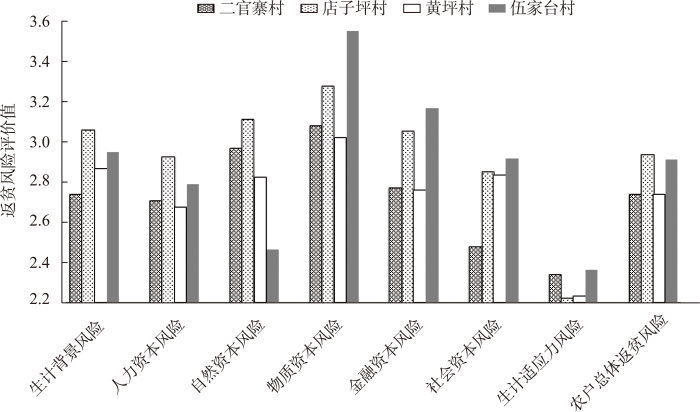
图4
不同发展模式下乡村旅游地返贫风险对比
Fig.4
Comparison of the risk of rural tourism areas returning to poverty under different development model
二官寨村农户总体返贫风险得分最低,在各村中返贫风险最小。各维度风险指数波动较小,介于2.3~3.1之间,其中物质资本风险最大,生计适应力风险最低,与农户整体返贫风险特征一致。村内注重民居保护,人居环境和乡风文明水平较高,返贫风险最小。在4个案例村中,二官寨村的生计背景风险和社会资本风险均为最低,原因在于二官寨村特色文化旅游资源保护较好,具有发展乡村旅游的优越条件,抵御外部冲击的能力较强。其次,该村村干部积极带动村民利用民居打造旅游景点,积极召开村级会议以传播政策信息,拓宽农户信息获取渠道和生计手段。受地理区位影响,该村耕地数量和质量欠佳,村内种植业以茶叶和烟叶为主,经济作物较少,同时因地处山区腹地,农副产品销售和出行条件受限,自然资本风险相对较高。
黄坪村整体返贫风险较低,其中人力资本风险和物质资本风险均低于其他案例村。黄坪村是恩施州政府定点帮扶村,政策倾斜和金融支持较多,政府兜底保证农产品的销售,为农户种植黄金梨解决后顾之忧。稳扎稳打的产业推动模式使得该村受疫情影响较小,生计适应力风险也相对较低。但从整体来看,该村还存在一定社会资本风险,究其原因是该村社会关系网络连接度较低,村集体权力较为集中,村民自治程度不高。
伍家台村存在一定返贫风险。伍家台村自然资本风险显著低于其他发展模式的案例村。该村依托茶园及深厚的贡茶文化着力打造万亩生态茶园,全力推进茶文旅融合,为当地农户提供多样化就业渠道,因此,自然资本风险及生计适应力风险较低。但该村企业市场化运营和收益分红机制给予边缘农户的让利较少,其物质资本积累较慢,村内居民收入两极分化明显,金融贷款、扶贫政策等信息覆盖面不足,金融资本及社会资本风险均高于其他案例村。
店子坪村返贫风险最高。生计背景风险、人力资本风险和自然资本风险高于其他案例村。政府的重点扶持给予当地农户多项扶持政策和金融支持,改善了交通条件。但村内产业较少,以种植辣椒等传统农业为主,产业融合度不高,且囿于其自然环境和基础条件的限制,其生计背景和自然资本仍弱于其他乡村旅游地。村内常住人口以中老年为主,偏僻的地理区位导致人才流失,劳动力不足,人力资本风险较高。
3.3 返贫风险阻断路径
从整体来看,案例地返贫风险主要集中在物质资本、金融资本和生计背景方面。物质资本风险主要来源于偏远的地理区位及闭塞的交通条件,政府应加大投入,积极完善县域和乡镇道路,构建“点—线—面”旅游交通网络,拓宽农产品外销渠道,促进旅游业和特色农业发展;多方筹措资金以提升基础设施建设水平,出台优惠政策鼓励旅游相关产业共筹共建,综合提升旅游服务品质。金融资本方面,针对当地家庭收入不高、金融渠道不健全等问题,政府需联合金融机构为农户制定差异化贷款政策,设置专项贷款项目,如农业种植、旅游经营和教育基金等;协同金融机构定期开展金融知识和相关政策宣讲,提高农户金融借贷意识,切实做到金融惠农。生计背景风险主要体现在旅游业的季节性和基础设施不全等方面,政府应重点关注产业融合发展,延伸产业链,鼓励农户积极参与非农技术培训以增加生计手段,多元提升抗风险能力,减轻市场风险等对农户的经济影响;引入外来资本加大基础设施建设,整体改善当地人居环境(图5)。
图5
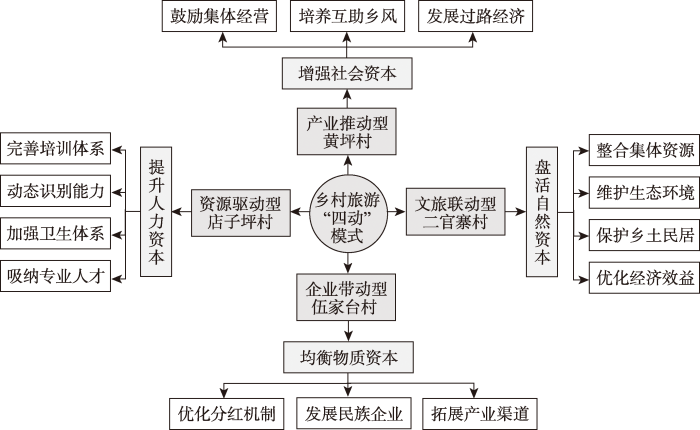
图5
乡村旅游地差异性返贫风险阻断路径
Fig.5
Different blocking pathways for the risk of returning to poverty in rural tourism areas
文旅联动型的二官寨村,在自然环境影响下其产业发展动力不足,政府和村集体应有效整合土地、山林、水域等集体资源,鼓励多方租赁经营自然资源,发展特色农业,扩大农业经营规模和效益,提高自然资本的利用效率和价值;维护好乡村旅游地水土保持、生态涵养、生物多样性等生态资源,保护好传统民居的自然风貌,增强自然资本的可再生能力,保证自然资本的可持续利用,深化旅游资源的经济功能。
产业推动型的黄坪村在金融和物质资本方面有较大提升,但受村内管理模式的限制,社会资本风险较高,当地居民自主权和知情权还有待提升。对此,村集体应成立互助合作社,鼓励多方参与,进一步扩大农户社会连接度,提高政府专项计划、乡村旅游等扶持政策对农户的普及度;培养互帮互助的文化风尚,通过教育普及提高村民文化素养,鼓励农户自主进行经济互助和技术交流,联合发展充分挖掘同质性社会资本的潜在价值。发挥区位优势,联结周边景区打造特色旅游线路,发展“过路”经济,以“他山之石”带动当地服务业、农业等产业融合发展。
企业带动型的伍家台村物质和金融资本风险两极分化明显,金融渠道和社会连接度等风险因素突出,村集体应优化企业分红机制,鼓励扶贫产业积极积极利用农户固定资产并增加投资回报率;优先录用边缘人口以增加就业机会,共享政策信息、打破信息壁垒,共同发展民族企业。鼓励农户团结协作组建合作社,纵向拓展现有产业结构,以先富带动边缘人口拓展生计渠道,融合电商、智慧化等现代技术发展高端特色农业,拓展农产品销售渠道。
以红色旅游资源驱动的店子坪村,应重点提升其人力资本,从数量和质量等方面提升农户发展的内生动力。政府应积极完善农户技能培训体系,充分了解农户需求,联合高校定期为当地农户提供针对性的培训课程,内部实行一对一帮扶机制,有效提升农户生计能力和内驱动力。加强对当地农户生计资本和发展动力的动态识别,及时调整低保等政策的辐射对象,保证政策的实用性和“造血功能”。提高农户身体保健意识,加强公共卫生体系建设,定期组织义务体检,提升劳动力质量。有效调节产业结构以适应当地人口比例,边培育边吸纳专业人才回乡就业,扩充产业发展的后备力量。
4 结论与讨论
本文对4个不同旅游发展模式的乡村农户返贫风险进行了多层次实证分析,对返贫风险程度和潜在返贫风险因子进行了识别,对比分析了不同模式下农户返贫风险的主要维度,并据此提出差异化阻断路径。主要结论如下:
(1) 案例地农户返贫风险值为2.8181,属一般水平,存在一定返贫风险。各维度间差异明显,物质资本风险和金融资本风险较高,人力资本风险和生计适应力风险最低,农户的内生发展动力和抵御外部冲击的能力较好。
(2) 从各乡村旅游地来看,不同乡村旅游发展模式的潜在返贫风险因子总体特征基本相同,但彼此间各风险水平值差异显著。文旅联动型的二官寨村自然资本风险较高,第一产业发展受限;资源驱动型的店子坪村具有较高生计背景和自然资本风险,劳动力数量和质量不足导致乡村可持续发展能力较低;产业推动型的黄坪村社会资本风险较高,村民自治水平不够;企业带动型的伍家台村在物质、金融资本方面两极分化严重,物质资本和金融资本风险最高。
(3) 根据案例地生计水平和返贫风险规律,依照差异化原则,针对“四动”模式的乡村旅游地返贫风险因子提出阻断路径,从充分利用和保护当地资源、优化经济效益方面降低文旅联动型乡村的自然资本风险;以鼓励农户自主经营、村民自治等为主阻断产业推动型乡村的社会资本风险;通过积极培训、吸纳人才等手段缓解资源驱动型乡村人力资本匮乏问题;以优化分红机制、增加市场主体等提升企业带动型乡村农户参与程度、削弱物质资本风险。整体上应重点防范脱贫人口和边缘人口,充分发挥资源、产业和企业的发展优势,全面提升农户脱贫稳定性。
防止返贫是已脱贫地区实现乡村振兴及共同富裕的重要任务,有效识别农户返贫风险、及时采取阻断措施是摆脱“扶贫—脱贫—返贫”恶性循环、巩固脱贫攻坚成果的重要手段[7,39]。因此,本文从驱动因素出发,总结归纳提出乡村旅游扶贫开发的“四动”模式,从农户内部生计条件和外部生计环境两方面综合衡量农户返贫风险,针对不同模式下旅游返贫风险因子的差异,提出差异化模式下乡村旅游地返贫的阻断路径,对脱贫地区实现乡村振兴具有一定的决策价值。引入可持续生计理论和风险—适应框架构建乡村旅游地农户返贫风险评价指标体系,较其他评价体系更为全面真实,更能有效反映农户真实现状,提高政府对脱贫地区农户生活现状的认识,在一定程度上也丰富了旅游返贫的研究。但此次调研数据仅能代表截面时间案例地农户返贫风险状况。为长期稳定脱贫攻坚成果,案例地还应建立返贫预警机制,对农户潜在返贫风险因子进行动态监测,包括自然灾害、农户生活质量、生计、人口变动等,以便及时采取措施阻断返贫路径。同时,本文发现脱贫户较边缘人口更易获得政策、金融等的扶持,生计策略较为丰富,而边缘人口的返贫风险更高,后续还需针对扶贫政策的动态管理和普及范围进行深入研究。
乡村旅游地农户返贫是一个动态问题,该调研是在疫情防控时期入户进行,因受地理环境、人力、经费及疫情防控措施等限制,本文主要选取了2021年案例地农户生活状况进行调研,收集到的访谈对象数量也较有限,缺乏多样化的数据进行纵向对比分析。后续研究将增加调研的时间跨度以及样本类型的丰富度,以期提高研究成果的普适性,为实现稳定脱贫及乡村振兴提供更加丰富的研究成果。
参考文献
秦巴山区村域稳定脱贫测度及返贫防控风险识别: 以重庆市城口县为例
[J].
DOI:10.18306/dlkxjz.2021.02.005
[本文引用: 1]

深度贫困地区农村实现稳定脱贫、建立返贫防控机制是后2020时代的现实要求,更是精准扶贫与乡村振兴承上启下的紧密衔接。以强度生态脆弱与集中连片特困复合地区重庆市城口县为研究区域,基于脱贫稳定性测度模型、障碍度模型和最小方差模型等方法对城口县60个行政村、1950个农户进行多维脱贫稳定性空间分异特征和返贫风险模式探究。研究发现:① 样本村脱贫稳定性等级分布总体呈现前端窄小、中部突出的“葫芦状”结构,各地区多维脱贫稳定性总体不高且存在空间异质性;② 城口县返贫风险可识别为双风险模式、三风险模式、四风险模式和五风险模式4种模式及各阻力因素多元整合主导的11种返贫风险类型,人力资本、发展机会等涉及农户可持续增收、动态抗风险能力及内生动力的要素逐渐成为现阶段返贫防控及减贫路径依赖的重点;③ 立足区域特征,把继续攻坚和稳定脱贫、防止返贫摆在同等重要位置上,因村施策提高群众抗风险能力,精准织密防止脱贫群体的返贫网。
Measurement of rural poverty alleviation sustainability and return-to-poverty risk identification in Qinling-Bashan Mountains: A case study of Chengkou County, Chongqing Municipality
DOI:10.18306/dlkxjz.2021.02.005
[本文引用: 1]
Achieving sustainable poverty alleviation and establishing a prevention and control mechanism for return-to-poverty in extreme poverty rural areas is a realistic requirement in the post-2020 era. It is also a key link between precision poverty alleviation and rural revitalization. Taking Chengkou County of Chongqing Municipality—an area of strong ecological fragility and concentrated continuous poverty—as the research area, and based on the poverty alleviation sustainability measurement model, obstacle degree model, and minimum variance model, this study explored the spatial differentiation of multidimensional poverty alleviation sustainability and the return-to-poverty risk models for 60 villages and 1950 farming households in the area. The study found that: 1) The sample villages' poverty alleviation sustainability distribution generally showed a "gourd-like" structure where the front end is narrow and the middle part protrudes. The multidimensional poverty alleviation sustainability in the area is generally low and of different degrees. 2) The return-to-poverty risk in Chengkou County can be divided into four models and 11 types, dominated by diversified integration of various resistance factors. Human capital, development opportunities, and other factors related to sustainable income growth, dynamic anti-risk capability, and endogenous drives of farmers have gradually become the focus of poverty reduction and control of return-to-poverty at this stage. 3) Local governments should give equal priority to alleviating poverty, improving the sustainability of poverty alleviation, and preventing return-to-poverty. At the same time, improve people's ability to resist risks and develop a network for preventing return-to-poverty of vulnerable groups with specific policy in each village.
精准扶贫背景下建档立卡脱贫户增收效果评估
[J].
DOI:10.18402/resci.2022.09.12
[本文引用: 1]
衡量精准扶贫政策实施效果,评估脱贫效果稳定性对“十四五”期间巩固脱贫攻坚成果有重要意义。本文基于2013—2020年四川省广元市3个县的精准扶贫数据库,采用事件研究法和倾向得分匹配-双重差分法评估了建档立卡户脱贫前后收入变化情况,并按来源分类对收入展开分析,探究收入增长的可持续性。研究发现:①贫困户的家庭收入水平在脱贫前一年迅速提升,脱贫后的收入总体保持平稳。其中工资性收入的提高最显著且具有可持续性,这主要源于当地“造血式”扶贫措施,包括推动就近务工和东西部就业扶贫协作、发展农业产业园区提供灵活就业机会等。②围绕不同的致贫原因进行异质性分析,发现因病、因残和因缺技术致贫家庭的工资性收入均在脱贫后得到了显著提升。因残疾和因缺技术而致贫的家庭的工资性收入在脱贫后得到了显著提升。本文的研究为评估脱贫动态效果提供了实证依据,对巩固脱贫攻坚成果、解决相对贫困问题具有重要的参考价值。
Income-increasing effects of registered poor households in the context of targeted poverty alleviation
DOI:10.18402/resci.2022.09.12
[本文引用: 1]
Based on the targeted poverty alleviation database of three counties in Guangyuan City of Sichuan Province, this study used the event study and the propensity score matching-difference in differences (PSM-DID) approach to evaluate the medium- and long-term income of the registered poor households after they are lifted out of poverty. We also combined field research to evaluate different types of poverty alleviation to analyze whether the income growth is sustainable. The study found that the household income level of poor households increased rapidly just before they were out of poverty, and the overall income remained stable after the poverty alleviation. The increase in wage income was the most significant and sustainable, which is mainly due to the local “hematopoietic” poverty alleviation measures, including the promotion of home area employment and the employment poverty alleviation cooperation between the eastern and the western regions, and the development of agricultural industrial parks to provide flexible employment opportunities. This study also conducted heterogeneity analysis around different causes of poverty, and we found that the wage income of families impoverished due to disability and lack of skills has been significantly improved after poverty alleviation, because the local governments provide flexible public welfare jobs for the disabled and targeted skills training for families lacking skills. This research provides an empirical support for evaluating the dynamic effect of targeted poverty alleviation policy, and has important reference value for consolidating the achievements of poverty alleviation and solving the problem of relative poverty.
巩固拓展脱贫攻坚成果同乡村振兴有效衔接的长效机制与政策研究
[J].
The long-term mechanism and strategy of the effective transition from consolidating and expanding the achievements of poverty alleviation to rural revitalization
规模性返贫风险因素、类型及其政策启示: 基于西南民族地区的调查
[J].
Risk factors, types and policy implications of large-scale poverty returning: Research based on the survey in southwest minority areas
The Livelihood Vulnerability Index: A pragmatic approach to assessing risks from climate variability and change: A case study in Mozambique
[J].DOI:10.1016/j.gloenvcha.2008.11.002 URL [本文引用: 1]
乡村旅游地农户返贫风险的识别与评估: 以恩施州为例
[J].
Identification and assessment of the poverty-returning risks facing households in rural tourism sites: A case study of Enshi Tujia and Miao Autonomous Prefecture of Hubei Province
返贫预警机制构建探究
[J].
Exploring the construction of the early-warning mechanism for returning to poverty
对返贫现象的一个分析
[J].
An analysis of the phenomenon of falling back into poverty
对返贫现象的社会学考察
[J].
Sociological investigation of the phenomenon of falling back into poverty
Non-parametric analysis of poverty duration using repeated cross section: An application for Peru
[J].DOI:10.1080/00036846.2016.1234696 URL [本文引用: 1]
建立返贫风险预警机制化解返贫风险
[J].
Establish an early warning mechanism for the risk of falling back into poverty to resolve the risk of falling back into poverty
乡村产业发展对农户生计的影响研究: 以宁夏红寺堡区为例
[J].
DOI:10.18306/dlkxjz.2021.05.006
[本文引用: 1]
梳理产业选择与培育的经验,分析产业发展对农户生计的影响,对于促进生态移民区的乡村产业振兴、农户生计恢复与可持续发展具有重要意义。论文以中国最大单体移民迁入区宁夏吴忠市红寺堡区为研究区,针对4大乡村产业各选1个样本村,采用问卷调查法和半结构访谈法获取数据,在比较不同产业投入产出效益的基础上,探究不同产业发展对移民生计产出、生计资本及生计策略的影响。结果表明:① 红寺堡区的乡村产业已呈现出由传统粗放型向高效集约型转型的特征,但产业链短、抵御市场风险和灾害能力偏低的问题仍然突出;② 乡村产业发展对农户收入有明显的提升作用,但影响程度与产业类型、农户参与度密切相关,已完成产业转型的农户的生计资本总量远高于其他农户,生计资本结构存在明显差异;③ 不同产业村的农户优势生计模式差异明显,产业发展对农户生计的支撑力度仍有待提高。乡村振兴背景下,亟待培育新型经营主体,引导小农户与现代农业产业有机衔接,推动农户深度融入乡村产业链并长效受益,全面释放乡村产业多元化的功能;同时,继续对存在产业转型困难的农户,通过资金扶持、技术培训、托管代养等不同形式开展针对帮扶,帮助其建立可持续生计体系。
Impact of agriculture industrial development on farmers' livelihood: Based on the research of four migrant villages in Hongsibu District, Ningxia
DOI:10.18306/dlkxjz.2021.05.006
[本文引用: 1]
Industrial development is not only the basis of rural revitalization, but also an important breakthrough point to increase farmers' income and rural prosperity. Industrial development and farmers' livelihood depend on and influence each other, and the mechanism of influence is very complex. Examining the experience of agriculture industrial development in the area of ecological migration and analyze the impact of industrial development on farmers' livelihood is of great significance for promoting the revival of rural industry, the restoration of farmers' livelihood, and the sustainable development in the area. This study took Hongsibu District of Ningxia Hui Autonomous Region, the largest single immigrant area in China, as the study area, selected one village for each of the major rural industries, and used data from a questionnaire survey and semistructured interviews to examine the impact of agricultural industries on farmers' livelihood. On the basis of comparing the input-output of different industries, the impact of industrial development on farmers' livelihood output, livelihood capital, and livelihood strategy was explored. The results show that: 1) The agricultural industries in Hongsibu District has shown the characteristics of transformation from traditional extensive to high efficiency intensive agriculture, but the problems of short industrial chain and low ability to resist market risks and natural hazards and disasters are still outstanding. 2) Agriculture industrial development has an obvious effect on improving farmers' income, but the degree of influence is closely related to industrial types and farmers' participation. The total livelihood capital of farmers who have completed agriculture industrial transformation is much higher than that of other farmers, and there are obvious differences in livelihood capital structure. 3) The dominant livelihood modes of farmers in different specialized villages vary, and the support of agriculture industrial development to farmers' livelihood still needs to be improved. Under the background of rural revitalization, it is urgent to cultivate new business entities, guide small farmers to organically connect with modern agricultural industries, promote farmers' deep integration into the agriculture industrial chain and benefit for a long time, and fully release the diversified functions of agricultural industries. At the same time, the local government should continue to provide targeted assistance to farmers with difficulties in industrial transformation through financial support, technical training, trusteeship, and other forms of help to enable them to establish a sustainable livelihood system.
可持续生计视角下乡村旅游地返贫风险识别及预警机制构建: 以湖北省恩施州W村为例
[J].
Risk identification and early-warning mechanism construction of poverty-returning in rural tourism destinations from the perspective of sustainable livelihood
“后扶贫时代”西江流域生态补偿式返贫治理模式探究
[J].
Research on ecological compensation governance model of returning to poverty in Xijiang River Basin in the "post-poverty alleviation ara"
中国集中连片特困地区贫困户致贫原因诊断及其帮扶需求分析
[J].
Study on the poverty causes and aid demands of poor rural households in the concentrated poverty-stricken areas in China
高质量发展背景下的乡村旅游地运行系统研究: 基于纳灰村和美泉村的对比分析
[J].
Research on the operation system of rural tourism destination under the background of high-quality development: A comparison of Nahui Village and Meiquan Village
基于旅游系统理论的中国乡村旅游发展模式探讨
[J].
Research on development model of China's rural tourism based on tourism system theory
DOI:10.11821/yj2012110016
[本文引用: 2]
Rural tourism, as an emerging effective catalyst in promoting industrial restructuring and upgrading rural areas has accelerated economic growth and developed rapidly in China in the last three decades.Analyses of the rural tourism development model based on the tourism system theory can help to recognize various driving factors in China's rural tourism development and their interaction mechanism, and thus this model provides a reference for the future development of China's rural tourism.However, people have little understanding of the core issues in rural tourism such as rural tourism system, development model and its driving factors.This article firstly addresses the definition and content of rural tourism system, and then provides an overview and brief evaluation on the development model.Finally, the authors sum up the five models and their characteristics of China's rural tourism development:demand-pull mode, the supply-driven mode, the mediation effecting model, supporting system affecting a role model and hybrid-driven mode. The paper selected the Kangling Village in Changping District of Beijing, Huangcheng Village of Shanxi, Xidi Village in Yixian County of Anhui, Tashi Village in Nyingchi of Tibet as typical study cases of rural tourism development model to analyze their system, driving mechanism, stakeholders and so on.The research result can provide reference for the resource development and policy making for China's rural tourism.
中国乡村旅游重点村空间分布、类型结构及影响因素
[J].
Spatial distribution, type structure and influencing factors of key rural tourism villages in China
乡村旅游对西部山区农户贫困脆弱性的影响
[J].
Impacts of rural tourism on rural households' poverty vulnerability in mountainous areas in Western China
西南民族地区旅游经济发展模式的转型升级: 以泸沽湖为例
[J].
Transformation and upgrading of tourism economic development model in southwest ethnic minority areas: Take Lugu Lake as an example
河南省旅游产业集聚区发展模式创新研究
[J].
The development model of tourism industrial agglomeration region in Henan Province
低碳旅游景区概念模型及评价指标体系构建
[J].
A conceptual model of low carbon scenic spots and construction of evaluation index system
乡村振兴背景下浙江省3A级景区村庄空间结构特征与影响因子分析
[J].
DOI:10.31497/zrzyxb.20220918
[本文引用: 1]
乡村振兴背景下,基于浙江省1597处3A级景区村庄数据,采用最邻近距离指数、点密度分析,结合ArcGIS 10.6、地理探测器等数据处理与分析工具,探讨浙江省及各地级市3A级景区村庄空间结构特征、影响因子,并提出空间结构优化思路:(1)浙江省及各地级市3A级景区村庄空间分布聚集性显著,空间结构呈“万”字形。(2)各地级市空间结构特征具有趋低海拔、趋平原、趋阳坡、趋河流、趋干线、趋中心地等分布规律。(3)3A级景区村庄数与高程、坡度、坡度变率、坡向变率呈负相关,距水域分布5 km范围、地级市40 km范围、区县15 km范围、重要道路干线4 km范围、高级别景区20 km范围内具有显著的聚集性与辐射性。(4)自然因子是影响3A级景区村庄空间结构特征的先决性因子,人文因子是村庄转型的牵引性因子。(5)3A级景区村庄优化可进一步以点促面,促成多核心放射结构和核聚—扩散结构、以线为轴,优化聚集—汇流结构、以面化点,优化同异互动结构。
Spatial structure characteristics and influencing factors of 3A-level scenic spots (villages) in Zhejiang Province under the background of rural revitalization
DOI:10.31497/zrzyxb.20220918
[本文引用: 1]
In the context of rural revitalization, based on the data of 1597 3A-level scenic villages in Zhejiang Province, this paper uses the nearest distance index and point density analysis, combined with data processing and analysis tools such as ArcGIS 10.6 and geographical detectors, to explore the spatial structure characteristics and influencing factors of 3A-level scenic spots (villages) in the province and its prefecture-level cities, and propose ideas for the spatial structure optimization as follows: (1) The spatial distribution of 3A-level scenic spots (villages) in the study area is featured by a remarkable aggregation, and the spatial structure presents a Chinese "万"-shaped structure. (2) The prefecture-level cities are significantly different in the spatial pattern, tending to be distributed in places with low altitudes, plains, sunny slopes, rivers, trunk lines and central areas. (3) The number of the 3A-level scenic spots (villages) is negatively correlated with the elevation, slope, slope variation rate and slope aspect variation rate, and the villages are significantly aggregated and radiated within a range of 5 km from the water body, 40 km from a prefecture-level city, 15 km from a district or a county, 4 km from the main road and 20 km from a high-level scenic spot with the remarkable aggregation and radiation. (4) The natural factors are predetermined among the influencing factors of spatial structure characteristics in 3A-level scenic spots (villages), while the human factors are the driving forces of village transformation. (5) The optimization of villages in 3A-level scenic spots can facilitate the multi-core radiation structure and the core aggregation-diffusion structure by further promoting the area with points, adjust the aggregation-confluence structure with the line as the axis, and harmonize the structure of the relationship between similarities and differences by magnifying the unique points in the same area.
日本和韩国发展第六产业的主要做法及启示
[J].
Main practices and inspirations for the development of the sixth industry in Japan and South Korea
论乡村能人与乡村发展
[J].
DOI:10.18306/dlkxjz.2020.10.003
[本文引用: 1]
乡村能人是中国乡村治理的重要主体,是推进乡村治理现代化的重要力量,深入研究乡村能人在乡村治理中的角色、作用及问题具有重要的现实意义。论文回顾了典型时期的乡村治理结构变迁,辨析了乡村能人的概念与类型,阐释了乡村能人在乡村发展中的多维角色,梳理了能人治村可能产生的负面效应,探讨了加强能人培育与监管的途径。研究认为:① 乡村能人是指在特定乡村被多数村民认可,具有较强的发展动力、个人能力和社会网络,有志于或正在或已经通过其专长带动乡村发展的人;② 通常,乡村能人是推动进步的“发动机”、集体行动的“火车头”、乡村发展的“铺路者”、对外联系的“架桥师”、乡村振兴的“带头人”;③ 但是,如果监管缺位,能人治村也可能对基层民主、经济发展和法制建设等带来负面影响;④ 为更好地实现国家乡村治理体系和治理能力现代化,需进一步加强能人的产生机制以及培育模式研究,深化能人治村的机理、模式与效应研究,关注驻村干部治村的新情况与新问题,并探索能人研究的新数据、新方法。在决胜全面建成小康社会、着力推进乡村振兴的转型期,加强乡村能人研究,有助于深化各界对乡村发展机制的理解、丰富乡村地理学研究的内容与理论。
Rural elite and rural development
DOI:10.18306/dlkxjz.2020.10.003
[本文引用: 1]
In recent years, rural geographers have made in-depth research on the utilization of resources, environmental change, economic development, spatial system, and regional pattern of rural areas. However, the research on the subjects/actors of rural development is relatively weak. Most of these studies focus on the temporal and spatial changes of population and interregional migration. In contrast, insufficient attention is paid to the subgroups of rural development subjects/actors. Rural elite is one of the main subjects of rural governance in China and an important force to promote the modernization of rural governance. Rural elite can often stimulate endogenous motivations, integrate external resources, and organize people to carry out a series of actions based on policy guidance and village resources to promote rural transformation and development. In-depth research on the roles, activities, and problems of rural elite in rural governance has important practical significance. This article analyzed the related concepts of rural elite and explored the active role of rural elite in maintaining the stability of rural society, promoting the economic development of villages, driving entrepreneurship, and fulfilling social responsibilities. We also analyzed the negative effects of autocracy and "distributed order" caused by the concentration of power, and discussed the obstacles and deficiencies of rural governance by rural elite. Rural elite refers to the individuals who are recognized by most villagers in a specific rural area, have strong motivation of development, personal ability, and social network, and are willing to lead or have driven rural development through own expertise. Generally, rural elite is the "engine" for promoting progress, the "locomotive" for collective action, the pioneer for village development, the "bridge builder" for external contact, and the leader of rural vitalization. However, if the supervision mechanism is absent, rural elite may also bring negative effects on the democracy, economic development, and law and order of local areas. In order to better realize the modernization of the rural governance system and governance capacity in China, it is recommended to further strengthen case studies of rural elite governance, deepen the theoretical research of rural elite governance, and explore innovative models for training rural elites. Specifically, it is necessary to strengthen the research on the emerging mechanism and cultivation model of rural elites, deepen the research on the mechanism, mode, and effect of governance by rural elites, pay attention to the new situation and problems of governance by rural elites, and explore the data and methods for the research on rural elites. Strengthening the research of rural elite is helpful for enriching the content and theory of rural geography.
乡村旅游地旅游发展对乡村振兴的影响效应与机理: 以关中地区为例
[J].
Mechanism of rural tourism development on rural revitalization: Taking Guanzhong area as an example
共同富裕目标下革命老区乡村旅游发展的农户生计效应
[J].
DOI:10.31497/zrzyxb.20230217
[本文引用: 1]
依托红色资源发展乡村旅游是革命老区推动农民农村共同富裕的特色路径。以共同富裕目标为导向,基于改进后的SLF框架,构建革命老区乡村旅游发展对农户生计的影响效应评价模型,采集井冈山10个村落326户农户感知数据,评价乡村旅游发展的影响效应。结果表明:(1)研究区域乡村旅游发展对农户生计的影响效应处于中等水平;(2)乡村旅游发展对农民农村共同富裕的推动正处于一个由表及里、从显性变化到内生发展的过程之中;(3)相较于企业主导的民宿型模式,社区主导的研学型模式是更契合共同富裕内涵的革命老区乡村旅游发展模式。针对研究区域乡村旅游产业发展不充分、社区内生动力不足、农户参与能力不够等问题,从产业高质量发展、治理机制创新、增收能力提升等方面提出了针对性建议。
Research on the farmers' livelihood effect of rural tourism development in old revolutionary areas under the goal of common prosperity
DOI:10.31497/zrzyxb.20230217
[本文引用: 1]
Relying on red resources to develop rural tourism is a characteristic path for old revolutionary areas to promote common prosperity of farmers and villages. Guided by the goal of common prosperity, based on the improved sustainable livelihood framework (SLF), this paper constructs an evaluation index system for the livelihood effect of rural tourism development in the old revolutionary areas. We evaluated livelihood effects of rural tourism development by taking 10 tourism villages in Jinggang Mountains as research cases and collecting the perception data of 326 rural households. The results show that: (1) The farmers' livelihood effect of rural tourism development in the study area is generally at a moderate level; (2) The promotion of rural tourism development for the common prosperity of farmers and villages is in a process developing from the surface to the inside, and changing from explicit to endogenous features; (3) Compared with the enterprise-led homestay type, the community-led study-tour type is a more suitable model for rural tourism development in the old revolutionary areas with the connotation of common prosperity. In response to the problems of insufficient development of rural tourism industry in the study area, insufficient endogenous power of the community, and insufficient participation ability of farmers, targeted suggestions are made in terms of high-quality industrial development, innovation of governance mechanism, and increase of farmers' income.
中国农户可持续生计研究进展及趋向
[J].
DOI:10.11820/dlkxjz.2013.04.018
[本文引用: 1]
开展农户可持续生计研究,对于解决农村贫困问题,促进农村社会经济可持续发展具有重要意义。在查阅大量相关文献的基础上,本文首先阐述了可持续生计的概念,并对国外农户可持续生计研究概况进行了简介;然后从生计资产(资本)研究、生计脆弱性分析、生计策略研究、政策、机构和过程对农户生计影响研究、农户生计与生态环境的相互关系研究等5 个方面对近年来国内农户生计的主要研究进展进行了归纳总结。最后,提出了中国农户可持续生计研究的主要趋向:跨学科综合性、系统性研究,新技术方法的综合与动态研究,农户可持续生计与贫困问题研究,城乡转型期农户可持续生计研究,重点区域的农户可持续生计研究。
Research progress and tendency of sustainable livelihoods for peasant household in China
DOI:10.11820/dlkxjz.2013.04.018
[本文引用: 1]
Carrying on the research of sustainable livelihoods for peasant household has great significance to eliminating poverty and promoting the social and economic sustainable development in rural areas. Based on consulting extensive related literature, this paper elaborates the definition of sustainable livelihoods firstly and briefly describes foreign research progress of it. Then, the research progress of sustainable livelihoods for peasant household in China is summarized from the research contents, research technologies and methodologies. The summary of recent research achievements concerns five topics: (1) research on livelihood assets; (2) research on livelihood strategies; (3) research on livelihood vulnerability; (4) research on transforming structures and processes of the institutions,organizations,policies and legislation; and (5) research on the interrelation between the livelihood of peasant household and the ecological environment. Finally, on the basis of analyzing the domestic research progress of sustainable livelihoods for peasant household above, this paper argues that the main trends of Chinese future research on sustainable livelihoods for peasant household should be as follows: (1) interdisciplinary, integrated and systematic research on sustainable livelihoods for peasant household; (2) integrated research using new technologies and dynamic research; (3) research on the sustainable livelihoods for peasant household and poverty; (4) research on the sustainable livelihoods for peasant household under the new situation of rural-urban transformation in China; and (5) research on the sustainable livelihoods for peasant household in the key areas.
深度贫困地区农户多维返贫测度与分解研究
[J].
Measurement and decomposition of multi-dimensional poverty reduction of farmers in deeply poor areas
典型山区农户生计脆弱性及其空间差异: 以四川凉山彝族自治州为例
[J].
Assessment and spatial difference of peasant household's livelihood vulnerability in representative mountain areas: A case study of Liangshan Yi Autonomous Prefecture of Sichuan, China
基于可持续生计分析框架的山区县域脱贫稳定性评价
[J].
Evaluation of poverty alleviation stability in poverty stricken counties in mountainous areas based on framework of sustainable livelihood analysis
乡村旅游对农户生计脆弱性影响评价: 基于社会—生态耦合分析视角
[J].
The impacts of rural tourism on the vulnerability of farmers' livelihood: From the perspective of coupled social-ecological system
Livelihood sustainability in a rural tourism destination-Hetu Town, Anhui Province, China
[J].DOI:10.1016/j.tourman.2018.10.019 URL [本文引用: 2]
国外农村贫困地理研究进展
[J].
The research progress of foreign rural poverty geography
DOI:10.2307/142333 URL [本文引用: 1]
A scaling method for priorities in hierarchical structures
[J].DOI:10.1016/0022-2496(77)90033-5 URL [本文引用: 1]
贫困退出背景下返贫风险预警与评价
[J].
Early warning and evaluation of the risk of falling back into poverty under the background of poverty exit


