吉林省县域农业现代化与农村现代化协调演变与互动响应关系
|
李少琦(1996— ),女,山东寿光人,博士生,主要研究方向为农业地理与乡村发展。E-mail: lishaoqi201124@163.com |
收稿日期: 2025-06-11
修回日期: 2025-09-16
网络出版日期: 2026-01-23
基金资助
国家自然科学基金项目(42471223)
Coordinated change and interactive response of agricultural modernization and modernization of rural areas in county area of Jilin Province
Received date: 2025-06-11
Revised date: 2025-09-16
Online published: 2026-01-23
Supported by
National Natural Science Foundation of China(42471223)
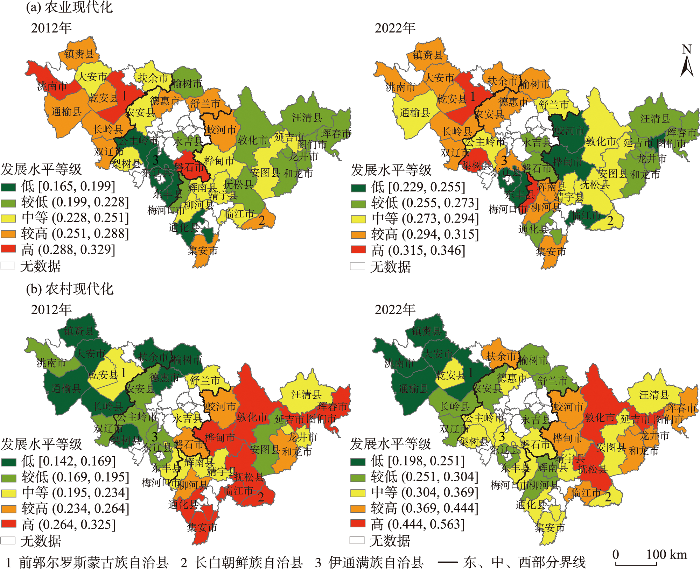
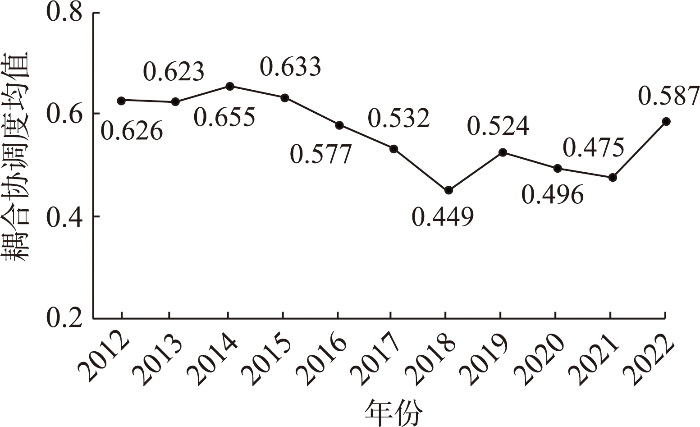
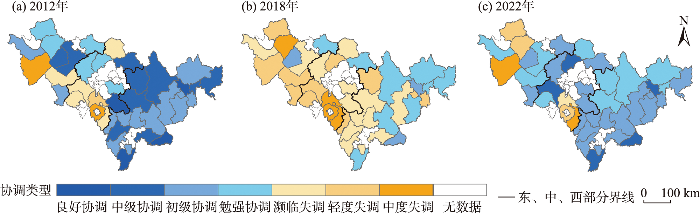
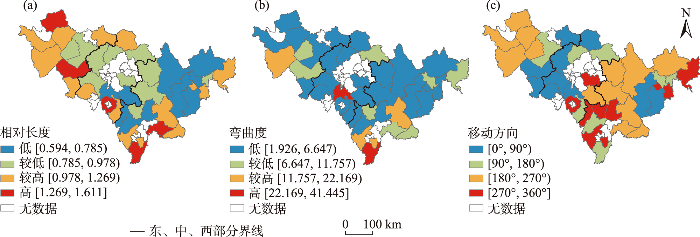
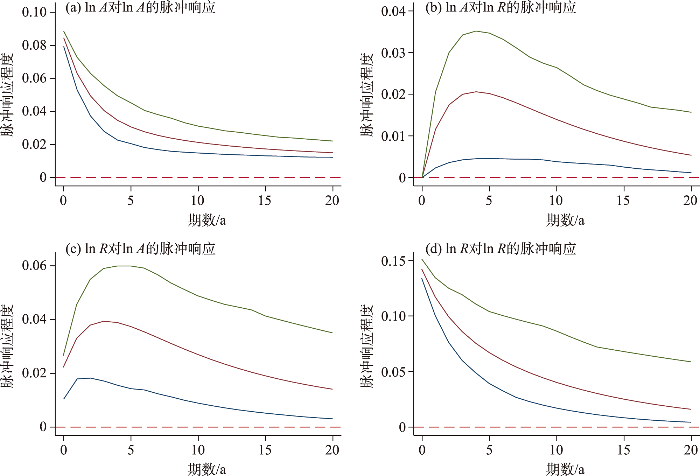
农业现代化与农村现代化是相互关联、相互促进的两个方面,它们共同构成了乡村全面振兴的主要内容。论文通过构建农业现代化和农村现代化的综合评价体系,采用耦合协调模型、LISA (local indicators of spatial association)时间路径、面板向量自回归模型(panel vector autoregression,P-VAR)等方法,剖析了2012—2022年吉林省县域农业现代化和农村现代化地域分异规律、协调演变特征与互动响应关系。结果表明:① 吉林省县域农业现代化和农村现代化水平进一步提高,整体呈现出梯度发展与区域分化。由于对资源禀赋和政策导向的路径依赖,最终形成了农业现代化水平“西强东弱”与农村现代化水平“东高西低”的梯度空间格局。② 二者耦合协调度总体偏低,2018年后在政策推动下有所提升,农村现代化水平高的地区,耦合协调度也相对较高,东部地区普遍优于中西部传统农区。空间上表现出协同低速增长特征,且区域联动性较差,存在较强的空间整合性和转移惰性。③ 农业现代化和农村现代化发展均具有一定的自我强化作用和惯性,且存在双向非线性互动响应关系,农村现代化对农业现代化推动作用显著而短暂,农业现代化对农村现代化影响较小却相对持久。最后,立足区域特征,提出了针对性的对策建议,以期为吉林省及其他粮食主产区制定科学的农业政策和农村发展规划提供科学依据。
李少琦 , 房艳刚 . 吉林省县域农业现代化与农村现代化协调演变与互动响应关系[J]. 地理科学进展, 2026 , 45(1) : 120 -135 . DOI: 10.18306/dlkxjz.2026.01.009
Agricultural modernization and modernization of rural areas are interrelated and mutually promoting, which together constitute the core content of the overall rural revitalization. This study constructed an evaluation indicator system for modernization of agriculture and rural areas, and used the modified coupling coordination degree model, LISA time path, and P-VAR model to explore the regional differentiation patterns, spatiotemporal coordinated change characteristics, and interactive response relationships of the two at the county scale of Jilin Province during 2012-2022. The results show that: 1) The level of agricultural modernization and modernization of rural areas in Jilin Province has been improved, showing an overall gradient development and regional differentiation. Due to the path dependence on resource endowment and policy orientation, a spatial pattern of agricultural modernization strong in the west and weak in the east and modernization of rural areas high in the east and low in the west has been formed. 2) The overall coupling and coordination degree is relatively low. After 2018, it has been slightly improved under the impetus of policies. Regions with higher levels of modernization of rural areas also have higher coupling and coordination degrees. The coupling and coordination degree in the eastern region is generally higher than that in the traditional agricultural areas in the central and western regions. Spatially, it shows slow coordination growth, with poor regional linkages. There is a strong spatial integration and transfer inertia. 3) The development of agricultural modernization and modernization of rural areas in counties both have some degree of self-strengthening effect and inertia, and there exists a two-way nonlinear interactive relationship. Modernization of rural areas has a significant but short promoting effect on agricultural modernization, while agricultural modernization has a small but relatively lasting impact on modernization of rural areas. Finally, based on the regional characteristics, this article put forward targeted countermeasures and recommendations, with the aim of providing a scientific basis for the formulation of agricultural policies and rural development plans in Jilin Province and other major grain-producing areas.
表1 农业现代化评价指标体系Tab.1 Evaluation indicator system of agricultural modernization |
| 目标层 | 一级指标 | 二级指标 | 指标解释 | 属性 | 权重 | 参考文献 |
|---|---|---|---|---|---|---|
| 农业 现代化 | 资源投入 | 户均播种面积(hm2/户) | 农作物播种面积/农村户数 | + | 0.050 | |
| 单位耕地面积农机总动力(万kW/hm2) | 农业机械总动力/耕地面积 | + | 0.060 | |||
| 耕地有效灌溉率(%) | 耕地有效灌溉面积/耕地面积 | + | 0.060 | |||
| 公共财政农林水事务支出占比(%) | 农林水事务支出/公共财政支出 | + | 0.046 | |||
| 生产能力 | 粮食生产稳定度(%) | (当年粮食产量-过去5年年均产量)/ 过去5年年均产量 | - | 0.027 | [37] | |
| 劳均粮食产量(t/人) | 粮食总产量/农业从业人口 | + | 0.036 | |||
| 劳均肉类产量(t/人) | 肉类总产量/农业从业人口 | + | 0.072 | |||
| 耕地生产率(万元/ hm2) | 农业产值/耕地面积 | + | 0.076 | [17,38] | ||
| 非粮作物种植比(%) | 1-粮食播种面积/农作物播种面积 | + | 0.075 | |||
| 产业经营 | 设施农业占比(%) | 设施农业面积/耕地面积 | + | 0.219 | ||
| 农林牧渔服务业产值占比(%) | 农林牧渔服务业产值/农林牧渔业 总产值 | + | 0.077 | |||
| 粮食商品率(%) | (粮食产量-0.4×农业人口)/粮食产量 | + | 0.055 | [39] | ||
| 劳均产值(万元/人) | 第一产业总产值/第一产业从业人员 | + | 0.041 | |||
| 绿色发展 | 单位播种面积化肥用量(kg/hm2) | 化肥施用总量/农作物播种面积 | - | 0.048 | [24] | |
| 农田生态系统多样性指数 | -∑bi ln bi, bi为各品种作物播种面积 与农作物播种面积之比 | + | 0.058 | [40] |
注:为消除指标间量纲的影响,对表中原始数据进行极差标准化处理后,再进行相关计算。表2同。 |
表2 农村现代化评价指标体系Tab.2 Evaluation indicator system of modernization of rural areas |
| 目标层 | 一级指标 | 二级指标 | 指标解释 | 属性 | 权重 | 参考文献 |
|---|---|---|---|---|---|---|
| 农村 现代化 | 共同富裕 | 农民人均可支配收入(元) | + | 0.061 | ||
| 乡村社会消费品总额(万元) | + | 0.097 | ||||
| 城乡收入比(%) | 城市居民人均可支配收入/农村居民人均可支配收入 | - | 0.040 | |||
| 农村非农产业就业人数占比(%) | 乡村非农就业人员数/乡村人口 | + | 0.040 | |||
| 村镇银行及其支行数量(个) | + | 0.080 | ||||
| 精神文明 | 全国文明村占比(%) | + | 0.063 | |||
| 通电话(宽带)村占比(%) | + | 0.082 | [41] | |||
| 公共服务 | 农村人均用电量(1000 kWh/人) | 农村用电量/乡村人口 | + | 0.093 | ||
| 医疗保障水平(张/人) | 医院卫生院床位数/乡村人口 | + | 0.074 | [39] | ||
| 自来水受益村占比(%) | 自来水受益村/行政村总数 | + | 0.041 | |||
| 人均乡村道路长度(m/人) | 乡道与乡间道路长度总和/乡村人口 | + | 0.171 | |||
| 农民最低生活保障人数(人) | - | 0.064 | ||||
| 宜居环境 | 森林覆盖率(%) | 森林面积/土地总面积 | + | 0.094 | [23] |
表3 时空跃迁类型Tab.3 Types of LISA spatial and temporal transitions |
| 跃迁类型 | 跃迁特征 | 含义 |
|---|---|---|
| TypeⅠ | LHt→LHt+1、HLt→HLt+1、HHt→HHt+1、LLt→LLt+1 | 邻近县(市)及自身都未发生跃迁 |
| TypeⅡ | LHt→HHt+1、HLt→LLt+1、HHt→LHt+1、LLt→HLt+1 | 邻近县(市)不变,仅自身发生跃迁 |
| TypeⅢ | LHt→LLt+1、HLt→HHt+1、HHt→HLt+1、LLt→LHt+1 | 自身不变,仅邻近县(市)发生跃迁 |
| TypeⅣa | HLt→LHt+1、LHt→HLt+1 | 自身与邻近县(市)跃迁方向相反 |
| TypeⅣb | LLt→HHt+1、HHt→LLt+1 | 自身与邻近县(市)跃迁方向一致 |
表4 农业农村现代化耦合协调度时空跃迁矩阵Tab.4 Spatial and temporal transition matrix of coupling coordination degree of modernization of agriculture and rural areas |
| t | t+1 | 类型 | 数量 | 占比/% | |||
|---|---|---|---|---|---|---|---|
| HH | HL | LH | LL | ||||
| HH | TypeⅠ (0.336) | TypeⅢ (0.036) | TypeⅡ (0.031) | TypeⅣb (0.003) | TypeⅠ | 300 | 76.923 |
| HL | TypeⅢ (0.036) | TypeⅠ (0.113) | TypeⅣa (0) | TypeⅡ (0.028) | TypeⅡ | 44 | 11.282 |
| LH | TypeⅡ (0.026) | TypeⅣa (0.003) | TypeⅠ (0.059) | TypeⅢ (0.012) | TypeⅢ | 40 | 10.256 |
| LL | TypeⅣb (0.010) | TypeⅡ (0.028) | TypeⅢ (0.017) | TypeⅠ (0.262) | TypeⅣa | 1 | 0.256 |
| TypeⅣb | 5 | 1.283 | |||||
注:t为年份;括号内为转移概率。 |
表5 格兰杰因果检验结果Tab.5 Granger causality test results |
| 原假设 | X2 | 自由度 | P值 | 结果 |
|---|---|---|---|---|
| 农业现代化不是农村现代化的格兰杰原因 | 4.0099 | 1 | 0.045 | 拒绝 |
| 农村现代化不是农业现代化的格兰杰原因 | 4.7331 | 1 | 0.030 | 拒绝 |
表6 GMM估计结果Tab.6 Results of the GMM method |
| 变量 | ln A | ln R | |||
|---|---|---|---|---|---|
| 系数 | Z值 | 系数 | Z值 | ||
| L1. ln A | 0.7046537*** | 10.84 | 0.1065385** | 2 | |
| L1. ln R | 0.2050599** | 2.18 | 0.7996720*** | 9.01 | |
注:*、**、***分别表示在10%、5%和1%水平上显著,L1为变量滞后1期。 |
| [1] |
刘继斌, 伊梦晗, 杜雪, 等. 面向农业农村现代化的中国乡村聚落空间重构[J]. 地理科学, 2025, 45(2): 326-338.
[
|
| [2] |
国务院发展研究中心农村经济研究部课题组, 叶兴庆, 程郁, 等. 中国农业现代化与农村现代化协调发展战略研究[J]. 农业经济问题, 2023(4): 13-27.
[Research Group of Rural Economic Research Department, Development Research Center of the State Council,
|
| [3] |
西奥多·W·舒尔茨. 改造传统农业[M]. 梁小民, 译. 北京: 商务印书馆, 2021.
[
|
| [4] |
钱佰慧, 陈思霖, 徐洋, 等. 农村现代化水平评价指标体系构建与测度分析[J]. 农业经济与管理, 2021(6): 39-49.
[
|
| [5] |
易福金, 支晓旭. 农业现代化评价: 基于农业资本的关键指标构建与应用[J]. 农业技术经济, 2025(1): 4-22.
[
|
| [6] |
郭澄澄, 安淑新. 我国基本实现农业现代化: 阶段特征、问题挑战与实施路径[J]. 农业经济, 2025(1): 3-6.
[
|
| [7] |
|
| [8] |
|
| [9] |
|
| [10] |
廖菁, 邹宝玲. 国外乡村产业发展经验及对中国乡村产业振兴的启示[J]. 世界农业, 2022(5): 16-26.
[
|
| [11] |
|
| [12] |
|
| [13] |
|
| [14] |
雷贵. 小农经济现代化发展的空间束缚及其叠层性支配形塑[J]. 农林经济管理学报, 2025, 24(2): 235-243.
[
|
| [15] |
|
| [16] |
龙冬平, 李同昇, 苗园园, 等. 中国农业现代化发展水平空间分异及类型[J]. 地理学报, 2014, 69(2): 213-226.
[
|
| [17] |
刘玉洁, 吕硕, 陈洁, 等. 青藏高原农业现代化时空分异及其驱动机制[J]. 地理学报, 2022, 77(1): 214-227.
[
|
| [18] |
覃诚, 汪宝, 陈典, 等. 中国分地区农业农村现代化发展水平评价[J]. 中国农业资源与区划, 2022, 43(4): 173-182.
[
|
| [19] |
|
| [20] |
刘世薇, 张平宇, 宋凤斌, 等. 黑龙江垦区农业现代化水平评价[J]. 地理科学, 2018, 38(7): 1051-1060.
[
|
| [21] |
刘璐, 辛岭, 朱铁辉. 我国农业农村现代化水平的时空特征及障碍因子研究[J]. 中国农业资源与区划, 2023, 44(6): 135-147.
[
|
| [22] |
|
| [23] |
孟晓, 田明华, 杜磊, 等. 中国农业农村现代化发展水平测度及其协调性研究[J]. 干旱区地理, 2024, 47(1): 137-146.
[
|
| [24] |
辛岭, 刘衡, 胡志全. 我国农业农村现代化的区域差异及影响因素分析[J]. 经济纵横, 2021(12): 101-114.
[
|
| [25] |
|
| [26] |
曹子建, 陈学渊, 高文菊, 等. 县域农业农村现代化发展: 互动逻辑、典型模式与经验启示: 基于河北唐山实地调研[J]. 中国农业资源与区划, 2025, 46(5): 116-127.
[
|
| [27] |
陈慧卿, 曾福生. 湖南省农业农村现代化发展水平测度及其区域差异[J]. 经济地理, 2022, 42(11): 185-194.
[
|
| [28] |
张俊婕. 中国农业农村现代化发展水平的时空特征及障碍因子分析[J]. 经济体制改革, 2022(2): 87-94.
[
|
| [29] |
田恬. 吉林省中部粮食主产区农业发展格局、机制及提升路径研究[D]. 长春: 中国科学院东北地理与农业生态研究所, 2022.
[
|
| [30] |
马楠, 陈若雪, 沈体雁. 中国市域农业现代化发展时空演进与空间溢出机制[J]. 经济地理, 2023, 43(6): 156-165.
[
|
| [31] |
杨奇峰, 张平宇, 李静, 等. 东北地区农业现代化发展水平测度与时空演变分析[J]. 地理科学, 2022, 42(9): 1588-1599.
[
|
| [32] |
张改清, 刘铄. 黄河流域农业现代化水平时空演化及障碍因素解析[J]. 农业现代化研究, 2023, 44(4): 624-634.
[
|
| [33] |
蓝红星, 王婷昱, 施帝斌. 中国农业农村现代化: 生成逻辑、内涵特征与推进方略[J]. 改革, 2023(7): 105-115.
[
|
| [34] |
刘吉双, 白洋, 刘子洋. 中国特色“并联式”农业农村现代化道路的探索[J]. 东北师大学报(哲学社会科学版), 2023(4): 9-18.
[
|
| [35] |
|
| [36] |
|
| [37] |
华坚, 李菁. 中国式农业现代化发展水平测度及区域差异分析: 以吉林省为例[J]. 中国农业资源与区划, 2024, 45(7): 156-169.
[
|
| [38] |
李裕瑞, 刘彦随, 龙花楼. 黄淮海地区乡村发展格局与类型[J]. 地理研究, 2011, 30(9): 1637-1647.
[
|
| [39] |
徐凯, 房艳刚. 辽宁省乡村多功能评价和演变特征分析[J]. 经济地理, 2021, 41(1): 147-157.
[
|
| [40] |
房艳刚, 刘本城, 刘建志. 农业多功能的地域类型与优化策略: 以吉林省为例[J]. 地理科学进展, 2019, 38(9): 1349-1360.
[
|
| [41] |
乔家君, 肖杰. 黄河中下游乡村振兴与新型城镇化耦合协调机制研究[J]. 地理科学进展, 2024, 43(3): 417-433.
[
|
| [42] |
|
| [43] |
卜伟, 刘珊珊, 李晨曦. 三大城市群经济高质量发展水平测度与比较[J]. 统计与决策, 2024, 40(12): 103-107.
[
|
| [44] |
尹君锋, 宋长青, 石培基, 等. 耦合视角下甘肃省县域乡村“三生”功能协调度的时空跃迁特征与影响因素[J]. 地理研究, 2024, 43(4): 874-892.
[
|
| [45] |
田俊, 李旭东, 陈璇, 等. 黔中城市群新型城镇化与农业现代化耦合协调对城乡收入差距的影响[J]. 地理科学进展, 2024, 43(7): 1355-1371.
[
|
| [46] |
尹君锋, 石培基, 黄万状, 等. 甘肃省县域乡村振兴与新型城镇化耦合协调发展的时空分异特征及影响因素[J]. 自然资源学报, 2023, 38(8): 2148-2168.
[
|
| [47] |
|
| [48] |
龚锐. 中国农业高质量发展与新型城镇化: 时空演进和互动关系研究[D]. 重庆: 重庆大学, 2022.
[
|
| [49] |
谢永顺, 王成金, 吴爱玲. 地理标志农产品和农业经济的时空演变及交互响应[J]. 地理科学, 2022, 42(9): 1577-1587.
[
|
| [50] |
李诚固. 吉林地理[M]. 北京: 北京师范大学出版社, 2010: 214-215.
[
|
| [51] |
吉林省人民政府. 吉林省发展改革委关于吉林省主体功能区建设有关情况的报告[EB/OL]. 吉林省发展改革委, 2017-02-06 [2025-05-20]. https://xxgk.jl.gov.cn/zcbm/fgw/xxgkmlqy/201812/t20181204_5603218.html.
[The People's Government of Jilin Province. Report of the development and reform commission of Jilin Province on the construction of the main functional zones in Jilin Province. Development and Reform Commission of Jilin Province, 2017-02-06 [2025-05-20]. https://xxgk.jl.gov.cn/zcbm/fgw/xxgkmlqy/201812/t20181204_5603218.html.]
|
/
| 〈 |
|
〉 |