基于荟萃分析的中国耕地“非粮化”时空演变特征与驱动机制研究
|
曲衍波(1982—),男,山东龙口人,教授,博士生导师,主要研究方向为土地系统优化与耕地保护。E-mail: yanboqu2009@126.com |
收稿日期: 2024-11-06
修回日期: 2025-06-11
网络出版日期: 2025-08-26
基金资助
国家自然科学基金项目(42471295)
国家自然科学基金项目(42077434)
山东省泰山学者基金(2023)
山东省社会科学规划研究项目(24CGLJ17)
Spatiotemporal change characteristics and driving mechanisms of “non-grain” production of cultivated land in China based on meta-analysis
Received date: 2024-11-06
Revised date: 2025-06-11
Online published: 2025-08-26
Supported by
National Natural Science Foundation of China(42471295)
National Natural Science Foundation of China(42077434)
The Taishan Scholar Foundation of Shandong Province in(2023)
The Social Science Planning Research Project of Shandong Province(24CGLJ17)
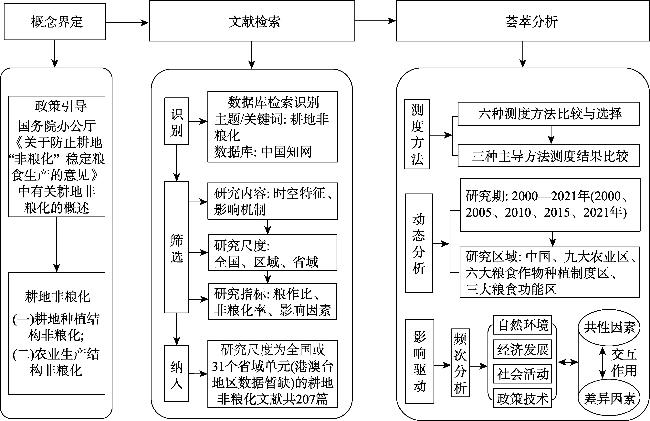
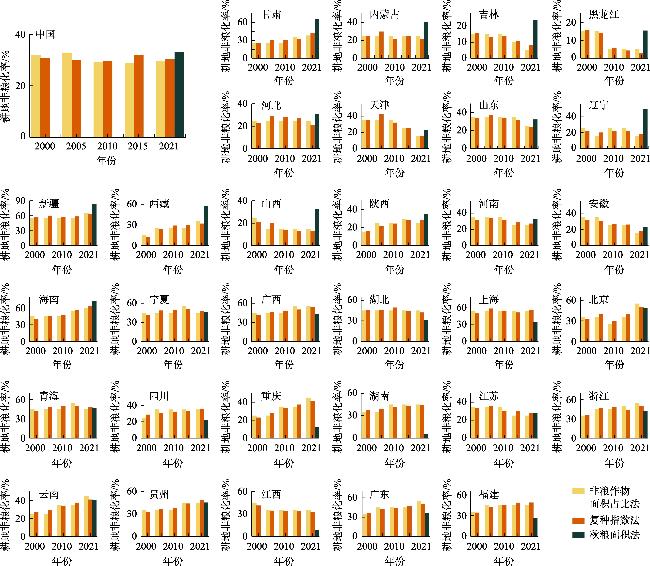
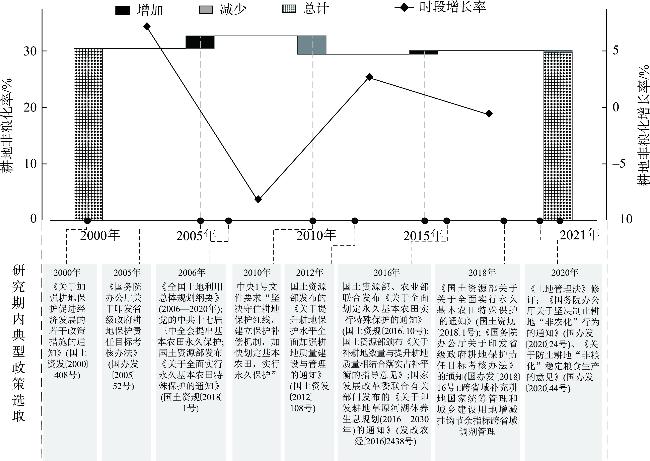
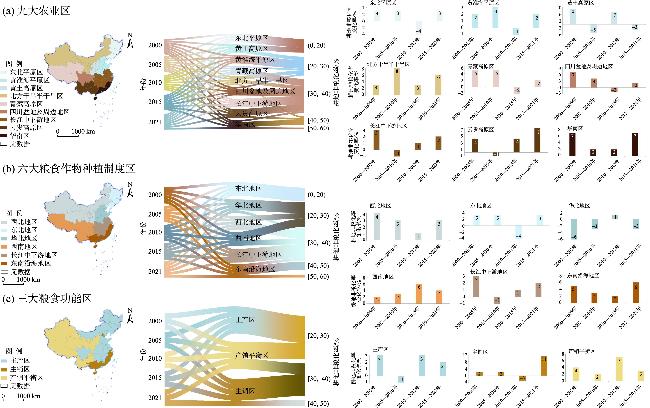
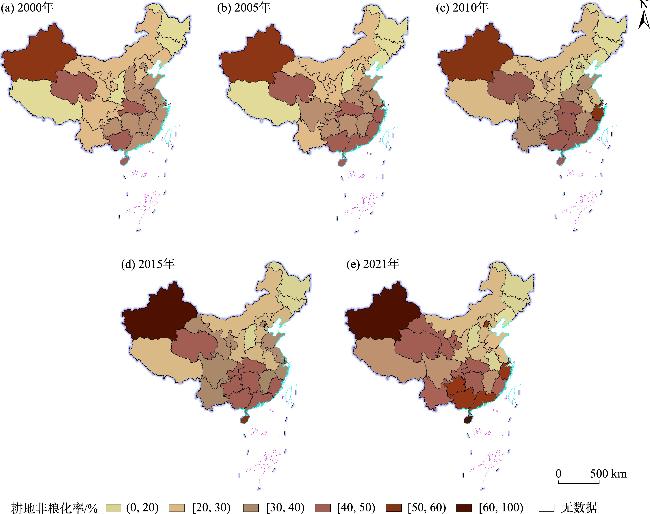
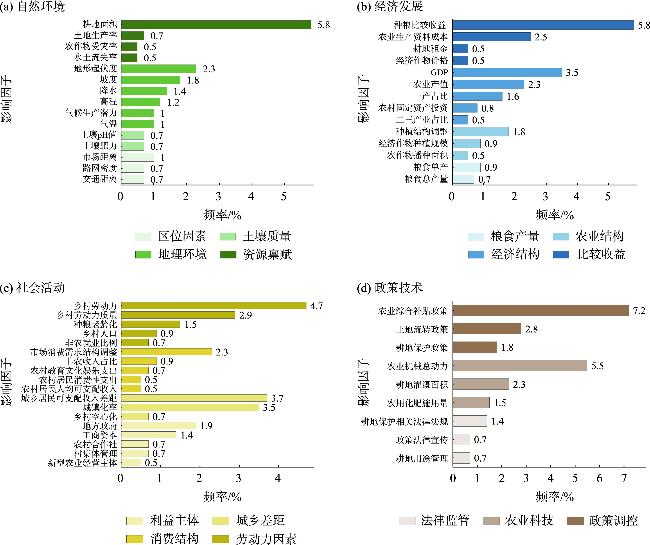
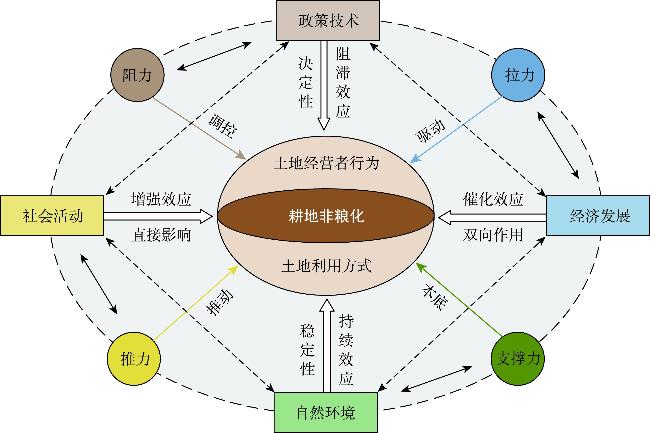
中国耕地非粮化现象日趋严峻,全面把握耕地非粮化演变规律及其形成机制,对于加强耕地保护和粮食安全具有重要意义。目前关于耕地非粮化的内涵和测度方法丰富多样,但测算结果却存在显著差异。论文采用荟萃分析方法对207篇有效文献进行统计分析,揭示了2000—2021年中国耕地非粮化演变特征与驱动机制。研究发现:① 非粮作物面积占比法、复种指数法和秋粮面积法的使用频次较高、范围广泛,在全国、区域及省际尺度上具有可比性,可作为耕地非粮化测度方法的优选。② 研究期内中国耕地非粮化率总体稳定在30.0%左右,并呈小幅度波动下降;九大农业区中,东北平原区、黄淮海平原区和黄土高原区耕地非粮化率低于30.0%且相对稳定,华南区耕地非粮化率高于50.0%且涨幅较大,其他地区处于30.0%~50.0%区间且基本上增长了10.0%~20.0%,北方粮食作物种植制度区的耕地非粮化率和增幅均低于南方地区;从粮食主产区、产销平衡区到主销区的耕地非粮化率和增幅均逐渐提升,省际层面的耕地非粮化呈现集聚式递增和阶段性分化的动态过程。③ 中国耕地非粮化受自然环境、经济发展、社会活动和政策技术等多重因素影响,通过共性和差异性因子的基础性、双向性、推动性和调控性等作用,形成耕地非粮化的本底、催化、增强和阻滞等驱动效应。论文支持和补充了已有研究的观点,为深入开展耕地非粮化影响效应分析提供了数据参考,也为科学推进耕地非粮化治理提出了优化对策。
曲衍波 , 王文 , 崔悦 , 展凌云 , 王东 . 基于荟萃分析的中国耕地“非粮化”时空演变特征与驱动机制研究[J]. 地理科学进展, 2025 , 44(8) : 1559 -1577 . DOI: 10.18306/dlkxjz.2025.08.002
The non-grain production of cultivated land in China is becoming increasingly severe. A comprehensive understanding of the patterns of change and formation mechanisms of non-grain production of cultivated land is of great significance for enhancing cultivated land protection and ensuring food security. Currently, there are diverse perspectives and methodologies for measuring non-grain production yet the results vary significantly, and comparative and integrated research on various measurement methods remains inadequate. Therefore, this study employed a meta-analysis approach to statistically examine 207 existing research articles, revealing the characteristics of change and driving mechanisms of non-grain production of cultivated land in China from 2000 to 2021. The findings are as follows: 1) The methods of non-grain crop area proportion, multiple cropping index, and autumn grain crop area are frequently used and widely applied, offering comparability at the national, regional, and provincial scales, which can be considered preferred methods for measuring non-grain production of cultivated land. 2) During the study period of this research, the rate of non-grain production of cultivated land in China remained stable at around 30.0% overall, with a slight downward fluctuation. Among the nine major agricultural regions, the Northeast China Plain, the Huang-Huai-Hai Plain, and the Loess Plateau had non-grain production rates below 30.0% that remained relatively stable, the rate of non-grain production of cultivated land in South China was higher than 50.0% and the increase was larger, while in other regions the rates were in the range of 30.0% to 50.0%, with a general increase of 10.0% to 20.0%. The rate and growth of non-grain production of cultivated land were both lower in the northern grain crop planting regions than in the southern regions, which gradually increased in the main grain-producing areas, grain balanced areas, and main grain-marketing areas. At the provincial level, non-grain production exhibited a dynamic process characterized by clustered incremental increases and phased differentiation. 3) Non-grain production of cultivated land in China is influenced by multiple factors, including natural environment, economic development, social activities, policies, and technology. Through the foundational, bidirectional, driving, and regulatory effects of common and differential factors, the driving effects of non-grain production of cultivated land such as background, catalytic, enhancement, and retardation effects are formed. This study supports the viewpoints of many scholars, provides data references for in-depth research on the socioeconomic and natural environmental effects of non-grain production, and proposes optimization strategies for the effective implementation of scientific measures to manage non-grain production of cultivated land.
表1 耕地非粮化水平测度方法Tab.1 Methods for measuring the level of non-grain production of cultivated land |
| 序号 | 方法 | 测度公式 | 使用范围 | 参考文献 |
|---|---|---|---|---|
| A | 非粮作物面积占比法 | 非粮化率=非粮食作物播种面积/农作物播种面积×100% | 全国 | [1,15,26] |
| B | 复种指数法 | 复种指数=农作物播种面积/耕地面积 非粮食作物播种面积=耕地面积×复种指数-粮食作物播种面积 非粮化率=1-粮食作物播种面积/(耕地面积×复种指数)×100% | 全国 | [13-14,28] |
| C | 秋粮面积法 | 非粮化率=(全省总耕地面积-秋粮种植面积)/全省总耕地面积×100% 秋粮种植面积=全年粮食播种总面积-夏粮播种面积-早稻播种面积 | 全国 | [29] |
| D | 全国国土调查数据法 | 农业生产结构非粮化=“三调”恢复属性土地面积/“二调”耕地总面积×100% | 山东 | [15] |
| E | 非粮作物产量占比法 | 考虑非粮作物播种面积占比指标的基础上,将种植结构和产量因素一并考虑在内,增加非粮作物产量占比这一指标。 | 广西 | [30] |
| F | 种植和产出结构加权法 | 种植结构非粮化=(1-粮食作物播种面积/农作物播种面积)×100% 产出结构非粮化=(1-粮食作物总产量/农作物总产量)×100% 区域非粮化率=种植结构非粮化×α+产出结构非粮化×β,式中α、β为权重 | 山西 | [31-32] |
| [1] |
张婕, 刘玉洁, 张二梅, 等. 中国县域耕地动态演变及其驱动机制[J]. 地理学报, 2023, 78(9): 2105-2127.
[
|
| [2] |
|
| [3] |
刘彦随, 乔陆印. 中国新型城镇化背景下耕地保护制度与政策创新[J]. 经济地理, 2014, 34(4): 1-6.
[
|
| [4] |
刘彦随. 中国新时代城乡融合与乡村振兴[J]. 地理学报, 2018, 73(4): 637-650.
[
|
| [5] |
曲艺, 龙花楼, 曹林森. 城镇化背景下土地利用转型的环境与经济效应耦合研究框架构建[J]. 地理科学进展, 2024, 43(4): 799-809.
[
|
| [6] |
刘正佳, 钟会民, 李裕瑞, 等. 近20年中国粮食生产变化特征及其对区域粮食供需格局的影响[J]. 自然资源学报, 2021, 36(6): 1413-1425.
[
|
| [7] |
梁鑫源, 金晓斌, 孙瑞, 等. 多情景粮食安全底线约束下的中国耕地保护弹性空间[J]. 地理学报, 2022, 77(3): 697-713.
[
|
| [8] |
曹宇, 李国煜, 王嘉怡, 等. 耕地非粮化的系统认知与研究框架: 从粮食安全到多维安全[J]. 中国土地科学, 2022, 36(3): 1-12.
[
|
| [9] |
匡远配, 刘洋. 农地流转过程中的“非农化”“非粮化”辨析[J]. 农村经济, 2018(4): 1-6.
[
|
| [10] |
王世磊, 金晓斌, 张辛欣, 等. 粮食主产区非粮化耕地整治潜力与分区调控: 以成都平原为例[J]. 地理科学进展, 2023, 42(11): 2172-2185.
[
|
| [11] |
|
| [12] |
|
| [13] |
陈浮, 刘俊娜, 常媛媛, 等. 中国耕地非粮化空间格局分异及驱动机制[J]. 中国土地科学, 2021, 35(9): 33-43.
[
|
| [14] |
张文芝, 程群玉, 查香香. 可持续发展视角下耕地“非粮化”影响因素研究[J]. 粮食科技与经济, 2022, 47(4): 9-14.
[
|
| [15] |
张惠中, 宋文, 张文信, 等. 山东省耕地“非粮化”空间分异特征及其影响因素分析[J]. 中国土地科学, 2021, 35(10): 94-103.
[
|
| [16] |
王全喜, 宋戈, 隋虹均. 耕地“非农化”的时空格局演变及其驱动因素研究: 基于影响分析与组态分析的双重视角[J]. 中国土地科学, 2023, 37(5): 113-124.
[
|
| [17] |
苑韶峰, 杨丽霞, 杨桂山, 等. 耕地非农化的社会经济驱动因素异质性研究: 基于STIRPAT和GWR模型的实证分析[J]. 经济地理, 2013, 33(5): 137-143.
[
|
| [18] |
朱道林. 耕地“非粮化”的经济机制与治理路径[J]. 中国土地, 2021(7): 9-11.
[
|
| [19] |
张学珍, 赵彩杉, 董金玮, 等. 1992—2017年基于荟萃分析的中国耕地撂荒时空特征[J]. 地理学报, 2019, 74(3): 411-420.
[
|
| [20] |
|
| [21] |
|
| [22] |
史铁丑, 李秀彬. 欧洲耕地撂荒研究及对我国的启示[J]. 地理与地理信息科学, 2013, 29(3): 101-103.
[
|
| [23] |
|
| [24] |
|
| [25] |
孔祥斌. 耕地“非粮化”问题、成因及对策[J]. 中国土地, 2020(11): 17-19.
[
|
| [26] |
杜国明, 李宁宁, 张娜, 等. 全国耕地“非粮化”时空格局分析[J]. 东北农业大学学报(社会科学版), 2022, 20(2): 17-27.
[
|
| [27] |
苗洁. 我国粮食主产区耕地“非粮化”的比较分析[J]. 农村·农业·农民, 2021(10): 4-5.
[
|
| [28] |
周晓航. 中国耕地“非粮化”时空分异特征及影响因素研究[D]. 广州: 华南理工大学, 2022.
[
|
| [29] |
李廷强, 郝点. 我国耕地“非粮化”现状及其复耕培肥技术研究进展[J]. 应用生态学报, 2023, 34(6): 1703-1712.
[
|
| [30] |
王鹏程, 张利国, 卢玉兰, 等. 广西耕地“非粮化”时空演变及影响因素研究[J]. 中国农业资源与区划, 2023, 44(5): 187-197.
[
|
| [31] |
牛金枫, 马艳杰, 晋鹏飞, 等. 粮食产销平衡区耕地非粮化时空分异及驱动类型[J]. 农业资源与环境学报, 2024, 41(4): 769-779.
[
|
| [32] |
吴大放, 吴钊骏, 李升发, 等. 粤北山区耕地非粮化演变特征及其影响因素[J]. 经济地理, 2023, 43(8): 144-153.
[
|
| [33] |
|
| [34] |
邵宇飞. 河南省耕地“非粮化”空间格局分异、成因及对策研究[J]. 湖北农业科学, 2022, 61(23): 234-238.
[
|
| [35] |
苏越. 耕地非粮化时空演变与管控研究[D]. 杭州: 浙江大学, 2020.
[
|
| [36] |
徐畅, 郭杰, 易家林, 等. 江苏省耕地非粮化时空格局演变及驱动因素分析[J]. 长江流域资源与环境, 2024, 33(2): 436-447.
[
|
| [37] |
|
| [38] |
易小燕, 陈印军. 农户转入耕地及其“非粮化”种植行为与规模的影响因素分析: 基于浙江、河北两省的农户调查数据[J]. 中国农村观察, 2010(6): 2-10, 21.
[
|
| [39] |
|
| [40] |
宋钰, 杨颖颖, 王家合, 等. 基于计划行为理论的农户耕地“非粮化”行为决策影响因素[J]. 中国农业大学学报, 2023, 28(9): 247-259.
[
|
| [41] |
罗丹, 李文明, 陈洁. 种粮效益: 差异化特征与政策意蕴: 基于3400个种粮户的调查[J]. 管理世界, 2013, 29(7): 59-70.
[
|
| [42] |
王勇, 陈印军, 易小燕, 等. 耕地流转中的“非粮化”问题与对策建议[J]. 中国农业资源与区划, 2011, 32(4): 13-16.
[
|
| [43] |
谢花林, 欧阳振益, 陈倩茹. 耕地细碎化促进了耕地“非粮化”吗: 基于福建丘陵山区农户的微观调查[J]. 中国土地科学, 2022, 36(1): 47-56.
[
|
| [44] |
|
| [45] |
|
| [46] |
孟菲, 谭永忠, 陈航, 等. 中国耕地“非粮化”的时空格局演变及其影响因素[J]. 中国土地科学, 2022, 36(1): 97-106.
[
|
| [47] |
李荣欣, 袁承程, 刘黎明. 我国耕地非粮化发展态势与对策研究[J]. 自然资源情报, 2022(8): 29-35.
[
|
| [48] |
张泽凡, 张学珍. 黄土高原植被恢复对土壤物理参数的影响: 基于已发表数据的荟萃分析[J]. 地理科学进展, 2021, 40(6): 1012-1025.
[
|
| [49] |
|
| [50] |
张青青, 曲衍波, 展凌云, 等. 中国粮食生产碳排放动态演进及驱动效应[J]. 地理学报, 2023, 78(9): 2186-2208.
[
|
| [51] |
金涛. 中国粮食作物种植结构调整及其水土资源利用效应[J]. 自然资源学报, 2019, 34(1): 14-25.
[
|
| [52] |
周小平, 梁颖, 李小天, 等. 耕地系统健康的时空演变及其驱动因素研究: 以长江中下游地区为例[J]. 自然资源学报, 2024, 39(5): 1174-1192.
[
|
| [53] |
黄海潮, 温良友, 孔祥斌, 等. 中国耕地空间格局演化对耕地适宜性的影响及政策启示[J]. 中国土地科学, 2021, 35(2): 61-70.
[
|
| [54] |
常媛媛, 刘俊娜, 张琦, 等. 粮食主产区耕地非粮化空间格局分异及其成因[J]. 农业资源与环境学报, 2022, 39(4): 817-826.
[
|
| [55] |
韦燕飞, 魏锋, 童新华. 广西石漠化地区耕地“非粮化” 特征刻画及归因识别[J]. 资源开发与市场, 2023, 39(1): 9-15, 105.
[
|
| [56] |
王成, 梁鑫, 豆浩健, 等. 乡村多元价值实现视角下的耕地“非粮化” 演变及其驱动机制: 以重庆市为例[J]. 经济地理, 2023, 43(4): 144-153.
[
|
| [57] |
葛玉娟, 赵宇鸾, 李秀彬. 山区耕地细碎化对土地利用集约度影响: 以贵州省亚鱼村为例[J]. 地理科学进展, 2020, 39(7): 1095-1105.
[
|
| [58] |
王文龙. 工商资本下乡利弊之争: 基于利益博弈的视角[J]. 经济体制改革, 2022(1): 88-94.
[
|
| [59] |
王冲. 山东省耕地非粮化时空特征及影响因素研究[D]. 青岛: 青岛科技大学, 2016.
[
|
| [60] |
王琅玕. 河南省耕地“非农化”“非粮化”问题对策研究[D]. 郑州: 华北水利水电大学, 2023.
[
|
| [61] |
杜国明, 柴璐佳, 李玉恒. 耕地利用系统的理论解析与研究框架[J]. 地理科学进展, 2022, 41(7): 1288-1299.
[
|
| [62] |
马慧汶, 王茂军, 刘涛, 等. 农村耕地林化的非农就业视角解释: 以山东省新泰市为例[J]. 地理科学进展, 2024, 43(4): 709-726.
[
|
/
| 〈 |
|
〉 |