空间句法结合时空间行为分析的城市社区生活圈空间评价研究——以北京市当代—怡美社区生活圈为例
|
刘伟中(1999— ),男,安徽马鞍山人,硕士生,研究方向为城市地理学、时空行为规划。E-mail: weizhong0923@163.com |
收稿日期: 2024-03-31
修回日期: 2024-08-06
网络出版日期: 2024-11-26
基金资助
国家自然科学基金项目(42471282)
国家自然科学基金项目(41771185)
国家自然科学基金项目(42071203)
Spatial evaluation of urban community life circle by spatial syntax combined with spatio-temporal behavior analysis: A case study of Dangdai-Yimei community life circle in Beijing
Received date: 2024-03-31
Revised date: 2024-08-06
Online published: 2024-11-26
Supported by
National Natural Science Foundation of China(42471282)
National Natural Science Foundation of China(41771185)
National Natural Science Foundation of China(42071203)
面向中国式现代化的城市高质量发展,建设开放性、多样性和弹性化的宜居社区生活圈,成为未来城市可持续发展和提升居民生活品质与幸福感的重要环节。在社区生活圈尺度进行服务设施时空优化是城市更新改造的重要方向。论文以北京近郊当代—怡美社区生活圈为例,将空间句法模型与居民日常活动的时空间特征相结合,开展城市社区生活圈尺度的空间环境评价并提出生活圈空间优化建议。研究发现,空间句法测度出可用性较高的空间通常因门禁管理、居民行为偏好、工作安排等因素而在居民日常活动中较少被使用;居民使用其他社区设施揭示了社区间空间共享的需求;社区生活圈内存在设施配置不合理、公共空间不足的短板,购物设施距居住区较远而较少被居民使用,休闲空间不足迫使居民将大型交通枢纽的开敞空间作为休闲活动空间。未来,从人的时空间行为需求与社区建成环境空间结构特征出发,提倡社区生活圈内的社区间更多开放和共享公共空间、增加弹性化活动空间等,从而营造更加宜居和谐的生活活动空间。
刘伟中 , 张艳 . 空间句法结合时空间行为分析的城市社区生活圈空间评价研究——以北京市当代—怡美社区生活圈为例[J]. 地理科学进展, 2024 , 43(11) : 2157 -2170 . DOI: 10.18306/dlkxjz.2024.11.005
Under the background of high-quality urban development in Chinese-style modernization, building open, diverse, and resilient livable community life circles has become an important aspect of the sustainable development of future cities and the improvement of residents' quality of life and sense of well-being. The spatial and temporal optimization of facilities in community life circles is an important direction for urban renewal and transformation. This study took the Dangdai-Yimei community life circle—an area located in the suburb of Beijing—as a case study area, and combined spatial syntactic modeling with spatiotemporal characteristics of residents' daily activities. By conducting a spatial environment evaluation at the scale of urban community life circle, we put forward recommendations for spatial optimization. The study found that space with high availability in spatial syntactic measurement results is usually rarely used in residents' daily life due to access control management, behavioral needs, work arrangements and other factors. The fact that residents indirectly use facilities in other communities reveals the need for sharing of space between communities. Within the community life circle, there are shortcomings such as inadequate facility allocation and insufficient public spaces. Shopping facilities are located far from residential areas, leading to fewer shopping activities within the community life circle. The lack of leisure spaces forces residents to use the major transportation hub as leisure spaces. Finally, the low activity of working professionals within the community life circle during weekday evenings reflects the inadequacy of spatial flexibility planning. We recommend that in the future, human behavioral needs should be integrated with the spatial structure characteristics of the built environment in communities. This includes advocating for increased openness and sharing between communities within community life circles, diversifying the functions of public spaces, and appropriately adding flexible activity spaces. These efforts aim to create more livable and harmonious living activity spaces.
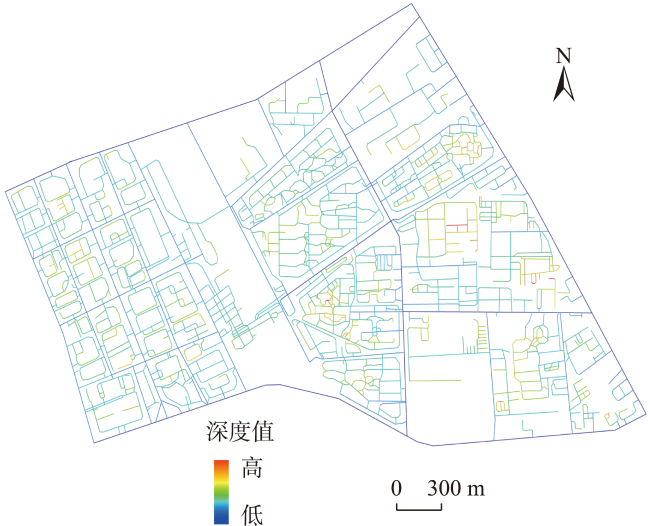
图6 基于空间句法模型的当代—怡美社区生活圈空间现状伽马图Fig.6 Gamma map of Dangdai-Yimei community life circle based on the spatial syntactic model |
表1 当代—怡美社区生活圈重要活动场所的空间句法模型计算值Tab.1 Calculated spatial syntax model values of important activity places of Dangdai-Yimei community life circle |
| 场所名称 | 空间类型 | 标准化角度整合度 | 视域围合度 | 深度 | 综合排名 |
|---|---|---|---|---|---|
| 怡美家园 | 商品房社区 | 0.714 | 0.509 | 83.95 | 1 |
| 安宁华庭 | 商品房社区 | 0.738 | 0.545 | 84.491 | 2 |
| 当代城市家园 | 商品房社区 | 0.713 | 0.531 | 92.719 | 3 |
| 安宁庄公园 | 公园绿地 | 0.924 | 0.487 | 99.961 | 4 |
| 清河站东街 | 商业街 | 0.904 | 0.435 | 146.254 | 5 |
| 清河站 | 交通枢纽 | 0.695 | 0.860 | 162.000 | 6 |
| 上地MOMA | 商品房社区 | 0.790 | 0.478 | 139.248 | 7 |
| 上地产业园 | 办公集聚区 | 0.797 | 0.524 | 134.555 | 8 |
| 清上园 | 商品房社区 | 0.456 | 0.539 | 396.619 | 9 |
| 金隅凤栖家园 | 共有产权房社区 | 0.811 | 0.429 | 367.426 | 10 |
| 小营西路23、25、29号院 | 单位社区 | 0.746 | 0.504 | 397.035 | 11 |
| 军区家属院 | 单位社区 | 0.683 | 0.681 | 471.696 | 12 |
| 小米科技园 | 办公集聚区 | 0.699 | 0.494 | 531.875 | 13 |
表2 “当代—怡美”社区生活圈公共空间人均活动次数Tab.2 Number of activities per capita in the public space of Dangdai-Yimei community life circle (次/人) |
| 空间 | 上班族(N=82) | 非就业者(N=67) | |||
|---|---|---|---|---|---|
| 工作日 | 休息日 | 工作日 | 休息日 | ||
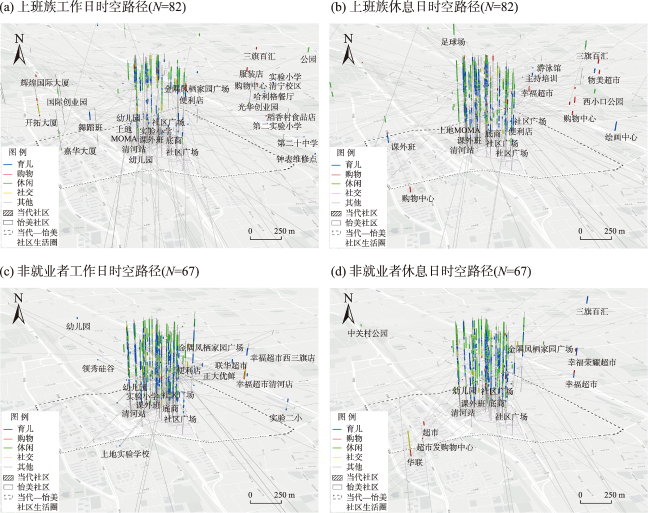
| 生活圈内 | 0.585 | 1.061 | 1.687 | 1.373 | |
| 生活圈外 | 8.988 | 4.183 | 2.269 | 2.358 | |
| [1] |
柴彦威, 于一凡, 王慧芳, 等. 学术对话: 从居住区规划到社区生活圈规划[J]. 城市规划, 2019, 43(5): 23-32.
[
|
| [2] |
王德, 胡杨. 城市时空行为规划: 概念、框架与展望[J]. 城市规划学刊, 2022(1): 44-50.
[
|
| [3] |
孙逸渊, 冯健. 郊区大型生活区: 现代化郊区的生活特征与形成机制: 基于活动空间的视角[J]. 城市发展研究, 2023, 30(9): 129-140.
[
|
| [4] |
邓羽, 陈田, 刘盛和. 城市物质空间更新研究进展与展望[J]. 地理科学进展, 2017, 36(5): 540-548.
[
|
| [5] |
湛东升, 张文忠, 谌丽, 等. 城市公共服务设施配置研究进展及趋向[J]. 地理科学进展, 2019, 38(4): 506-519.
[
|
| [6] |
申悦, 柴彦威. 基于日常活动空间的社会空间分异研究进展[J]. 地理科学进展, 2018, 37(6): 853-862.
[
|
| [7] |
|
| [8] |
柴彦威, 李春江, 张艳. 社区生活圈的新时间地理学研究框架[J]. 地理科学进展, 2020, 39(12): 1961-1971.
[
|
| [9] |
中华人民共和国自然资源部. 社区生活圈规划技术指南[S]. TD/T 1062—2021. 北京: 地质出版社, 2021.
[Ministry of Natural Resources of the People's Republic of China. Technical guidelines for community life circle planning. TD/T 1062-2021. Beijing, China: Geology Press, 2021.]
|
| [10] |
许伟麟, 柴彦威. 移动性地理学视角下时空间行为研究创新[J]. 地理学报, 2023, 78(4): 1015-1027.
[
|
| [11] |
柴彦威, 李春江. 城市生活圈规划: 从研究到实践[J]. 城市规划, 2019, 43(5): 9-16, 60.
[
|
| [12] |
杨婕, 柴彦威. 城市体检的理论思考与实践探索[J]. 上海城市规划, 2022(1): 1-7.
[
|
| [13] |
柴彦威, 许伟麟, 张文佳, 等. 新冠肺炎疫情精准防控的时空间行为地理学研究框架[J]. 地理科学, 2020, 40(10): 1585-1592.
[
|
| [14] |
|
| [15] |
|
| [16] |
吴秋晴, 王睿, 奚文沁. 时间城市规划的上海探索: 15分钟社区生活圈规划的时间路径[J]. 国际城市规划, 2024, 39(3): 58-65.
[
|
| [17] |
赵鹏军, 罗佳, 胡昊宇. 基于大数据的生活圈范围与服务设施空间匹配研究: 以北京为例[J]. 地理科学进展, 2021, 40(4): 541-553.
[
|
| [18] |
赵彦云, 张波, 周芳. 基于POI的北京市“15分钟社区生活圈”空间测度研究[J]. 调研世界, 2018(5): 17-24.
[
|
| [19] |
孙道胜, 柴彦威. 城市社区生活圈体系及公共服务设施空间优化: 以北京市清河街道为例[J]. 城市发展研究, 2017, 24(9): 7-14, 25, 2.
[
|
| [20] |
柴彦威, 李春江, 夏万渠, 等. 城市社区生活圈划定模型: 以北京市清河街道为例[J]. 城市发展研究, 2019, 26(9): 1-8, 68.
[
|
| [21] |
王星, 张姗琪, 甄峰, 等. 面向社区生活圈的行为—设施时空匹配度评价: 以南京市中心城区为例[J]. 上海城市规划, 2024(2): 15-22.
[
|
| [22] |
常飞, 王录仓, 马玥, 等. 城市公共服务设施与人口是否匹配? 基于社区生活圈的评估[J]. 地理科学进展, 2021, 40(4): 607-619.
[
|
| [23] |
|
| [24] |
盛强, 武静芬, 荣毅龙. 社区商业活力的空间韧性: 北京胡同区空间治理对比研究[J]. 城市问题, 2021(8): 83-92.
[
|
| [25] |
何韶瑶, 鲁娜, 龚卓, 等. 基于空间句法的住区公共空间开放策略研究: 以长沙三个住区为例[J]. 城市发展研究, 2018, 25(1): 63-69, 96.
[
|
| [26] |
丁传标, 古恒宇, 陶伟. 空间句法在中国人文地理学研究中的应用进展评述[J]. 热带地理, 2015, 35(4): 515-521, 540.
[
|
| [27] |
陶伟, 丁传标, 古恒宇. 空间句法理论在城市游憩系统空间规划中的运用[J]. 规划师, 2015, 31(8): 26-31.
[
|
| [28] |
古恒宇, 周麟, 沈体雁, 等. 基于空间句法的长江中游城市群公路交通网络研究[J]. 地域研究与开发, 2018, 37(5): 24-29.
[
|
| [29] |
谭钦心, 张艳, 柴彦威. 新冠肺炎疫情下社区活动的地方秩序变化: 北京双井案例[J]. 人文地理, 2022, 37(5): 80-88.
[
|
| [30] |
黄泰, 卫嫚, 支钰婷, 等. 基于行为仿真的城市休闲绿地步行空间网络适老性重构: 以苏州市虎丘湿地公园为例[J]. 地理与地理信息科学, 2022, 38(2): 79-88.
[
|
| [31] |
柴彦威, 谭一洺, 申悦, 等. 空间—行为互动理论构建的基本思路[J]. 地理研究, 2017, 36(10): 1959-1970.
[
|
| [32] |
|
| [33] |
盛强, 夏海山, 刘星. 空间句法对地铁站间截面客流量的实证研究: 以北京、天津和重庆为例[J]. 城市规划, 2018, 42(6): 57-67.
[
|
| [34] |
柴彦威, 颜亚宁, 冈本耕平. 西方行为地理学的研究历程及最新进展[J]. 人文地理, 2008, 23(6): 1-6, 59.
[
|
| [35] |
塔娜, 申悦, 柴彦威. 生活方式视角下的时空行为研究进展[J]. 地理科学进展, 2016, 35(10): 1279-1287.
[
|
| [36] |
|
| [37] |
|
| [38] |
杨振宇. 理想社区生活圈与实际生活圈的划分与比较: 以北京市当代—怡美社区为例[D]. 北京: 北京大学, 2023.
[
|
| [39] |
杨滔, 林旭辉, 刘歆婷, 等. 空间句法的流形理论探讨[J]. 城市环境设计, 2023(4): 337-340.
[
|
| [40] |
张大玉, 凡来, 刘洋. 基于空间句法的北京市展览路街道公共空间使用评价及提升对策研究[J]. 城市发展研究, 2021, 28(11): 38-44, 173.
[
|
/
| 〈 |
|
〉 |