建成环境对星级酒店内被盗的影响——以ZG市中心城区为例
|
张春霞(1982— ),女,山东郓城人,副教授,博士,研究方向为旅游管理与犯罪地理。E-mail:zcx020@163.com |
收稿日期: 2019-09-09
要求修回日期: 2020-01-19
网络出版日期: 2020-07-28
基金资助
广州市科学研究计划重点项目(201804020016)
国家重点研发计划项目(2018YFB0505500)
国家重点研发计划项目(2018YFB0505503)
国家自然科学基金重点项目(41531178)
广东省自然科学基金研究团队项目(2014A030312010)
广州市哲学社会科学发展“十三五”规划项目(2018GZGJ129)
版权
Relationship between the built environment and theft cases in star hotels in ZG central city
Received date: 2019-09-09
Request revised date: 2020-01-19
Online published: 2020-07-28
Supported by
Key Project of Science and Technology Program of Guangzhou City, China(201804020016)
National Key R&D Program of China(2018YFB0505500)
National Key R&D Program of China(2018YFB0505503)
Key Program of National Natural Science Foundation of China(41531178)
Research Team Program of Natural Science Foundation of Guangdong Province, China(2014A030312010)
The 13th Five-Year Plan for the Development of Philosophy and Social Science in Guangzhou(2018GZGJ129)
Copyright
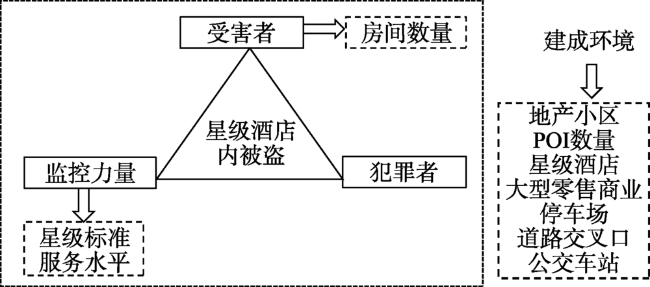
盗窃是中西方酒店内财产犯罪中最为高发的一种,但鲜有研究关注建成环境对酒店被盗的影响。论文以2012—2014年ZG市中心城区发生过被盗的星级酒店作为研究样本,在综合分析酒店被盗时空特征的基础上,选取酒店周围500 m范围内的建成环境指标,利用负二项回归模型,对分时段各类型的星级酒店被盗的影响因素进行系统建模分析。结果表明:被盗星级酒店的时空分布呈现典型的集聚分布特征。不同时段空间“主热点”分布相对稳定,“次热点”有所不同。整体来看,提高服务水平对降低星级酒店被盗的作用最为稳定,周围的兴趣点(Point of Interest, POI)数量会显著增加星级酒店被盗的机会,道路交叉口则对星级酒店被盗起显著监管作用。分模型结果显示,服务水平对三星级和五星级酒店被盗的抑制作用显著,道路交叉口则对以商务客人为主的四星级酒店被盗的抑制作用更强,而POI数量对等级较低的三星、四星酒店被盗作用更为明显;大型零售商业中心能显著增加旅游旺季及周末时段的酒店被盗的数量,道路交叉口数量则对旅游淡季、工作日2个时段的星级酒店被盗风险的监控作用显著。研究表明建成环境在影响ZG市星级酒店被盗的机会和成本方面作用显著。结果验证了日常活动理论在中国大城市星级酒店被盗方面研究的适用性,拓展了犯罪地理学在星级酒店被盗方面的研究成果,对酒店盗窃预防有指导意义。
张春霞 , 周素红 , 柳林 , 肖露子 . 建成环境对星级酒店内被盗的影响——以ZG市中心城区为例[J]. 地理科学进展, 2020 , 39(5) : 829 -840 . DOI: 10.18306/dlkxjz.2020.05.011
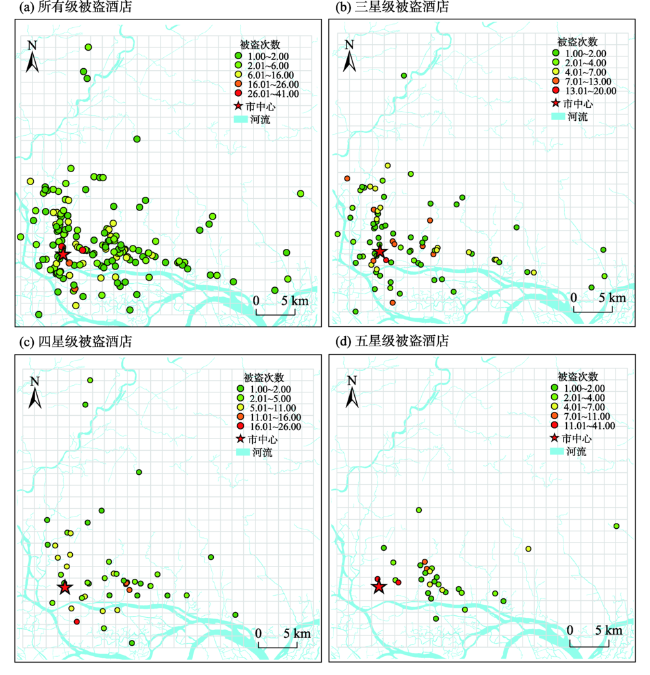
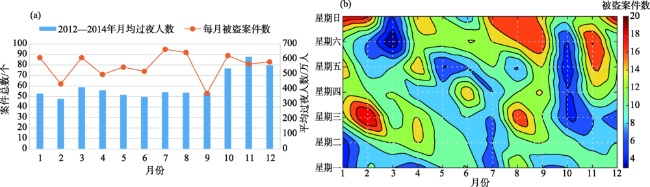
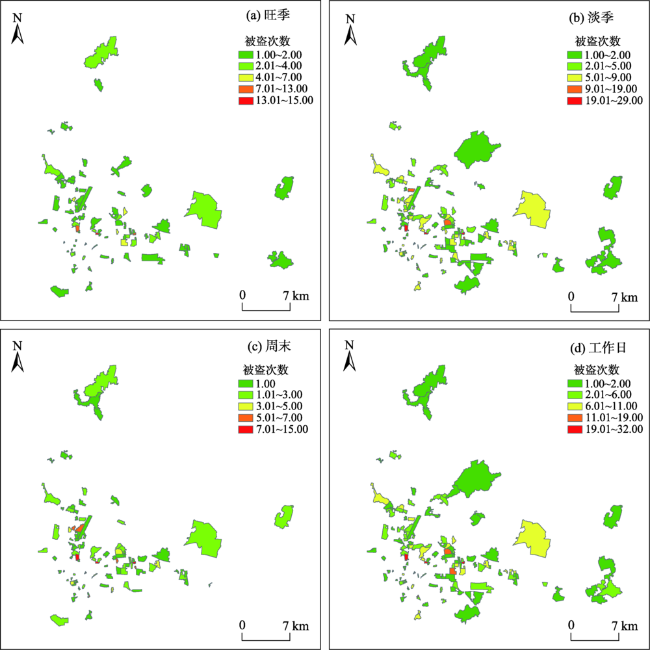
As a ticklish social problem, crime committed in hotels has been concerned by both Chinese and Western scholars. Theft is one of the most frequent crime types occurred in hotels, especially in star hotels. Previous studies on influencing factors of hotel theft cases mainly focused on star hotel and personal attributes of victims at the micro level from the perspective of sociology, rather than considering the built environmental factors at the macro level from the perspective of geography. Using the data on the star hotels with theft cases in 2012-2014 in ZG central city obtained from Municipal Public Security Bureau, this study examined the spatial-temporal characteristics of these hotels. Then the environmental indicators within 500 m around the hotels were examined and the negative binomial regression method was used to make a systematic analysis on the factors affecting the theft of different types of star hotels in various time periods. The main results are as follows: 1) The spatial-temporal distribution of star hotels showed obvious agglomeration features. Generally, most of the main hotspots in the high incidence areas of hotel theft were time invariant, all of them are highlighted near the old city central business district, the eastern extension of the main road and the railway station. However, the spatial distribution of secondary hotspots was time-varying. 2) The overall model analysis indicates that the improvement of the service level was the most effective way to reduce the theft cases of all star hotels. The surrounding property and community points of interest (POIs) will significantly increase the opportunity for all star hotels to be stolen, while road intersections play a significant regulatory role in the theft of all star hotels. 3) The results of the sub models demonstrate that the effect of service level on the theft of three-star and five-star hotels is significant, and the effect of road intersection on the theft of four-star hotels often used by guests of business travel is stronger; the number of POIs has more obvious effect on three-star and four-star hotels. Large-scale retail business center can significantly increase the number of theft cases in hotels in the peak season and the weekend, and the number of road intersections is significant for the monitoring of stolen risk of the star hotels in the off-season period and the working days. These results have shown that the built environment played a significant role in affecting the opportunity and cost of hotel theft. The results verify the applicability of the daily activity theory in the study of hotel crimes in large cities in China, and expand the research results of crime geography in the direction of star hotel theft, which has a guiding effect for the prevention of hotel theft.
表1 变量描述Tab.1 Variable description |
| 变量 | 变量描述 | 最小值 | 最大值 | 均值 | 标准差 | VIF |
|---|---|---|---|---|---|---|
| 盗窃犯罪数(个) | 星级酒店内被盗次数 | 1 | 42 | 4.66 | 6.26 | — |
| 星级标准 | 星级酒店自身的星级等级 | 2 | 5 | 3.62 | 0.82 | 2.04 |
| 服务水平 | 携程网客户对星级酒店的评分 | 3.4 | 4.9 | 4.22 | 0.40 | 1.38 |
| 房间数(个) | 星级酒店客房的数量 | 10 | 850 | 181.47 | 141.88 | 1.75 |
| 地产小区 | 500 m缓冲区地产小区的数量 | 0 | 182 | 34.95 | 33.76 | 1.58 |
| POI(个) | 500 m缓冲区各类POI的数量 | 27 | 3272 | 905.22 | 687.77 | 1.92 |
| 星级酒店(个) | 500 m缓冲区星级酒店的数量 | 1 | 12 | 3.08 | 2.36 | 1.54 |
| 大型零售商业(个) | 500 m缓冲区商业大厦的数量 | 0 | 16 | 2.59 | 2.78 | 1.39 |
| 停车场(个) | 500 m缓冲区停车场的数量 | 0 | 92 | 24.22 | 19.95 | 2.10 |
| 道路交叉口(个) | 500 m缓冲区内道路交叉口数量 | 0 | 98 | 14.60 | 17.03 | 2.25 |
| 公交车站(个) | 500 m缓冲区内公交车站的数量 | 0 | 19 | 5.68 | 3.99 | 1.84 |
表2 酒店被盗分星级负二项模型统计结果Tab.2 Negative binomial model results by hotel grades |
| 变量 | 模型1:总模型 | 模型2:三星级 | 模型3:四星级 | 模型4:五星级 |
|---|---|---|---|---|
| 常数 | 1.180(3.255) | 0.113(1.120) | -1.564(0.209) | 7.260(1422.87) |
| 星级标准 | -0.158(0.854) | — | — | — |
| 服务水平 | -1.101***(0.333) | -0.939**(0.391) | -0.662(0.516) | -2.335**(0.097) |
| 地产小区 | 0.002(1.002) | 0.001(1.001) | 0.002(1.002) | 0.003(1.003) |
| POI数量 | <0.001***(1.000) | <0.001**(1.000) | <0.001***(1.000) | <-0.001(1.000) |
| 星级酒店 | -0.018(0.982) | -0.011(0.989) | -0.068(0.934) | 0.080(1.084) |
| 大型零售商业 | 0.033(1.033) | 0.020(1.021) | 0.037(1.037) | -0.026(0.974) |
| 停车场 | -0.002(0.998) | -0.006(0.994) | 0.002(1.002) | 0.017(1.017) |
| 道路交叉口 | -0.010***(0.990) | -0.004(0.996) | -0.028**(0.973) | -0.003(0.997) |
| 公交车站 | 0.028(1.028) | 0.041(1.042) | 0.079(1.082) | -0.010(0.990) |
| 对数似然函数 | -390.861 | -185.786 | -111.835 | -73.029 |
| Alpha | 0.379*** | 0.328** | 0.268*** | 0.376** |
| 被盗比 | 53.59% | 59.85% | 52.87% | 71.43% |
| N | 163 | 82 | 46 | 30 |
注:*、**、***分别表示P<0.1、P<0.05、P<0.01;括号内数据为发生率比(IRR)。下同。 |
表3 酒店被盗分时段负二项模型估计结果Tab.3 Negative binomial model results by time periods |
| 变量 | 模型1:旺季 | 模型2:淡季 | 模型3:周末 | 模型4:工作日 |
|---|---|---|---|---|
| 常数 | -0.747(0.474) | 0.939(2.558) | -0.787(0.455) | 1.167(3.212) |
| 星级标准 | -0.152(0.856) | -0.174*(0.840) | -0.200*(0.819) | -0.140(0.869) |
| 服务水平 | -0.810***(0.445) | -1.078***(0.340) | -0.753**(0.471) | -1.183***(0.306) |
| 地产小区 | 0.003(1.003) | 0.002(1.002) | 0.003(1.003) | 0.002(1.002) |
| POI数量 | <0.001**(1.000) | <0.001***(1.000) | <0.001***(1.000) | <0.001***(1.000) |
| 星级酒店 | -0.050(0.951) | 0.004(1.004) | -0.048*(0.953) | -0.013(0.987) |
| 大型零售商业 | 0.083***(1.086) | 0.035(1.035) | 0.079***(1.083) | 0.023(1.024) |
| 停车场 | -0.007(0.993) | 0.002(1.002) | -0.003(0.997) | 0.002(1.002) |
| 道路交叉口 | -0.006(0.994) | -0.009**(0.991) | -0.007(0.993) | -0.011***(0.989) |
| 公交车站 | 0.003(1.003) | 0.007(1.007) | -0.012(0.988) | 0.026(1.026) |
| 对数似然函数 | -165.210 | -315.380 | -181.734 | -313.656 |
| Alpha | 0.107*** | 0.227*** | 0.076*** | 0.275*** |
| 被盗比 | 32.03% | 47.71% | 34.64% | 48.37% |
| N | 97 | 146 | 106 | 147 |
| [1] |
文吉 . 广州市星级酒店空间发展格局 [J]. 经济地理, 2006,26(3):451-455.
[
|
| [2] |
|
| [3] |
|
| [4] |
|
| [5] |
柳林, 姜超, 周素红 , 等. 城市入室盗窃犯罪的多尺度时空格局分析: 基于中国H市DP半岛的案例研究 [J]. 地理研究, 2017,36(12):2451-2464.
[
|
| [6] |
|
| [7] |
|
| [8] |
|
| [9] |
|
| [10] |
|
| [11] |
|
| [12] |
|
| [13] |
|
| [14] |
郑云燕 . 星级酒店风险控制与系统安全管理应用研究[D]. 福州: 福州大学, 2006: 82.
[
|
| [15] |
李婷, 李文皓 . 2006—2016年酒店安全事故特征变化研究 [J]. 乐山师范学院学报, 2018(1):52-57.
[
|
| [16] |
欧阳常青, 陈东明 . 宾馆盗窃案件的特点及现场勘查技巧 [J]. 新疆警察学院学报, 2006,26(4):21-23.
[
|
| [17] |
谢朝武 . 我国酒店业盗窃案件的发生特征及其管理体系研究 [J]. 华侨大学学报(哲学社会科学版), 2010(3):74-82.
[
|
| [18] |
|
| [19] |
姜超, 唐焕丽, 柳林 . 中国犯罪地理研究述评 [J]. 地理科学进展, 2014,33(4):561-573.
[
|
| [20] |
龙冬平, 柳林, 周素红 , 等. 地理学视角下犯罪者行为研究进展 [J]. 地理科学进展, 2017,36(7):886-902.
[
|
| [21] |
朱其静, 陆林 . 商务会展旅游者视角下广州城市形象分析评价 [J]. 旅游论坛, 2016,9(1):8-13.
[
|
| [22] |
刘国果 . 广州星级酒店空间分布特征研究 [J]. 中山大学研究生学刊(自然科学·医学版), 2011(1):102-113.
[
|
| [23] |
熊伟, 吴必虎 . 大型展会对高星级酒店房价影响的空间分析: 以第100届广交会为例 [J]. 旅游学刊, 2008,23(2):80-86.
[
|
| [24] |
柳林, 张春霞, 冯嘉欣 , 等. ZG市诈骗犯罪的时空分布与影响因素 [J]. 地理学报, 2017,72(2):315-328.
[
|
| [25] |
郭福涛, 胡海清, 金森 , 等. 基于负二项和零膨胀负二项回归模型的大兴安岭地区雷击火与气象因素的关系 [J]. 植物生态学报, 2010,34(5):571-577.
[
|
| [26] |
塔娜, 柴彦威, 关美宝 . 建成环境对北京市郊区居民工作日汽车出行的影响 [J]. 地理学报, 2015,70(10):1675-1685.
[
|
| [27] |
|
| [28] |
许泽宁, 高晓路 . 基于电子地图兴趣点的城市建成区边界识别方法 [J]. 地理学报, 2016,71(6):928-939.
[
|
| [29] |
查爱苹, 徐娜, 后智钢 . 经济型酒店微观选址适宜性研究: 以上海中心城区锦江之星为例 [J]. 人文地理, 2017,32(1):152-160.
[
|
| [30] |
|
| [31] |
|
| [32] |
邱建辉 . 我国热点旅游城市入境旅游季节性空间差异及影响因素研究[D]. 上海: 华东师范大学, 2014: 82.
[
|
| [33] |
文吉 . 广州市星级酒店客源市场结构及其影响因素研究 [J]. 消费经济, 2006,22(1):75-77.
[
|
| [34] |
|
/
| 〈 |
|
〉 |