领域陷阱与中国在缅甸北部的跨国禁毒实践
作者简介:苏晓波(1978-),男,湖北荆州人,华南师范大学特聘教授,美国俄勒冈大学地理系副教授,主要从事政治文化地理、 旅游地理研究,E-mail: xiaobo@uoregon.edu。
网络出版日期: 2017-12-20
基金资助
国家自然科学基金项目(41528102,41671146,41630635)
Territorial trap and China's transnational anti-drug practices in northern Myanmar
Online published: 2017-12-20
Supported by
National Natural Science Foundation of China, No.41528102, No.41671146, No.41630635
Copyright
非法毒品不仅给国家安全和社会稳定带来新的挑战,也促使地理学者深入研究并揭示毒品贸易背后的地缘政治因素和经济社会问题。目前,中国已经成为缅甸北部“金三角”核心区域毒品的主要市场之一,基于中国政府恪守和平共处五项基本原则,无法对盘踞在“金三角”的毒贩进行有效的打击和根除。面对跨国毒贩,中国政府陷入了John Agnew提出的“领域陷阱”。如何在尊重缅甸国家主权的前提下实施有效的跨国禁毒,以维护中缅边境的安全和云南的社会稳定?本文借助政策报告和深度访谈资料,揭示毒品贸易的非传统安全属性,并且分析中国在缅甸北部的禁毒实践——采取武装威慑与替代种植。前者针对毒贩和跨国毒品集团,后者主要面向缅北依赖罂粟种植的农民。两种实践策略针对不同群体,相辅相成,标本兼治,不仅在缅甸领土主权和中缅边境安全之间找到了平衡,也为中国政府克服“领域陷阱”,建构了有效的跨国管制机制。本文丰富了地理学者对于领土主权、地缘政治以及边境安全的探讨,可为中国西南边境共建“一带一路”提供有益借鉴。
苏晓波 , 蔡晓梅 . 领域陷阱与中国在缅甸北部的跨国禁毒实践[J]. 地理科学进展, 2017 , 36(12) : 1552 -1561 . DOI: 10.18306/dlkxjz.2017.12.010
Illicit drugs generate numerous threats to national security and social stability as more and more countries face how to handle these drugs. Geographers are motivated to raise critical questions about geographical factors and socioeconomic problems that underpin the widespread problems brought by illicit drugs. Nowadays, China has become a major market for illicit drugs produced in northern Myanmar, the core area of the notorious Golden Triangle. The Chinese state complies with the Five Principles of Peaceful Coexistence, particularly the non-intervention policy, and thus cannot crack down on drug lords dwelling in northern Myanmar. In this sense, the Chinese state falls into what Agnew calls a “territorial trap.” How can the Chinese state launch effective narcotics control in northern Myanmar without jeopardizing Myanmar's national sovereignty? The ultimate goal is to maintain border security between China and Myanmar and weaken the damage brought by illicit drugs to Yunnan and even the whole country. Built upon policy report analysis and in-depth interview, this article explores illicit drugs as a non-traditional security challenge and analyzes China’s narcotics control practices in northern Myanmar—coercive crackdown and opium substitution. It is found that coercive crackdown targets drug lords and transitional drug cartels while opium substitution aims to help ex-poppy farmers to plant licit economic crops. These two practices focus on different groups to cope with the chain of drug plantation and trafficking. By doing so, these practices achieve a balance between Myanmar's national sovereignty and the China-Myanmar border security. Through these practices, the Chinese state evades territorial trap by an effective transnational governance regime for narcotics control. This article furthers our understanding of territory, geopolitics, and border security in the context of transnational regionalization, and generates some theoretical implications for building the “belt and road” between Yunnan and mainland Southeast Asia.
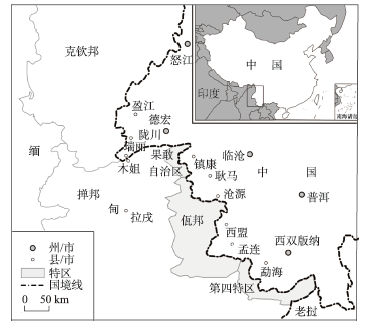
Fig.1 The border between Yunnan and Burma图1 云南与缅甸边境 |
Tab.1 Estimates of poppy cultivation and opium production in Laos and Burma, 1998-2015表1 老挝和缅甸罂粟种植和鸦片产量的估计,1998-2015 |
| 年份 | 罂粟种植面积/hm2 | 干鸦片的估计产量/t | |||
|---|---|---|---|---|---|
| 老挝 | 缅甸 | 老挝 | 缅甸 | ||
| 1998 | 26837 | 130300 | 124 | 1303 | |
| 1999 | 22543 | 89500 | 124 | 895 | |
| 2000 | 19052 | 108700 | 167 | 1087 | |
| 2001 | 17255 | 105000 | 134 | 1097 | |
| 2002 | 14000 | 81400 | 112 | 828 | |
| 2003 | 12000 | 62200 | 120 | 810 | |
| 2004 | 6600 | 44200 | 43 | 370 | |
| 2005 | 1800 | 32800 | 14 | 312 | |
| 2006 | 2500 | 21500 | 20 | 315 | |
| 2007 | 1500 | 27700 | 9 | 460 | |
| 2008 | 1600 | 28500 | 10 | 410 | |
| 2009 | 1900 | 31700 | 11 | 330 | |
| 2010 | 3000 | 38100 | 18 | 580 | |
| 2011 | 4100 | 43600 | 25 | 610 | |
| 2012 | 6800 | 51000 | 41 | 690 | |
| 2013 | 3900 | 57800 | 23 | 870 | |
| 2014 | 6200 | 57600 | 92 | 670 | |
| 2015 | 5700 | 55500 | / | 647 | |
资料来源:(UNODC, 2016)。需要指出的是,除鸦片提炼后的海洛因外,缅甸北部也生产冰毒片剂,主要走私到泰国和中国,但是冰毒片剂的产量无法估算。 |
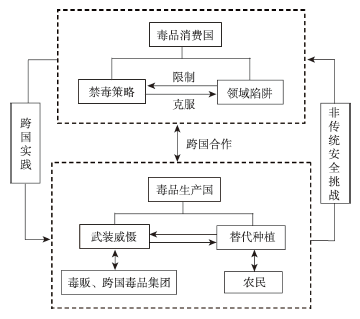
Fig.2 Analytical framework图2 研究框图 |
The authors have declared that no competing interests exist.
| [1] |
[
|
| [2] |
[
|
| [3] |
[
|
| [4] |
|
| [5] |
|
| [6] |
|
| [7] |
|
| [8] |
|
| [9] |
|
| [10] |
|
| [11] |
|
| [12] |
|
| [13] |
|
| [14] |
|
| [15] |
|
| [16] |
|
| [17] |
|
| [18] |
|
| [19] |
|
| [20] |
|
| [21] |
|
| [22] |
|
| [23] |
|
| [24] |
UNODC.2016. World rug report 2016[R]. Vienna, Austria: UNODC. 10.
|
| [25] |
|
| [26] |
|
| [27] |
|
| [28] |
|
| [29] |
Williams J. 2003. Mong La: Burma’s city of lights[EB/OL]. The Irrawaddy, 11(1):
|
| [30] |
|
| [31] |
|
/
| 〈 |
|
〉 |