Spatial distribution and agglomeration measurement of specialized villages in Henan Province
Received date: 2021-05-25
Request revised date: 2021-10-21
Online published: 2022-05-28
Supported by
National Natural Science Foundation of China, No(42071220)
National Natural Science Foundation of China, No(41671172)
Copyright
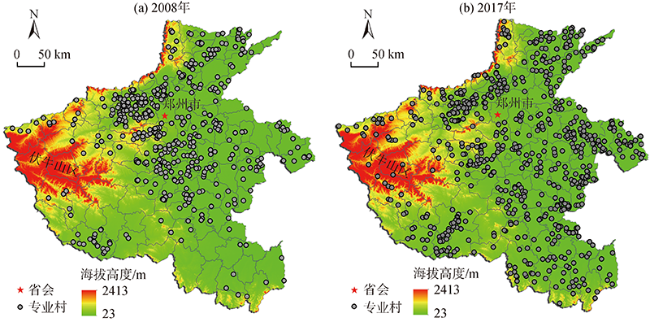
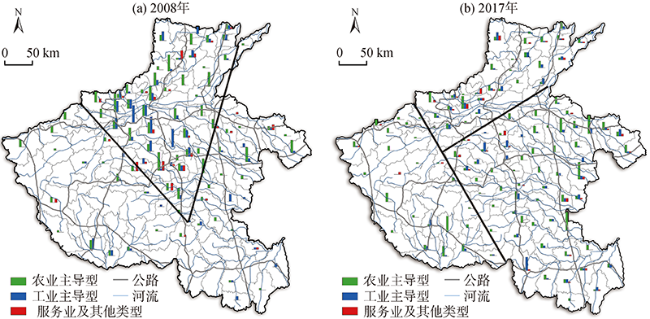
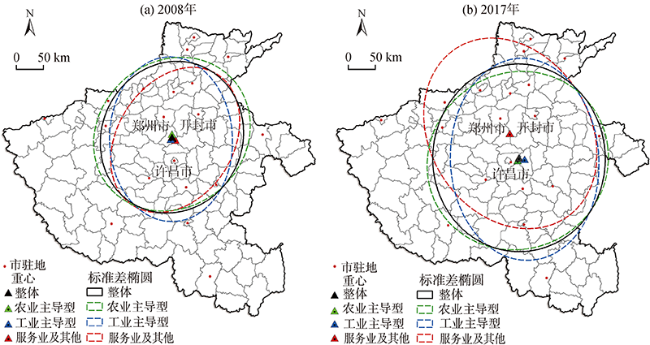
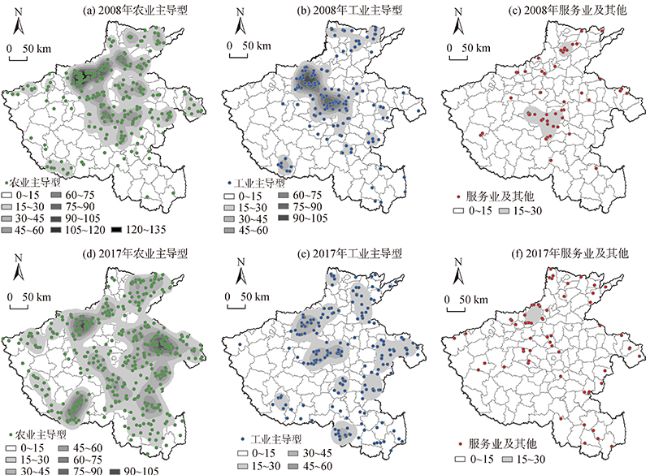
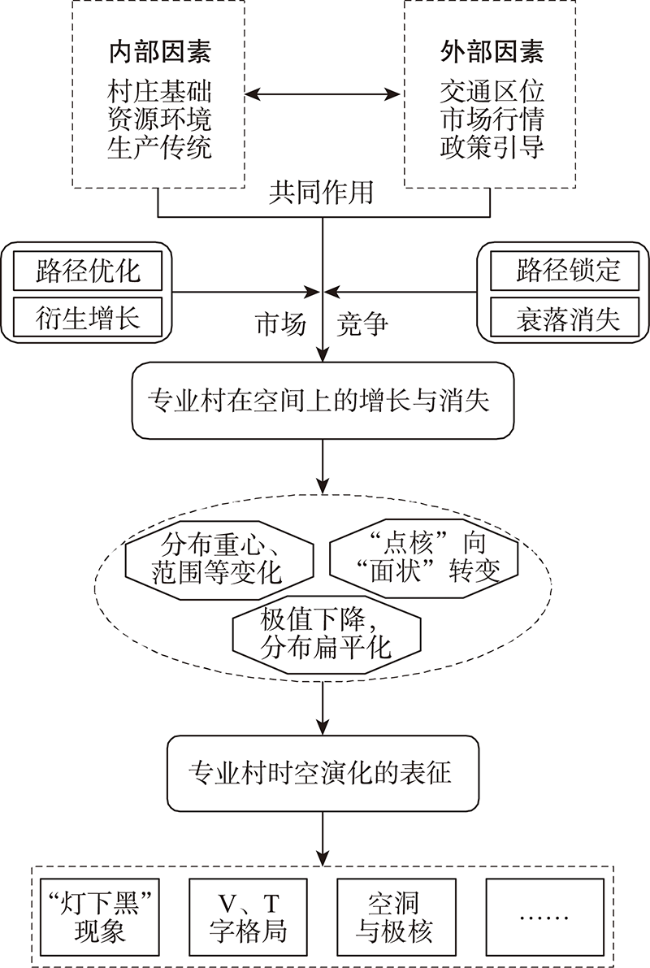
Rural prosperity means national prosperity. Specialized villages (SVs) are the typical model of village economic development and the important starting point to realize rural revitalization. Funded by the Henan Provincial Agricultural Work Office, this study investigated nearly 1200 and 1500 SVs in Henan Province in 2009 and 2018 through questionnaire surveys. Based on the definition of SVs and the evaluation of village economy, 487 and 668 SVs were selected respectively for the two years. Using spatial autocorrelation, nearest neighbor index, and kernel density estimation methods, we explored the spatial changes of SVs in Henan Province. The research found that: 1) In terms of spatial patterns, the SVs in Henan Province had changed from local agglomeration to full-scale diffusion, showing the distribution characteristics of "large-scale dispersion and small-scale aggregation". The number of SVs in southern Henan and southwestern Henan were relatively small. 2) In terms of zoning differences, the core-periphery spatial structure of SVs had gradually faded, and the "V-shaped" partition in the past had gradually changed into a "T-shaped" partition. There were significant differences in the density of SVs in different districts, and there existed the phenomenon of darkness under the lights at the junction of the districts. 3) In terms of the characteristics of change, the spatial distribution of SVs showed an expanding trend, with the center of gravity moved to the southeast. The number of SVs in eastern Henan had increased significantly. 4) In terms of the degree of agglomeration, the agglomeration areas of SVs had changed from a single core to multi-cores. Many secondary agglomeration centers were formed, and the agglomeration extreme value decreased. In some areas, there was a "disappearance under growth".
ZHU Qiankun , QIAO Jiajun , HAN Dong , XIN Xiangyang . Spatial distribution and agglomeration measurement of specialized villages in Henan Province[J]. PROGRESS IN GEOGRAPHY, 2022 , 41(3) : 396 -408 . DOI: 10.18306/dlkxjz.2022.03.004
表1 2008、2017年河南省专业村基础信息Tab.1 Basic information of specialized villages in Henan Province in 2008 and 2017 |
| 年份 | 类型名称 | 专业村数量/个 | 村均户数/户 | 村均劳动力/人 | 村均外出 务工/人 | 村均纯收入 /(元/人) | 村均专业户/户 | 村均参加 合作社/户 |
|---|---|---|---|---|---|---|---|---|
| 2008 | 农业主导型 | 277 | 477 | 1075 | 337 | 6141 | 278 | 146 |
| 工业主导型 | 158 | 621 | 1399 | 353 | 6995 | 263 | 78 | |
| 服务业及其他 | 52 | 467 | 1108 | 368 | 6715 | 270 | 51 | |
| 合计 | 487 | 522 | 1183 | 346 | 6479 | 272 | 115 | |
| 2017 | 农业主导型 | 422 | 549 | 1185 | 558 | 11723 | 206 | 91 |
| 工业主导型 | 186 | 592 | 1260 | 483 | 12719 | 200 | 69 | |
| 服务业及其他 | 60 | 438 | 940 | 374 | 13896 | 162 | 48 | |
| 合计 | 668 | 551 | 1184 | 521 | 12196 | 201 | 81 |
图2 2008、2017年河南省不同类型专业村空间格局与分区特征Fig.2 Spatial pattern and zoning characteristics of different types of specialized villages in Henan Province in 2008 and 2017 |
表2 2008、2017年河南省专业村分区特征Tab.2 Spatial zoning characteristics of specialized villages in Henan Province in 2008 and 2017 |
| 年份 | 分区 名称 | 县区数量 /个 | 专业村 数量/个 | 区域面积 /km2 | 专业村密度 /(个/km2) |
|---|---|---|---|---|---|
| 2008 | 核心区 | 59 | 347 | 54828.65 | 63.29 |
| 外围区 | 107 | 140 | 110771.35 | 12.64 | |
| 2017 | 豫西北 | 34 | 186 | 28640.56 | 64.94 |
| 豫东 | 65 | 384 | 82746.29 | 46.41 | |
| 豫西南 | 27 | 98 | 54213.15 | 18.08 |
表3 2008、2017年河南省专业村标准差椭圆计算结果Tab.3 Standard deviation ellipse calculation results of specialized villages in Henan Province in 2008 and 2017 |
| 年份 | 类型 | 标准差椭圆 | ||||||
|---|---|---|---|---|---|---|---|---|
| 周长/km | 面积/万km2 | 重心经度/(°E) | 重心纬度/(°N) | 长轴标准差/km | 短轴标准差/km | 方位角/(°) | ||
| 2008 | 整体 | 859.14 | 5.82 | 113.78 | 34.44 | 146.93 | 126.14 | 75.84 |
| 农业主导型 | 908.53 | 6.43 | 113.78 | 34.49 | 161.49 | 126.65 | 75.90 | |
| 工业主导型 | 828.40 | 5.44 | 113.76 | 34.40 | 138.68 | 124.83 | 179.71 | |
| 服务业及其他 | 806.28 | 5.23 | 113.85 | 34.39 | 143.69 | 107.15 | 53.47 | |
| 2017 | 整体 | 1044.89 | 8.66 | 114.04 | 34.08 | 174.37 | 158.03 | 89.44 |
| 农业主导型 | 1050.19 | 8.64 | 114.01 | 34.04 | 183.84 | 149.57 | 83.54 | |
| 工业主导型 | 1007.54 | 8.03 | 114.15 | 34.06 | 170.35 | 150.04 | 176.62 | |
| 服务业及其他 | 1053.18 | 8.66 | 113.87 | 34.50 | 185.61 | 148.61 | 124.28 | |
表4 2008、2017年河南省专业村最邻近指数Tab.4 Nearest neighbor index of specialized villages in Henan Province in 2008 and 2017 |
| 年份 | 类型 | 最邻近指数 | ||||
|---|---|---|---|---|---|---|
| 平均观测距离/km | 期望观测距离/km | R指数 | Z得分 | P值 | ||
| 2008 | 整体 | 6.70 | 11.37 | 0.59 | -17.32 | <0.01 |
| 农业主导型 | 10.18 | 19.56 | 0.52 | -15.25 | <0.01 | |
| 工业主导型 | 10.08 | 17.12 | 0.59 | -9.90 | <0.01 | |
| 服务业及其他 | 17.99 | 26.76 | 0.67 | -4.52 | <0.01 | |
| 2017 | 整体 | 6.85 | 10.22 | 0.67 | -16.32 | <0.01 |
| 农业主导型 | 8.46 | 12.41 | 0.68 | -12.50 | <0.01 | |
| 工业主导型 | 11.61 | 18.08 | 0.64 | -9.33 | <0.01 | |
| 服务业及其他 | 21.19 | 30.13 | 0.70 | -4.40 | <0.01 | |
注:Z得分和P值是统计显著性的量度。Z得分越高(或越低),P值越接近0,则聚类程度就越高。 |
表5 2008、2017年河南省专业村核密度分析结果Tab.5 Kernal density results of specialized villages in Henan Province in 2008 and 2017 |
| 年份 | 类型 | 核密度分析 | |||
|---|---|---|---|---|---|
| 最大值 | 最小值 | 平均值 | 标准差 | ||
| 2008 | 整体 | 234.76 | 0 | 17.20 | 30.51 |
| 农业主导型 | 131.67 | 0 | 5.73 | 13.34 | |
| 工业主导型 | 103.54 | 0 | 7.51 | 14.68 | |
| 服务业及其他 | 23.83 | 0 | 2.96 | 4.68 | |
| 2017 | 整体 | 176.72 | 0 | 22.05 | 26.24 |
| 农业主导型 | 96.02 | 0 | 14.29 | 16.90 | |
| 工业主导型 | 46.80 | 0 | 6.97 | 8.63 | |
| 服务业及其他 | 18.20 | 0 | 2.09 | 2.98 | |
| [1] |
|
| [2] |
|
| [3] |
|
| [4] |
|
| [5] |
|
| [6] |
|
| [7] |
新华社. 中共中央国务院关于实施乡村振兴战略的意见[J]. 农村经营管理, 2018(2):6-15.
[
|
| [8] |
习近平. 在黄河流域生态保护和高质量发展座谈会上的讲话[J]. 实践(思想理论版), 2019(11):5-9.
[
|
| [9] |
金凤君. 黄河流域生态保护与高质量发展的协调推进策略[J]. 改革, 2019(11):33-39.
[
|
| [10] |
刘彦随, 周扬, 李玉恒. 中国乡村地域系统与乡村振兴战略[J]. 地理学报, 2019,74(12):2511-2528.
[
|
| [11] |
李小建, 罗庆, 樊新生. 农区专业村的形成与演化机理研究[J]. 中国软科学, 2009(2):71-80.
[
|
| [12] |
龙花楼, 刘彦随, 邹健. 中国东部沿海地区乡村发展类型及其乡村性评价[J]. 地理学报, 2009,64(4):426-434.
[
|
| [13] |
农业农村部新闻办公室. 全国贫困县已发展各类一村一品专业村1.5万个[J]. 中国畜牧业, 2018(24):10.
[ Ministry of Agriculture and Rural Areas. The poverty-stricken counties in China have developed 15000 specialized villages with one village and one product. China Animal Industry, 2018(24):10. ]
|
| [14] |
|
| [15] |
李乾文. 日本的“一村一品”运动及其启示[J]. 世界农业, 2005(1):32-35.
[
|
| [16] |
李小建, 周雄飞, 郑纯辉, 等. 欠发达区地理环境对专业村发展的影响研究[J]. 地理学报, 2012,67(6):783-792.
[
|
| [17] |
乔家君, 李亚静. 专业村集聚的空间表达: 以河南省专业村为例[J]. 经济地理, 2014,34(6):142-148.
[
|
| [18] |
乔家君, 李亚静. 专业村集聚的空间测度: 以河南省专业村为例[J]. 地域研究与开发, 2014,33(5):140-143, 154.
[
|
| [19] |
乔家君, 李亚静. 专业村集聚的形成机理: 以河南省专业村为例[J]. 河南大学学报(自然科学版), 2014,44(3):312-316, 323.
[
|
| [20] |
刘晨光. 黄河流域专业村空间格局演化及影响因素[J]. 资源科学, 2020,42(12):2300-2313.
[
|
| [21] |
向延平. 我国“一村一品”地理分布与数量特征分析: 兼论区域内生发展[J]. 地域研究与开发, 2014,33(2):51-53, 87.
[
|
| [22] |
曹智, 刘彦随, 李裕瑞, 等. 中国专业村镇空间格局及其影响因素[J]. 地理学报, 2020,75(8):1647-1666.
[
|
| [23] |
张超, 乔家君. 种植专业村空间集聚的定量分析: 以河南省信阳市浉河区为例[J]. 河南大学学报(自然科学版), 2015,45(3):291-298, 307.
[
|
| [24] |
朱乾坤, 乔家君, 马玉玲, 等. 欠发达农区传统手工业的形成与影响因素研究: 以兰考县徐场村为例[J]. 人文地理, 2019,34(2):125-134.
[
|
| [25] |
白丹丹, 乔家君. 服务型专业村的形成及其影响因素研究: 以河南省王公庄为例[J]. 经济地理, 2015,35(3):145-153.
[
|
| [26] |
辛向阳, 乔家君. 淘宝村集聚的时空演变及形成机制[J]. 地域研究与开发, 2018,37(1):11-15, 30.
[
|
| [27] |
李小建, 罗庆, 杨慧敏. 专业村类型形成及影响因素研究[J]. 经济地理, 2013,33(7):1-8.
[
|
| [28] |
|
| [29] |
|
| [30] |
黄晗, 李寻欢, 周扬. 中国丘陵山区农村贫困时空格局及其演变机制研究: 以江西省于都县为例[J]. 地理科学进展, 2020,39(6):938-950.
[
|
| [31] |
谭雪兰, 蒋凌霄, 王振凯, 等. 地理学视角下的中国乡村贫困: 源起、进展与展望[J]. 地理科学进展, 2020,39(6):913-923.
[
|
| [32] |
钱家乘, 张佰林, 刘虹吾, 等. 东部旅游特色山区乡村发展分化及其驱动力: 以浙江省平阳县为例[J]. 地理科学进展, 2020,39(9):1460-1472.
[
|
| [33] |
史焱文, 李小建, 孟德友. 典型农区县域工业化进程评价及时空演进: 以河南省为例[J]. 经济地理, 2020,40(10):118-126, 153.
[
|
| [34] |
徐志强, 张光灿, 刘霞, 等. 淮河流域伏牛山区水土保持生态自然修复适宜性评价与分区[J]. 中国水土保持科学, 2013,11(3):17-23.
[
|
| [35] |
乔家君, 马玉玲. 城乡界面的经济效应[J]. 经济地理, 2016,36(9):1-9.
[
|
| [36] |
吴娜琳, 李小建. 我国农区专业村消失因素的分析: 以河南省郏县前王庄村为例[J]. 经济地理, 2016,36(1):127-134.
[
|
| [37] |
张富刚, 刘彦随. 中国区域农村发展动力机制及其发展模式[J]. 地理学报, 2008,63(2):115-122.
[
|
| [38] |
吴娜琳, 李二玲, 李小建. 特色种植专业村空间扩散及影响因素分析: 以河南省柘城县辣椒种植为例[J]. 地理研究, 2013,32(7):1303-1315.
[
|
| [39] |
高更和, 石磊. 专业村形成历程及影响因素研究: 以豫西南3个专业村为例[J]. 经济地理, 2011,31(7):1165-1170.
[
|
| [40] |
吴娜琳, 李立, 李二玲, 等. 特色种植的空间持续性及其影响因素研究: 以河南省封丘县树莓产业为例[J]. 地理科学, 2018,38(3):428-436.
[
|
| [41] |
乔家君, 杨家伟. 中国专业村研究的新近进展[J]. 人文地理, 2013,28(5):76-80, 60.
[
|
| [42] |
朱乾坤. 河南省专业村发展变化研究: 以50个专业村为例[D]. 开封: 河南大学, 2019.
[
|
| [43] |
蔡希, 崔国江, 周春梅. 发展“一村一品”推进现代农业建设[J]. 农业科技管理, 2008,27(6):68-70.
[
|
| [44] |
琚胜利, 陶卓民. 南京市农家乐专业村的网络空间中心性[J]. 经济地理, 2016,36(3):109-117.
[
|
| [45] |
曾亿武, 郭红东. 农产品淘宝村形成机理: 一个多案例研究[J]. 农业经济问题, 2016,37(4):39-48, 111.
[
|
| [46] |
邵留长. 河南省专业村集聚机理探析: 以太行山麓专业村集聚区为例[D]. 开封: 河南大学, 2016.
[
|
| [47] |
吴孔森, 芮旸, 陈佳, 等. 旅游驱动下乡村转型发展的微尺度研究: 以西安市上王村为例[J]. 地理科学进展, 2020,39(6):1047-1059.
[
|
| [48] |
李小建, 胡雪瑶, 史焱文, 等. 乡村振兴下的聚落研究: 来自经济地理学视角[J]. 地理科学进展, 2021,40(1):3-14.
[
|
/
| 〈 |
|
〉 |