新疆2001—2020年露点温度与降水的关系
|
陈文辉(1997— ),女,山西长治人,博士生,主要研究方向为气候变化。E-mail: chenwh.19s@igsnrr.ac.cn |
收稿日期: 2024-12-02
修回日期: 2025-06-10
网络出版日期: 2025-12-26
基金资助
第三次新疆综合科学考察项目(2021xjkk0802)
Relationship between dew point temperature and precipitation in Xinjiang, Northwest China during 2001-2020
Received date: 2024-12-02
Revised date: 2025-06-10
Online published: 2025-12-26
Supported by
The Third Xinjiang Scientific Expedition Program(2021xjkk0802)
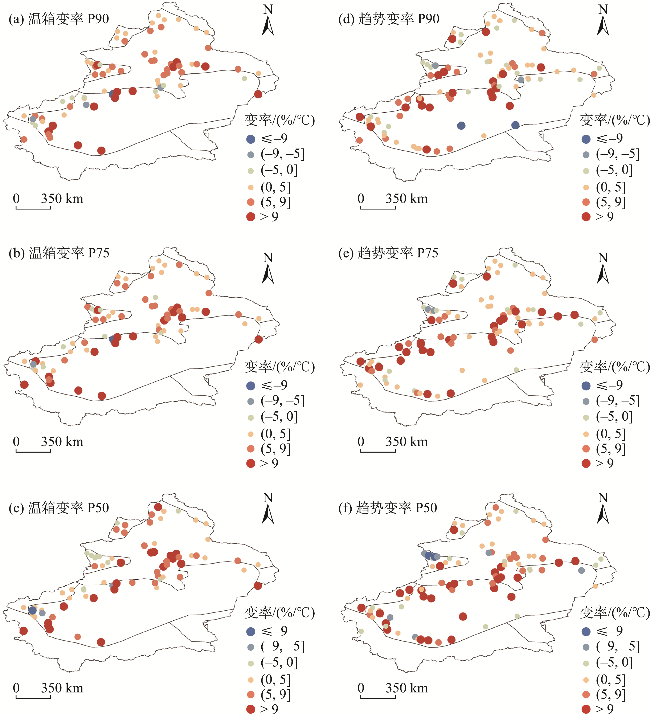
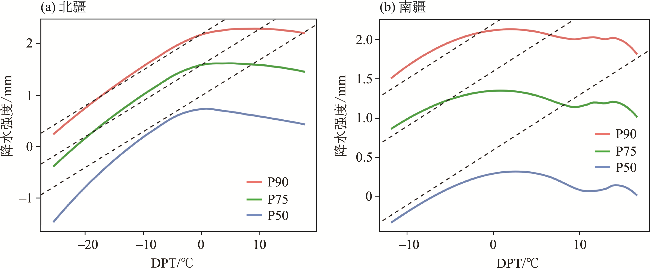
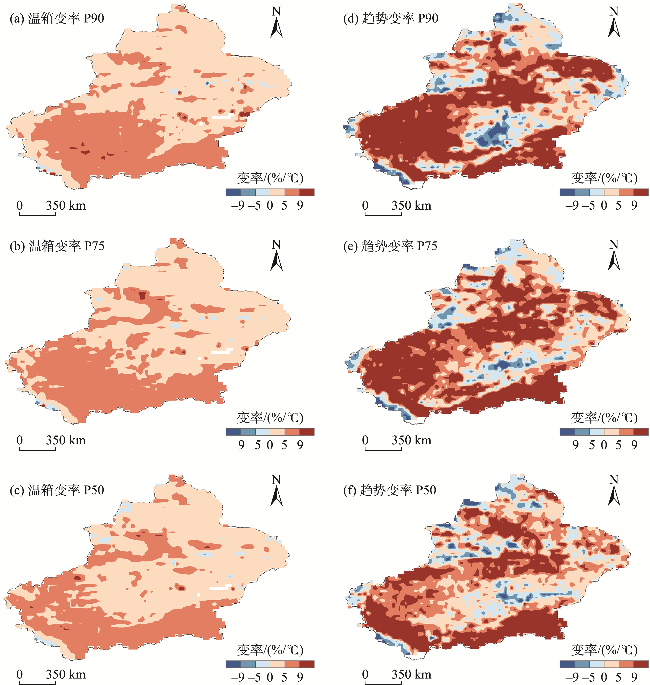
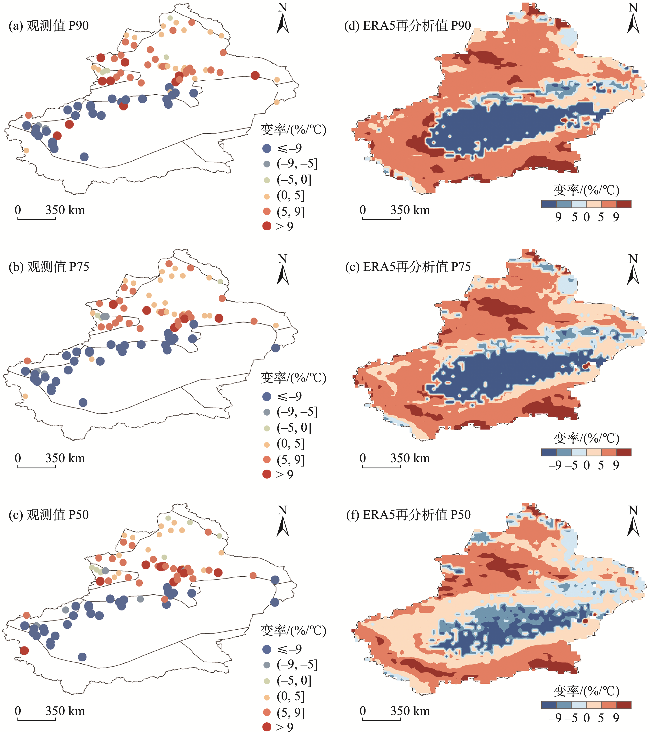
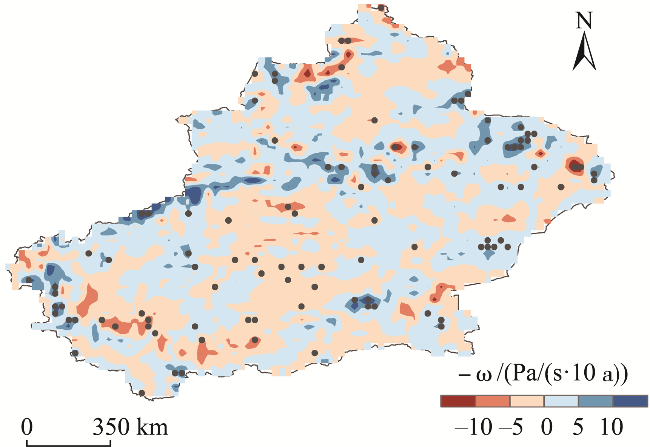
近几十年来,中国西北干旱半干旱地区尤其新疆地区,呈现暖湿化趋势。根据Clausius-Clapeyron (C-C)关系,大气持水量随温度升高而增加,从而可能导致极端降水强度上升。论文基于1990—2020年气象站观测数据和ERA5数据,采用年内温箱变率和年际趋势变率方法分析了新疆降水与露点温度关系的空间分布特征。结果表明:1990—2020年,新疆不同降水强度普遍随露点温度的增加而增加。主要的变率类型为次C-C变率(0%/℃, 5%/℃],分布在北疆;而天山附近和南疆呈类C-C变率(5%/℃, 9%/℃]甚至超C-C变率(>9%/℃)特征,对露点温度的敏感性更强。观测到的趋势变率与温箱变率具有相似的空间格局,但具有更多的超C-C变率。此外,天山南麓垂直速度的减小可能导致降水强度的减小。研究结果证实了新疆暖湿化的热力学作用,为进一步认识气候变化对新疆降水事件的影响提供了坚实的基础。
关键词: 降水; 露点温度; Clausius-Clapeyron关系; 气候变化; 新疆
陈文辉 , 崔惠娟 , 郑景云 . 新疆2001—2020年露点温度与降水的关系[J]. 地理科学进展, 2025 , 44(12) : 2448 -2460 . DOI: 10.18306/dlkxjz.2025.12.002
In the past few decades, a warming-wetting trend has been observed in the arid and semiarid Northwest China, especially in Xinjiang. According to the Clausius-Clapeyron (C-C) relationship, the atmospheric moisture-holding capacity increases with rising temperature, which may lead to an intensification of extreme precipitation. In this study, we examined the spatial distribution of scaling relationships between precipitation and dew point temperature in Xinjiang, using intra-annual binning scaling and inter-annual trend scaling based on station observations and ERA5. The results show that the predominant binning scaling in Xinjiang is sub C-C scaling (0%/°C-5%/°C), transitioning from northern Xinjiang to C-C like scaling (5%/°C-9%/°C) or super C-C scaling (>9%/°C) near the Tianshan Mountains and southern Xinjiang. The observed trend scaling exhibited a similar spatial pattern to that of binning scaling, but with more super C-C scaling. Furthermore, the reduction in vertical velocity at the southern foothills of the Tianshan Mountains may lead to a decrease in precipitation intensity. Overall, these findings provide a solid basis for enhancing our understanding of how climate change influences precipitation events in Xinjiang.
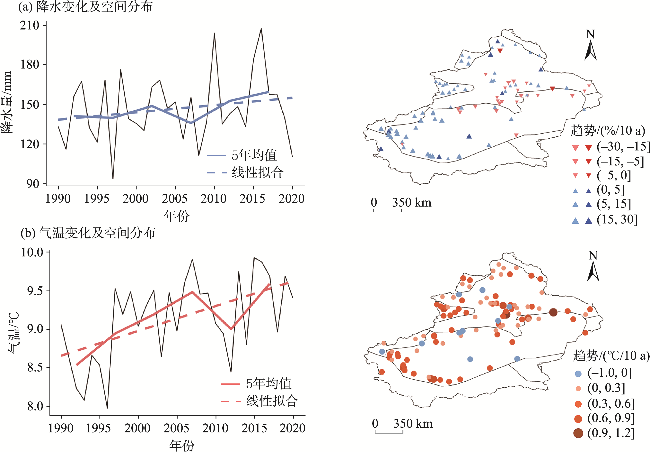
图2 1990—2020年新疆地区年降水量和年平均气温的时间序列及其趋势空间分布注:降水变化空间分布图中,深红色、深蓝色三角形表示变化趋势显著(P<0.05),浅红色和浅蓝色三角形则表示不显著趋势(P>0.05)。 Fig.2 Annual time series of annual precipitation and annual daily average temperature and their spatial distribution of trend from observation station data over Xinjiang from 1990 to 2020 |
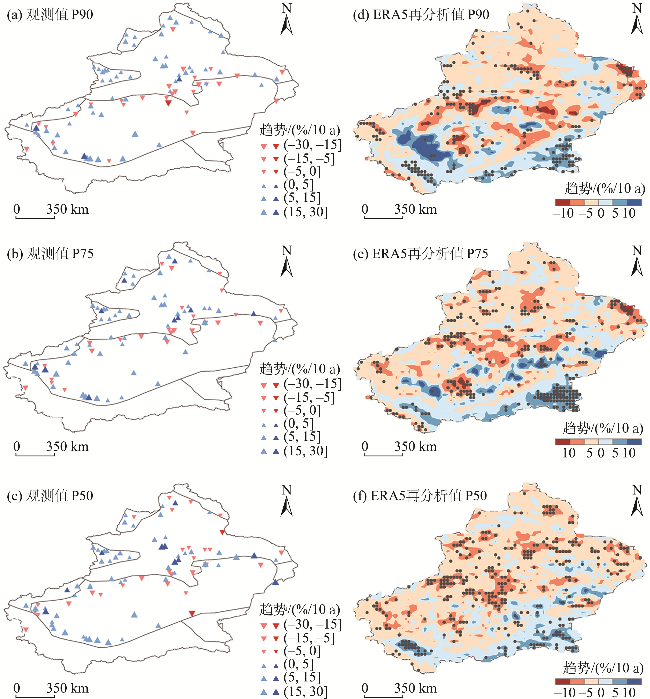
图3 1990—2020年中国新疆地区逐日降水站观测值和ERA5再分析值的第90、75和50百分位数的变化趋势注:图a~c中,深红色、深蓝色三角形表示变化趋势显著(P<0.05),浅红色和浅蓝色三角形则表示不显著趋势(P>0.05);图d~f中,黑点表示变化趋势显著(P<0.05)。 Fig.3 The trend in the annual 90th (P90), 75th (P75) and 50th (P50) percentiles of daily precipitation from station observations and ERA5 reanalysis over Xinjiang from 1990 to 2020 |
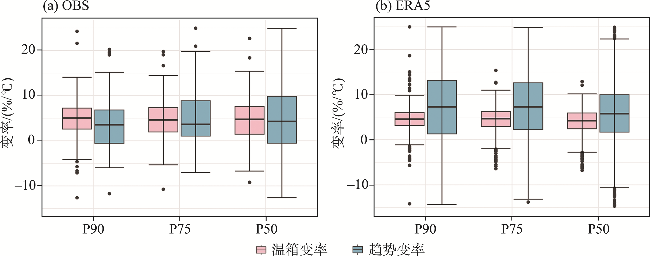
图4 站点观测(OBS)和ERA5数据的P90、P75和P50的温箱变率和趋势变率箱线图Fig.4 Boxplots of the binning and trend scaling rates for P90, P75 and P50 from the station observations (OBS) and ERA5 data |
| [1] |
IPCC. Climate change 2021: The physical science basis[M]. Cambridge, UK: Cambridge University Press, 2021: 287-422.
|
| [2] |
|
| [3] |
|
| [4] |
唐明秀, 朱秀芳, 刘婷婷, 等. 基于CMIP6不同重现期的全球未来暴雨社会经济风险变化评估[J]. 地理科学进展, 2023, 42(3): 531-542.
[
|
| [5] |
|
| [6] |
|
| [7] |
|
| [8] |
张学珍, 郑景云, 郝志新. 中国主要经济区的近期气候变化特征评估[J]. 地理科学进展, 2020, 39(10): 1609-1618.
[
|
| [9] |
王澄海, 张晟宁, 张飞民, 等. 论全球变暖背景下中国西北地区降水增加问题[J]. 地球科学进展, 2021, 36(9): 980-989.
[
|
| [10] |
|
| [11] |
|
| [12] |
乔木, 周生斌, 卢磊, 等. 新疆渭干河流域土壤盐渍化时空变化及成因分析[J]. 地理科学进展, 2012, 31(7): 904-910.
[
|
| [13] |
|
| [14] |
姚秀萍, 肖峰, 马嘉理. 新疆地区夏季降水研究进展与展望[J]. 沙漠与绿洲气象, 2023, 17(1): 1-9.
[
|
| [15] |
吴秀兰, 张太西, 王慧, 等. 1961—2017年新疆区域气候变化特征分析[J]. 沙漠与绿洲气象, 2020, 14(4): 27-34.
[
|
| [16] |
|
| [17] |
|
| [18] |
李佳秀, 杜春丽, 杜世飞, 等. 新疆极端降水事件的时空变化及趋势预测[J]. 干旱区研究, 2015, 32(6): 1103-1112.
[
|
| [19] |
|
| [20] |
张灵, 张俊, 杜良敏, 等. 长江上游降水对三峡水库蓄水关键月入库流量的影响[J]. 地理科学进展, 2020, 39(7): 1117-1125.
[
|
| [21] |
|
| [22] |
|
| [23] |
|
| [24] |
|
| [25] |
|
| [26] |
|
| [27] |
|
| [28] |
|
| [29] |
|
| [30] |
|
| [31] |
|
| [32] |
|
| [33] |
|
| [34] |
|
| [35] |
|
| [36] |
|
| [37] |
|
| [38] |
|
| [39] |
|
| [40] |
|
| [41] |
|
| [42] |
|
| [43] |
|
| [44] |
|
| [45] |
|
| [46] |
|
| [47] |
|
| [48] |
|
| [49] |
|
| [50] |
|
| [51] |
|
| [52] |
|
| [53] |
任国玉, 袁玉江, 柳艳菊, 等. 我国西北干燥区降水变化规律[J]. 干旱区研究, 2016, 33(1): 1-19.
[
|
| [54] |
|
| [55] |
|
| [56] |
|
| [57] |
|
| [58] |
陈活泼, 孙建奇, 范可. 新疆夏季降水年代际转型的归因分析[J]. 地球物理学报, 2012, 55(6): 1844-1851.
[
|
| [59] |
陈冬冬, 戴永久. 近五十年中国西北地区夏季降水场变化特征及影响因素分析[J]. 大气科学, 2009, 33(6): 1247-1258.
[
|
| [60] |
|
/
| 〈 |
|
〉 |